


Client success stories

Clinical evidence delivered. Complex programs made defensible.

Eclevar is a specialist medical device CRO. These selected EU MDR clinical evidence programs show how we structure and deliver complex investigations, PMCF and clinical evidence, from the initial evidence question through to documentation for review.

Evidence pathway

How a program reaches conformity assessment.

Four stages, one accountable chain. The programs below are entered at different points on it, and every one of them ends in the same place: documentation prepared for review.

  1. Clinical strategyEvidence question, study design, regulatory route
  2. Clinical deliverySites, monitoring, follow-up
  3. Structured dataCapture, cleaning, analysis
  4. Regulatory evidenceDocumentation prepared for conformity assessment
40+Medical device companies
150+Clinical studies
IIa to IIIDevice risk class
7Programs on this page
Featured program navigator

Seven programs. Seven different evidence challenges.

Follow each program from the initial evidence challenge through Eclevar’s contribution, program architecture and documented evidence position.

Jump to a program

Jump to a program

01 RegenLab Client-verified program

One European PMCF program across two chronic wound populations

Step 1 · The challenge

An autologous platelet-rich plasma technology used in chronic wound care needed post-market clinical follow-up across more than one wound population and more than one country. Diabetic foot ulcers and venous leg ulcers are treated in different clinics, by different specialists, using different assessment habits. Evidence gathered that way is not comparable. The program had to fix one preparation and application protocol, one assessment schedule and one data structure before any European conclusion could be drawn.

Participants
160
Clinical sites
14
Wound populations
2

Step 2 · Eclevar’s contribution

  • Program architecture for two parallel wound cohorts
  • One standardized preparation and application protocol across sites
  • Multicountry clinical site coordination and delivery
  • Longitudinal clinical follow-up against a single assessment schedule
View full Eclevar contribution 2 more
  • Structured electronic data capture in Milo Studio
  • A shared analysis and reporting model for both cohorts

Step 3 · Program and evidence position

A multicountry European PMCF program delivered to one standardized protocol across both wound populations, producing evidence in four common domains: wound healing and closure, clinical and safety outcomes, patient-reported outcomes, and treatment and resource use.

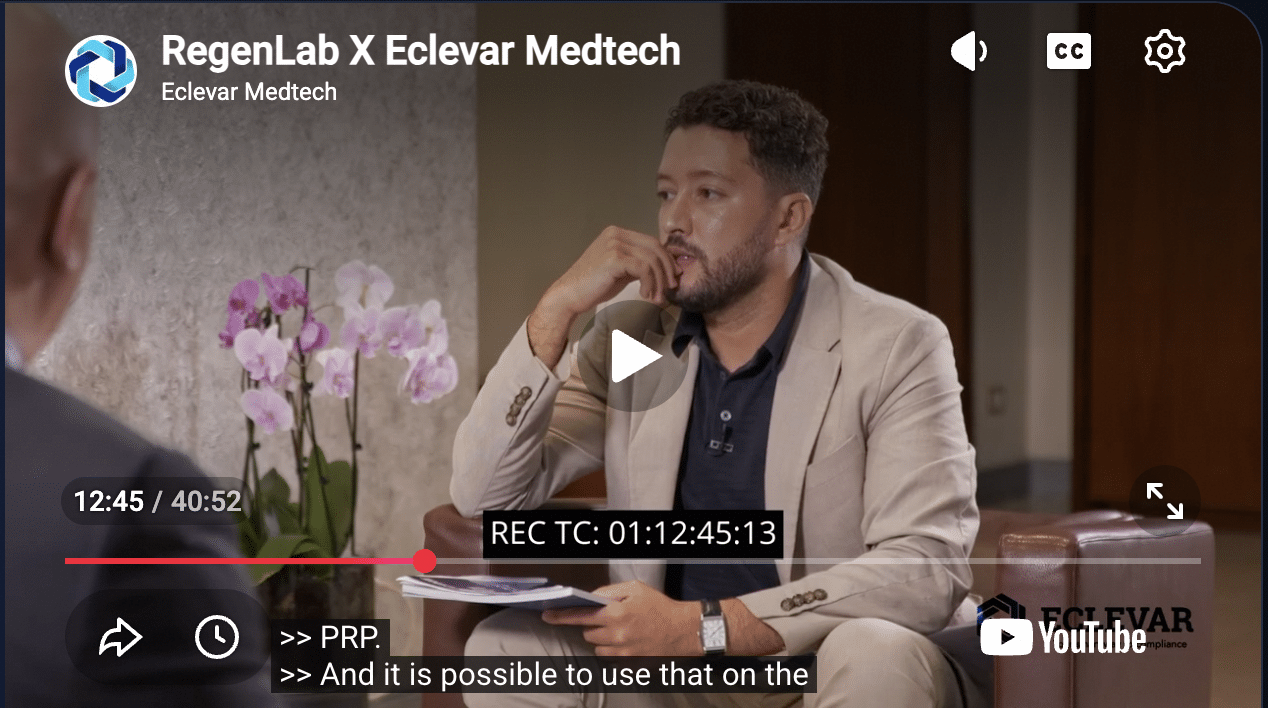
Client-verified program. A filmed discussion with the client is referenced in the perspectives section below.

Program architecture
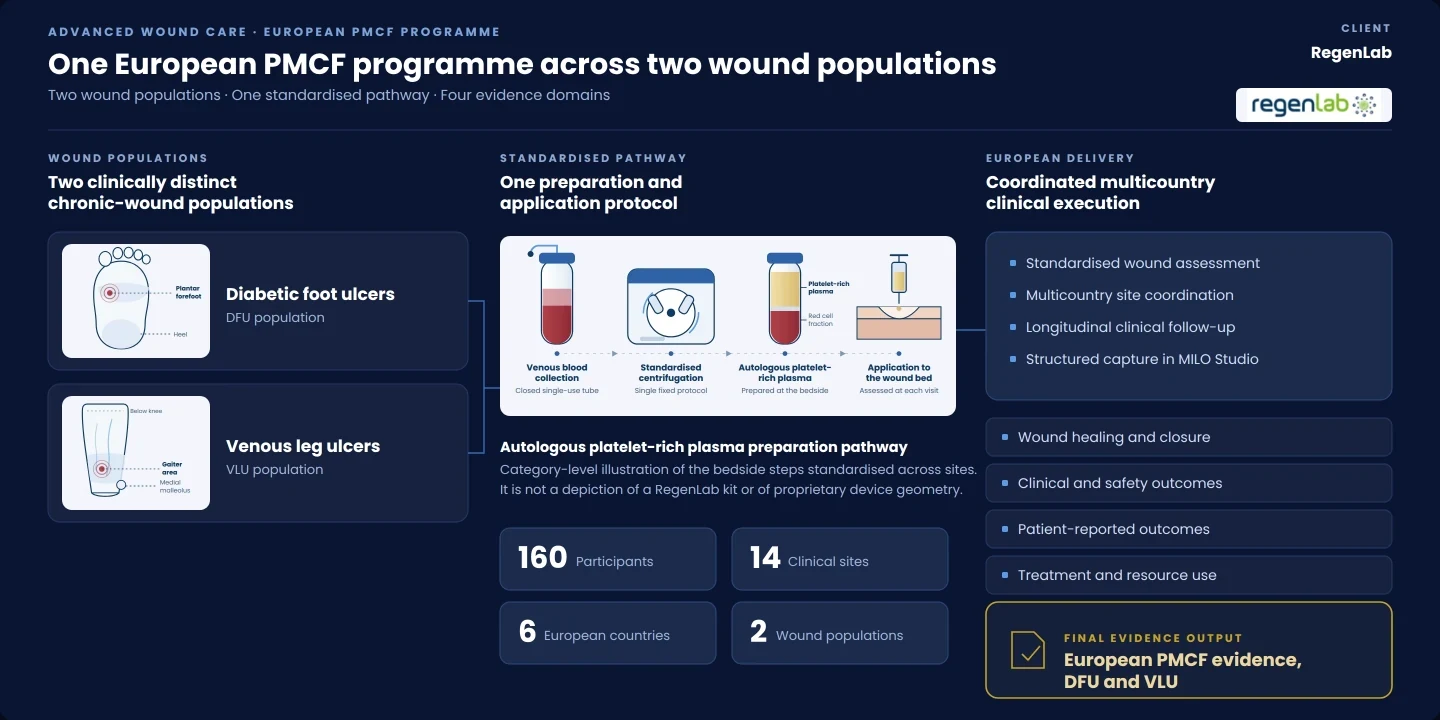
What this architecture shows
  • Two clinically distinct chronic wound populations are followed in parallel: diabetic foot ulcers and venous leg ulcers.
  • Both cohorts use one preparation and application protocol, standardized at the bedside and assessed at every visit.
  • Delivery is coordinated across multiple European countries, with standardized wound assessment, longitudinal clinical follow-up and structured capture in Milo Studio.
  • Four evidence domains are common to both cohorts: wound healing and closure, clinical and safety outcomes, patient-reported outcomes, and treatment and resource use.
  • The program output is European PMCF evidence covering both wound populations.

Program architecture. The preparation pathway is a category-level illustration of the standardized bedside steps. It is not a depiction of a RegenLab kit or of proprietary device geometry.


02 Mölnlycke Named client engagement

Two PMCF programs built to feed successive clinical evaluation cycles

Step 1 · The challenge

An advanced wound care portfolio moving to MDR needed post-market clinical follow-up that would hold together under review, not a set of unconnected studies. Diabetic foot ulcers and venous leg ulcers each required their own program, yet both had to produce evidence in the same shape: the same endpoints, the same assessment intervals, the same reporting structure. Without that discipline the two programs would have supported two separate arguments instead of one clinical evaluation.

PMCF programs
2
Wound populations
DFU and VLU
Delivery
Multicenter, France

Step 2 · Eclevar’s contribution

  • Clinical evidence strategy for the advanced wound care portfolio under MDR
  • Gap analysis against the applicable MDCG guidance
  • PMCF plan and study design for both wound populations
  • Multicenter clinical delivery in France
View full Eclevar contribution 2 more
  • Clinical evaluation reporting
  • Review by colleagues who previously assessed clinical evidence inside a Notified Body

Step 3 · Program and evidence position

Two multicenter PMCF programs designed around one assessment method, so that successive clinical evaluation cycles draw on evidence in a single comparable structure.

Named client engagement. No clinical results, site names or investigator names are published here.

Program architecture
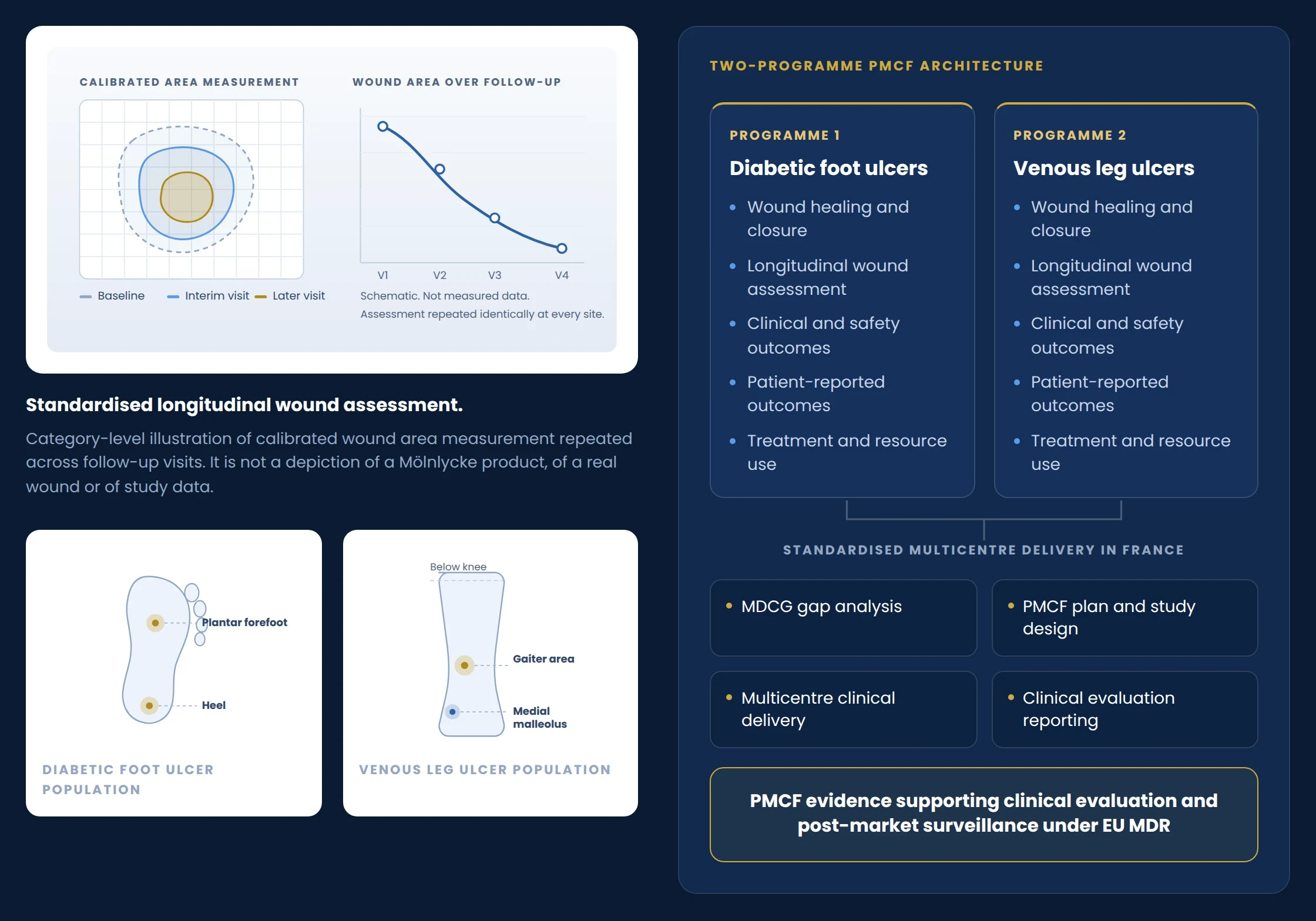
What this architecture shows
  • Wound area is measured with a calibrated method repeated identically at every site and every follow-up visit.
  • Two programs run in parallel, diabetic foot ulcers and venous leg ulcers, against the same five evidence lines.
  • Both feed standardized multicenter delivery in France, supported by MDCG gap analysis, PMCF plan and study design, clinical delivery and clinical evaluation reporting.
  • The output is PMCF evidence supporting clinical evaluation and post-market surveillance under EU MDR.

Program architecture. The wound area measurement panel is a schematic of the assessment method, not measured study data, and no Mölnlycke product is depicted.

03 Perouse Medical, Vygon Group Publicly documented program

One PMCF evidence program across three implantable device families

Step 1 · The challenge

Three families of implantable vascular devices (vascular patches, vascular prostheses and implantable ports) each needed post-market clinical follow-up under MDR. Run independently, six studies would have produced six incompatible datasets and six separate arguments about one portfolio. The difficulty was not collecting evidence but comparing it: safety definitions, performance measures, follow-up windows and reporting outputs had to be identical before portfolio-level conclusions were possible.

Device families
3
Registered studies
6
Evidence model
1 harmonized

Step 2 · Eclevar’s contribution

  • One harmonized retrospective PMCF model across the portfolio
  • Common safety definitions and event reporting
  • Comparable clinical performance measures at device-family level
  • Post-implantation clinical follow-up design
View full Eclevar contribution 2 more
  • A shared data structure, analysis conventions and reporting outputs
  • Registration and observational conduct across the six studies

Step 3 · Program and evidence position

Six registered retrospective observational studies running on one harmonized model, producing clinical safety and clinical performance evidence per device family and a comparable structure across the portfolio.

Publicly documented program. The studies are registered observational studies.

Program architecture
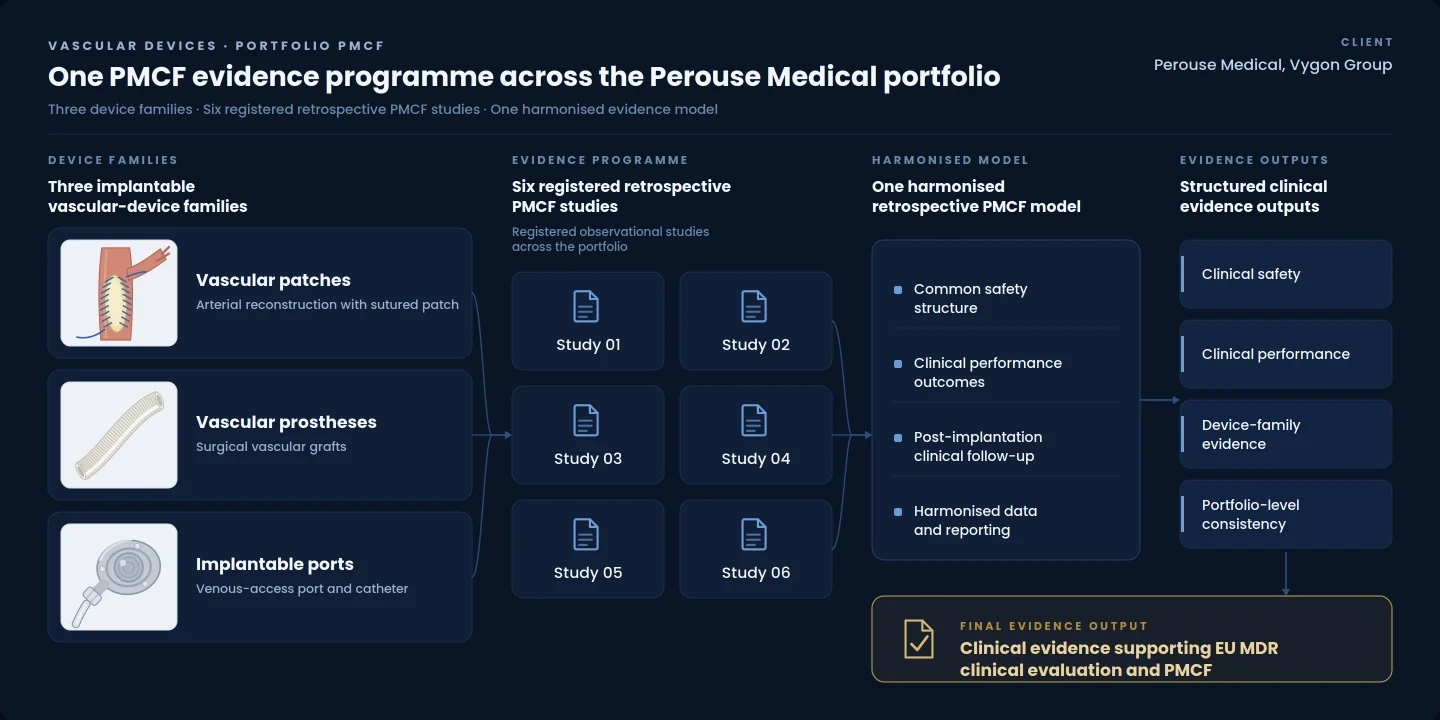
What this architecture shows
  • Three implantable vascular device families are covered: vascular patches for arterial reconstruction, surgical vascular prostheses and venous-access implantable ports.
  • Six registered retrospective observational studies sit across the portfolio.
  • One harmonized retrospective PMCF model imposes a common safety structure, comparable clinical performance outcomes, post-implantation clinical follow-up and shared data and reporting conventions.
  • Evidence outputs are produced at four levels: clinical safety, clinical performance, device-family evidence and portfolio-level consistency.
  • The final output supports EU MDR clinical evaluation and PMCF.

Program architecture. The device illustrations are neutral, clinically accurate representations at device-family level and are not depictions of Perouse Medical or Vygon products.

04 Meril Life Sciences Named client engagement

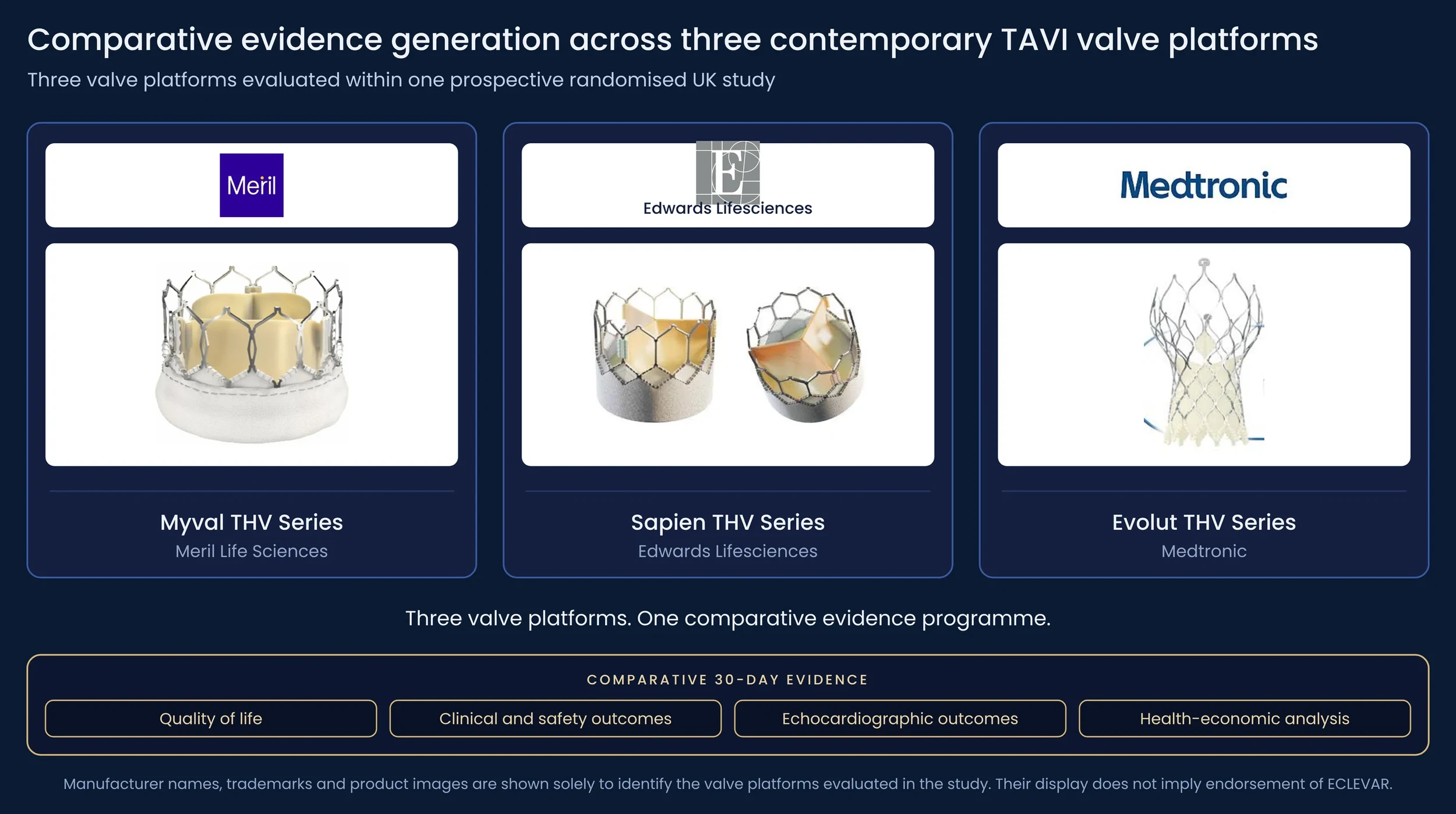
Comparative evidence generation across three contemporary TAVI valve platforms

Step 1 · The challenge

Comparative evidence across transcatheter aortic valve platforms is usually assembled after the fact, from studies run at different times, in different populations, against different endpoints. Assembled that way it is not comparable. The requirement here was to evaluate three contemporary valve platforms inside one prospective randomized UK study, so that quality of life, clinical and safety outcomes, echocardiographic outcomes and health-economic data are collected on the same schedule and adjudicated against the same definitions.

Valve platforms
3
Study design
Prospective randomized
Evidence domains
4

Step 2 · Eclevar’s contribution

  • Clinical program delivery across the comparative study
  • Evidence coordination across three parallel study arms
  • One common assessment schedule for every arm
  • Standardized imaging review
View full Eclevar contribution 2 more
  • Adjudicated clinical endpoints
  • Health-economic data capture

Step 3 · Program and evidence position

Three valve platforms compared within one study rather than in sequence, producing comparative 30-day evidence across quality of life, clinical and safety outcomes, echocardiographic outcomes and health-economic analysis.

Named client engagement. Sponsor of record: Meril Life Sciences. No clinical result is published here.

Program architecture
What this architecture shows
  • Three contemporary transcatheter aortic valve platforms are evaluated within a single prospective randomized UK study.
  • The arms run in parallel rather than in sequence, on a common assessment schedule with standardized imaging review and adjudicated clinical endpoints.
  • Health-economic data is captured alongside the clinical data rather than reconstructed afterwards.
  • Four comparative 30-day evidence domains are produced: quality of life, clinical and safety outcomes, echocardiographic outcomes and health-economic analysis.

Program architecture. Manufacturer names, trademarks and product images are shown solely to identify the valve platforms evaluated in the study. Their display does not imply endorsement of Eclevar.

05 JRI Orthopaedics Named client engagement

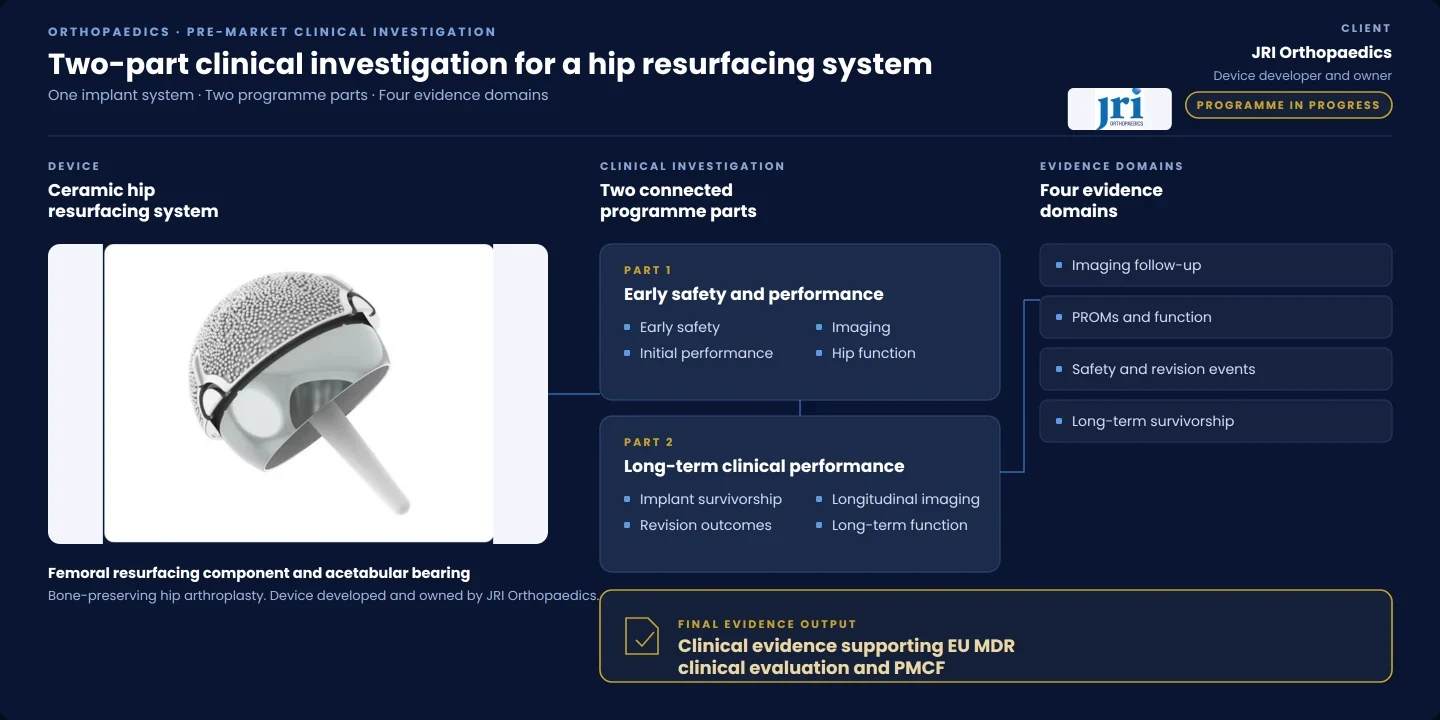
A two-part clinical investigation for a ceramic hip resurfacing system

Step 1 · The challenge

A bone-preserving ceramic hip resurfacing system needed one clinical investigation able to answer two questions with very different time horizons. Early safety and performance have to be established before the device can progress, while implant survivorship, revision outcomes and long-term function only become visible years later. Splitting them into separate studies would have produced two incompatible datasets on the same implant. Both parts had to sit inside one endpoint architecture.

Implant system
1
Program parts
2
Evidence domains
4

Step 2 · Eclevar’s contribution

  • Clinical investigation strategy, synopsis and endpoint architecture
  • Long-term follow-up planning across both program parts
  • Patient-reported outcome integration
  • Digital clinical data capture
View full Eclevar contribution 1 more
  • Statistical methodology

Step 3 · Program and evidence position

Part 1 covers early safety and performance, including metal-ion assessment, imaging and hip function. Part 2 covers long-term clinical performance: implant survivorship, revision outcomes, longitudinal imaging and long-term function. Both parts report into the same four evidence domains.

Named client engagement. Pre-market clinical investigation, in progress.

Program architecture
What this architecture shows
  • Part 1 covers early safety and performance: early safety, initial performance, metal-ion assessment, imaging and hip function.
  • Part 2 covers long-term clinical performance: implant survivorship, revision outcomes, longitudinal imaging and long-term function.
  • The two parts share four evidence domains so that early and long-term data remain comparable.
  • The output supports EU MDR clinical evaluation and PMCF.

Program architecture, JRI Orthopaedics.

06 Coloplast Publicly documented program

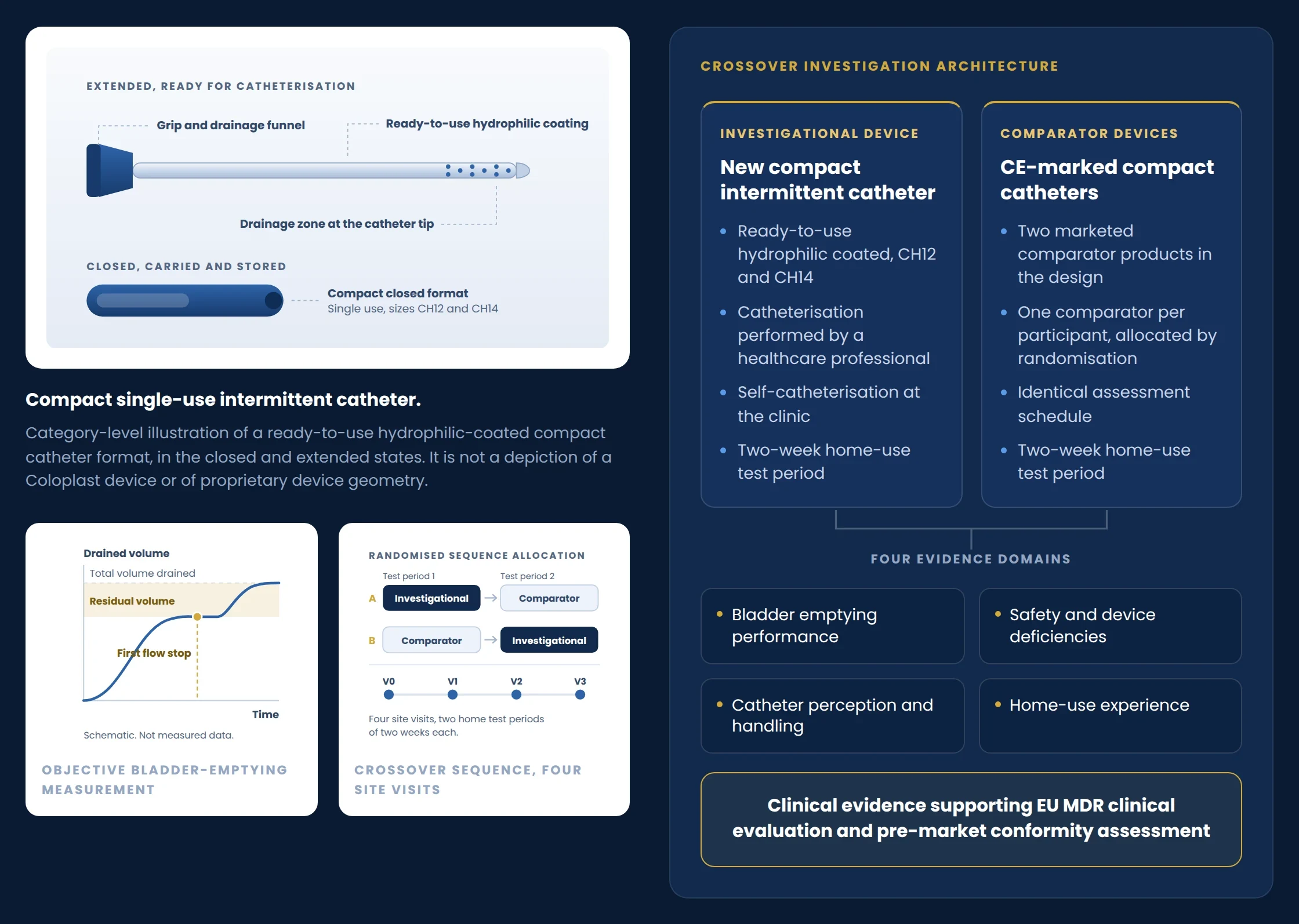
Clinical investigation architecture for a new compact intermittent catheter

Step 1 · The challenge

A non-CE-marked investigational catheter had to be evaluated against marketed comparators on an objective bladder-emptying endpoint. That endpoint depends on catheterization technique, on whether the catheterization is performed by a nurse or by the participant, and on four weeks of largely unsupervised use at home. Two marketed comparators randomized across participants, three jurisdictions with different national requirements and crossover carry-over effects all had to be held in one architecture.

Planned participants
72
European countries
3
Site visits per participant
4

Step 2 · Eclevar’s contribution

  • Clinical investigation strategy and synopsis
  • Crossover design, randomization and sequence allocation
  • Country strategy and site feasibility
  • Regulatory and ethics submissions per country
View full Eclevar contribution 3 more
  • Clinical operations, monitoring and site training
  • Standardized measurement and data capture in Milo
  • Statistical analysis plan and missing-data handling

Step 3 · Program and evidence position

A multi-center, randomized, open-label crossover investigation across three European countries, with two home-use test periods per participant and four evidence domains: bladder emptying performance, safety and device deficiencies, catheter perception and handling, and home-use experience.

Publicly documented program. Registered as NCT05814211, protocol CP348, completed. Design, registration and scale details are taken from the public registration and the registered clinical investigation plan. Assessments are described as designed, not as completed, and no clinical result is published here.

Program architecture
What this architecture shows
  • Each participant is randomized to a sequence and receives one CE-marked comparator alongside the investigational compact catheter.
  • Catheterization is performed both by a healthcare professional at the clinic and by the participant, on an identical assessment schedule for every device.
  • Two home-use test periods of two weeks each are separated across four site visits.
  • Four evidence domains are collected: bladder emptying performance, safety and device deficiencies, catheter perception and handling, and home-use experience.
  • No clinical result is reproduced on this page. The public registration is the source of record.

Program architecture. The catheter illustration is a neutral category-level drawing and does not reproduce Coloplast device geometry. The catheterization profile is schematic, not measured data.

07 Nihon Kohden Named client engagement

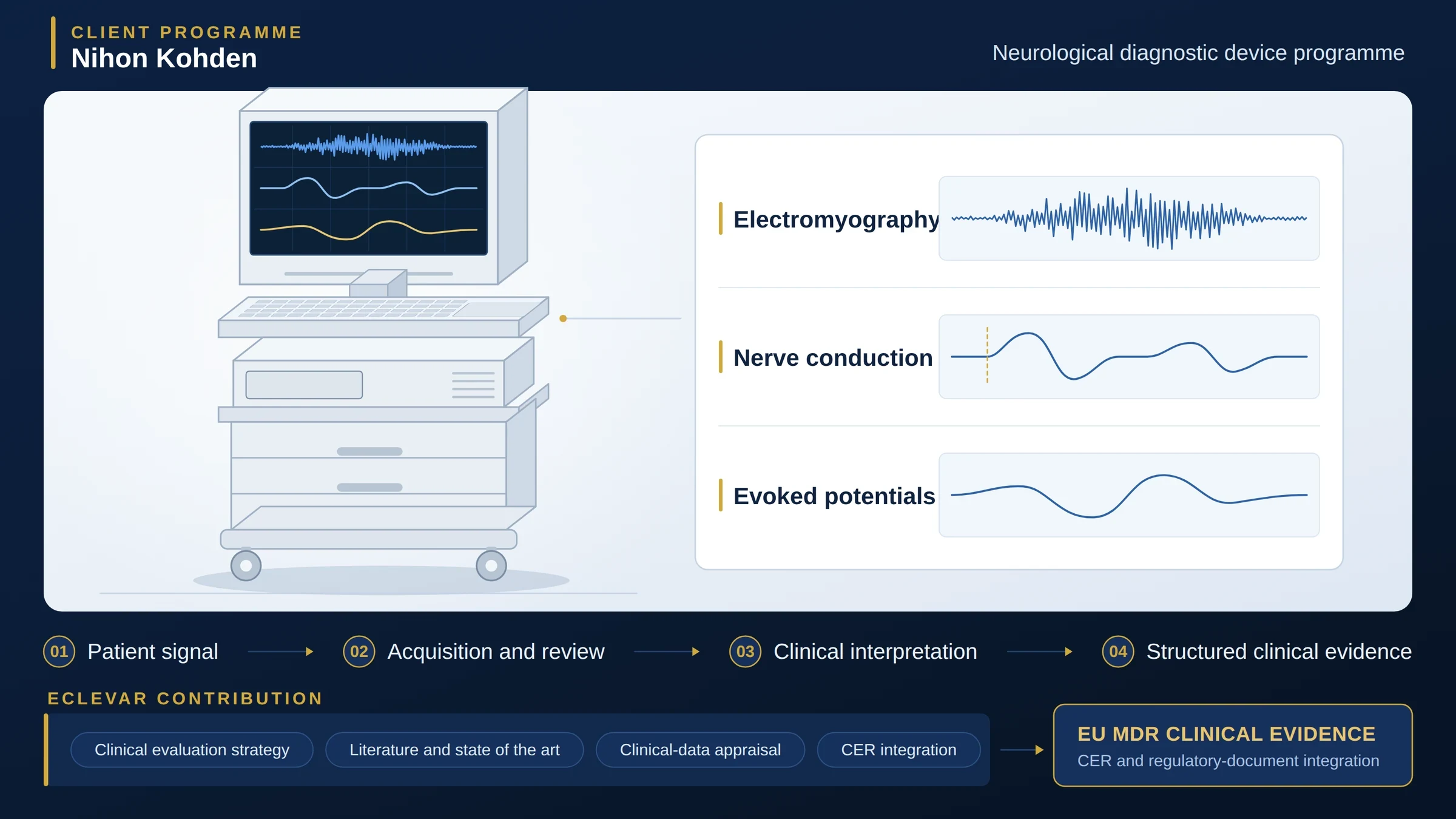
EU MDR clinical evidence for an electromyography and evoked-potential system

Step 1 · The challenge

A neurological diagnostic system combining electromyography, nerve-conduction assessment and evoked-potential measurement needed a clinically and regulatorily defensible evidence package. The device measures nerve and muscle signals rather than treating, so its clinical evidence had to be built from existing clinical data and the state of the art rather than from a new investigation. Adequacy then had to be demonstrated across three distinct diagnostic modalities inside one clinical evaluation.

Diagnostic modalities
3
Verified deliverables
5
Regulation
EU 2017/745

Step 2 · Eclevar’s contribution

  • Clinical evaluation strategy
  • Systematic literature review
  • State-of-the-art assessment
  • Clinical-data appraisal
View full Eclevar contribution 1 more
  • Clinical Evaluation Report and regulatory-document integration

Step 3 · Program and evidence position

A clinical evidence package covering electromyography, nerve conduction and evoked potentials, prepared to support the manufacturer’s conformity assessment under Regulation (EU) 2017/745. The system is a diagnostic clinical-neurophysiology platform and does not deliver therapeutic neurostimulation.

Named client engagement. The public scope is limited to activities verified against the contract and the delivered documentation. No certification, approval or conformity-assessment outcome is attributed to Eclevar.

Program architecture
What this architecture shows
  • Three diagnostic modalities are in scope: electromyography, nerve conduction and evoked potentials.
  • The clinical pathway runs from patient signal, through acquisition and review, to clinical interpretation and structured clinical evidence.
  • Eclevar contributed the clinical evaluation strategy, the systematic literature review, the state-of-the-art assessment, the clinical-data appraisal and the Clinical Evaluation Report.
  • The output is a clinical evidence package prepared to support conformity assessment under Regulation (EU) 2017/745. No regulatory decision is attributed to Eclevar.

Program illustration. Proprietary illustration built on generic device-category geometry. No client product photograph, traced outline or model designation is used. This is a diagnostic neurophysiology system, not a therapeutic neurostimulation device.

Independent recognition

xShare and EUCROF Platinum Award, 2026.

The award recognizes Eclevar’s contribution to the xShare initiative on health data standards. Its scope is data innovation. It is not an assessment of the clinical programs on this page, and it is not a regulatory approval or a Notified Body decision.

Senior oversight

Who reviews the evidence before it leaves.

  • Mark Da Costa

    Chief Operating Officer

    Mark leads Eclevar’s clinical operations. He assessed clinical evidence inside a Notified Body before joining Eclevar, and applies that review perspective to how programs are structured, documented and delivered.

  • Nikhil Khadabadi

    Former Notified Body reviewer

    Nikhil reviewed clinical evidence submissions inside a Notified Body before joining Eclevar. He works on program design in orthopedics and spine, and on how clinical data is presented for review.

  • Pierre-Marie Boutanquoi

    Head of Medical Writing

    Pierre-Marie leads clinical and regulatory writing, including Clinical Evaluation Reports, PMCF plans and reports, and the documentation that carries a program’s evidence into conformity assessment.

Colleagues described as former Notified Body reviewers assessed clinical evidence inside a Notified Body before joining Eclevar. They do not represent a Notified Body and take no part in conformity assessment decisions. Eclevar does not issue certificates, grant market access or make regulatory decisions.

Perspectives

In their own words.

Two recorded conversations: a client on running a multicountry PMCF program, and an investigator on what the work looks like at site level. Both open on YouTube. Nothing is embedded here, so no third-party cookie is set before you choose to watch.

Client perspective

RegenLab on running a multicountry PMCF program

“ECLEVAR provides a unique, tailor-made approach; paired with the advanced MILO Studio platform, they are a major strategic asset for any device investigation.”

Antoine Turzi, Chief Executive Officer, RegenLab

A recorded discussion about the European PMCF program covering diabetic foot ulcers and venous leg ulcers.

Investigator perspective

Dr Axel Schulz on the documentation burden at site level

“Conducting clinical trials can be overwhelming due to documentation and compliance tasks, but with Milo, everything has become easier, faster, and more manageable.”

Dr Axel Schulz, Orthopedic and Trauma Surgeon, Germany

A recorded interview about eligibility screening, regulatory paperwork and keeping documentation structured in an outpatient setting.

Start here

Bring us the program that has to survive review.

Tell us the evidence question, the device class and the deadline. We will tell you what the program has to look like to answer it.

Program architecture

Reforming Clinical Evaluation of Medical Devices in Europe