ECLEVAR is a specialist MedTech CRO for manufacturers planning clinical investigations and post-market clinical follow-up (PMCF) studies in Europe. Our clinical operations, medical writing and data teams coordinate study design, delivery and clinical evaluation reports. Tell us about your device, target countries and study timeline so we can scope a proposal.
Planning a study at US sites? Explore our US medical device clinical trial services for feasibility, start-up and monitoring. Planning a European study from the US? Compare European study options for US sponsors.
 Platinum Award 2026
Top prize in the xShare x European CRO Federation "EHDS & Clinical Research" Open Call, awarded to Eclevar MedTech and its Milo Studio platform, presented at the EUCROF 2026 conference in Amsterdam.
Horizon Europe · Grant Agreement No. 101136734 · Amsterdam, 2 Feb 2026
Device leaders across cardiovascular, orthopedics, wound care and more choose Eclevar. Read all client success stories.






A medical device CRO (contract research organization) is a specialist partner that designs, runs and reports the clinical evidence a manufacturer needs to CE mark a device and keep it on the market.
For EU clinical investigations, EU MDR 2017/745 sets the regulatory requirements, and ISO 14155:2026 describes good clinical practice for device studies. The sponsor retains responsibility for the investigation. A medical device CRO can carry out the work agreed with the sponsor, including clinical strategy and gap analysis, study design and protocol, ethics committee and competent authority submissions, feasibility and site selection, patient recruitment, on-site and remote monitoring, clinical data management, medical writing (the clinical evaluation report and the clinical investigation report), and post-market clinical follow-up (PMCF).
For higher-risk Class IIb and Class III devices, that evidence must satisfy a Notified Body, so a device CRO also anticipates how assessors will read the file. In short, a medical device CRO turns a manufacturer's engineering and clinical intent into regulator-ready evidence, from first protocol to lifelong surveillance.
Manufacturers typically engage a device CRO at three moments: before a first submission, to design a defensible clinical strategy and avoid a costly Notified Body deficiency letter; during the MDR transition, to upgrade legacy evidence that no longer meets Annex XIV; and after CE marking, to run the ongoing PMCF that keeps a certificate valid. The earlier the CRO is involved, the fewer expensive reworks appear later, because endpoints, sample size and follow-up are set to the regulatory standard from day one.
Three heart-valve platforms in one UK trial. For Meril, ECLEVAR coordinated evidence across three study arms using the same assessment schedule and a standardized imaging review. Read the structural heart case study.
Two wound populations across European sites. For RegenLab, ECLEVAR coordinated a common protocol and follow-up schedule for diabetic foot and venous leg ulcer cohorts. Read the wound-care case study.
Medical device studies need a design that reflects the device’s intended purpose, clinical risks and use in practice. Relevant considerations include operator experience, learning curves and the evidence required for the target market.
Every franchise is led with dedicated senior attention and, where relevant, former Notified Body insight. We concentrate on higher-risk Class IIb and Class III devices, where the clinical evidence bar and PMCF obligations are highest.
From complex TAVI pivotal programs to IIS conversion, clinical evidence aligned with Notified Body expectations for Class III structural heart devices.
Cardiovascular CRO servicesEWMA collaboration, chronic wound endpoints and PMCF strategies for NPWT systems and bioengineered tissue substitutes, with deep KOL networks across the EU.
Wound care CRO servicesLed by former TÜV SÜD assessors: Class IIb / III implants, registry-based PMCF and Annex XIV compliance for joint reconstruction and fusion.
Orthopedic and spine CRO servicesClass III active implantable devices face rigorous requirements. We build 10-year PMCF architectures with AIMD-specific methodology.
Neuromodulation CRO servicesWe also run dedicated programs for vascular and interventional devices, from peripheral access to endovascular implants, with the same ISO 14155 and Annex XIV rigour.
One accountable team covers every stage of the clinical investigation lifecycle, so nothing is lost between a protocol, a monitoring visit and a Notified Body submission.
Pre and post-market trials under ISO 14155, from feasibility and site selection and study initiation through multi-country ethics submissions and on-site and remote monitoring.
Clinical evaluation reports, PMCF plans and, where required, SSCPs, written by clinicians and reviewed by former Notified Body assessors, with reference to applicable EU MDR requirements and relevant guidance.
Specialist-led clinical data management and EDC: eCRF design, DMP and DVP, powered by MILO Studio, natively built for EU MDR.
PMCF surveys designed to address defined clinical evidence gaps, using appropriate questionnaires, documented methods and data-quality controls in accordance with EU MDR Annex XIV Part B and the principles of MDCG 2020-7.
Where suitable, established national or specialty clinical registries, such as the National Joint Registry (NJR), can support long-term real world evidence, PMCF evidence generation and implant follow-up, subject to device identification, data completeness and appropriate access.
Regulatory affairs and clinical strategy for CE mark pathways and equivalence, backed by a quality management system certified to ISO 13485.
A European manufacturer of a Class III active implantable came to Eclevar after a Notified Body review flagged insufficient clinical evidence for its legacy CE certificate during the MDR transition. We began with a clinical evidence gap analysis against Annex XIV, then rebuilt the strategy: a focused pre-market clinical investigation under ISO 14155 to close the highest-risk performance and safety claims, paired with a registry-based PMCF plan designed to generate real world evidence over the full service life of the device.
Eclevar handled protocol design, competent authority and ethics submissions across three countries, in-house monitoring, and clinical data management on MILO Studio, then wrote the clinical evaluation report and PMCF plan the way former Notified Body reviewers know assessors expect to read them. The sponsor entered its Notified Body assessment with a coherent, defensible file and a follow-up architecture already running.
Outcome: a clear, evidence-led route to CE marking under EU MDR, with a PMCF engine feeding the next certificate cycle rather than starting from zero.
Former Notified Body reviewers from TÜV SÜD. We know what fails inspection and design programs to avoid it.
Clinical ops, writing and data management. One point of accountability, no handoff fragmentation.
Proprietary EDC built natively for EU MDR, with Annex XIV mapping and AI eCRF generation.
Entities in the United Kingdom, Ireland, the United States, Japan and Mauritius, with one accountable program team.
Awarded by xShare & EUCROF to Eclevar MedTech and its MILO platform for innovation in clinical research and health data interoperability.
ISO 13485 certified. Every program structured for TMF completeness and Notified Body inspection readiness.
Eclevar remains accountable for program governance across feasibility, submissions, sites, monitoring, data and reporting, with the delivery model defined for the contracted scope.
France · EU MDR clinical operations
France is a core market for Eclevar: a fully French-speaking clinical team takes device sponsors from ANSM authorisation through PMCF and HAS reimbursement. As a specialist medical device CRO in Europe, we run French EU MDR studies with local regulatory, ethics and monitoring expertise on the ground.
Clinical investigation applications to the ANSM and ethics review through the CPP, including initial dossiers, substantial modifications and safety reporting under EU MDR Articles 62–80.
Site identification and activation across French university hospitals and private centers, matched to your therapeutic area, with feasibility and site contracting handled locally.
In-house French-speaking clinical research associates for on-site and remote monitoring, source data verification and ISO 14155-compliant trial conduct.
Evidence planning aligned with the French market-access pathway, so your clinical data supports a CNEDiMTS reimbursement submission, not just CE marking.
Trusted by MedTech manufacturers
The team coordinating our French studies also supports EU MDR investigations across European sites. See how sponsors have worked with us in our client success stories.
Whitepapers, client testimonials and publications produced by our teams and partners (BSI, TÜV SÜD, RegenLab).

Written with Notified Body BSI: a practical reading of the clinical evidence expectations under EU MDR 2017/745, relevant to any high risk device program.
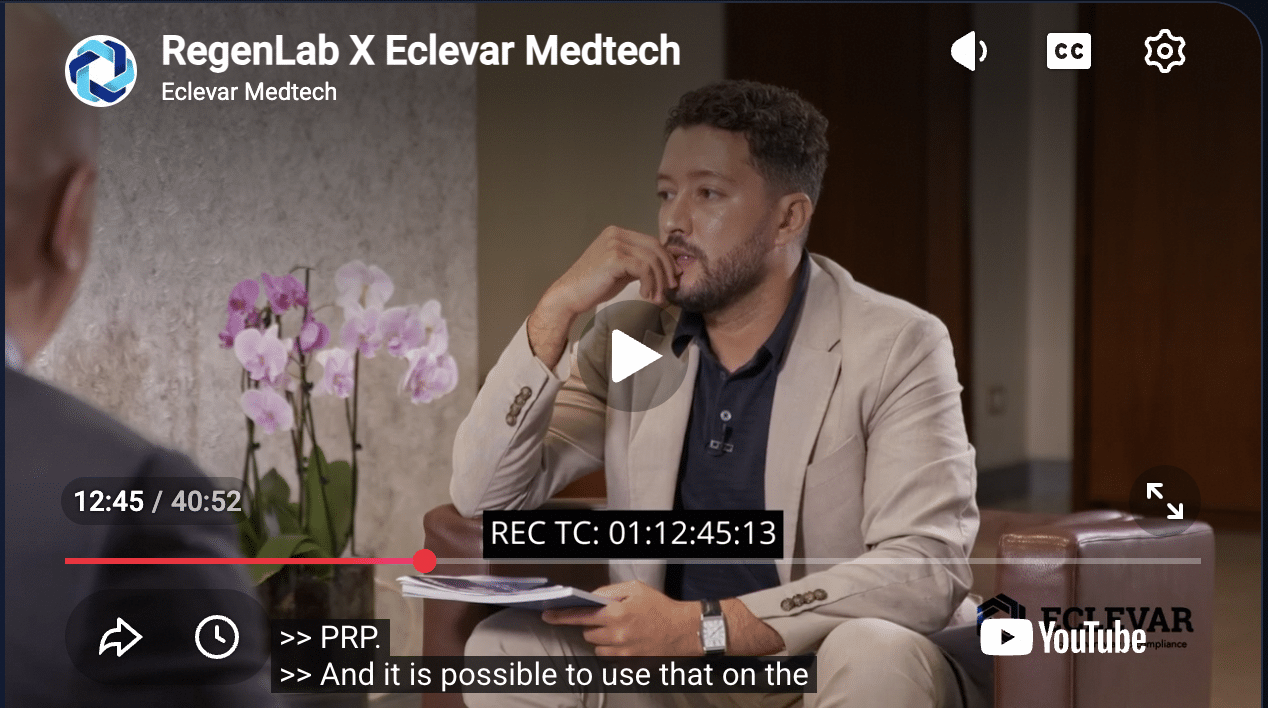
Eclevar manages RegenLab's PMCF program on chronic wound devices. This is a randomized study of 160 patients across 14 sites in 5 EU countries, covering both diabetic foot ulcer (DFU) and venous leg ulcer (VLU) indications. The partnership combines Eclevar's ISO 14155 clinical expertise with the Milo Studio platform to deliver post-market clinical follow-up evidence that supports both Notified Body scrutiny and reimbursement endpoints, from protocol design through to final study report.
« Eclevar, with its tailor-made approach and advanced Milo Studio platform, represents a major strategic asset. »
A medical device CRO is a contract research organization that helps a manufacturer plan, conduct and report clinical investigations and other clinical evidence activities. For EU projects, its work is scoped to applicable EU MDR requirements and, where relevant, ISO 14155 good clinical practice principles. Services can include clinical strategy, study design, regulatory and ethics submissions, site management, monitoring, data management, medical writing and PMCF. The sponsor retains responsibility for the investigation.
Its agreed scope can include clinical evidence strategy, protocol development, clinical evaluation reports, regulatory and ethics submissions, site selection, monitoring, clinical data management and PMCF. The responsibilities, deliverables and oversight arrangements should be defined with the sponsor for each study.
Assess the proposed team’s experience with your device type, risk class, therapeutic area and target countries. Ask how the CRO will justify the study design and PMCF methods, manage data quality and coordinate regulatory and ethics submissions. Clarify who will perform each activity, how subcontractors will be overseen, and what the proposal includes in its budget and timeline.
Cost depends on device class, study design, the number of sites and countries, endpoint complexity and the length of post-market follow-up: a single-country PMCF survey sits at one end, a multi-country Class III pre-market investigation at the other. Eclevar scopes each program against the device’s clinical evidence needs, proposed methods and target markets, so the budget reflects the work required for the agreed scope. We provide a transparent, itemised proposal after a short scoping call.
Medical device studies need a design that reflects the device’s intended purpose, clinical risks and use in practice. Relevant considerations include operator experience, learning curves and the evidence required for the target market. When selecting a CRO, assess its relevant device experience, study delivery capability and proposed PMCF methods. Surveys, suitable registries or clinical studies may be appropriate, depending on the device’s evidence needs.
ISO 14155 is the international standard for good clinical practice in clinical investigations of medical devices involving human participants. ECLEVAR structures study planning, monitoring, data management and study documentation with reference to ISO 14155 principles and the regulatory requirements applicable to the investigation. The protocol and oversight arrangements are defined for the device, study design and contracted scope.
Manufacturers must demonstrate conformity with applicable General Safety and Performance Requirements using sufficient clinical evidence, documented in a clinical evaluation. EU MDR Article 61 and Annex XIV address clinical evaluation and its ongoing update, including PMCF. MDCG 2020-6 concerns clinical evidence for legacy devices, while MDCG 2020-7 provides a PMCF plan template. A Summary of Safety and Clinical Performance is required for implantable devices and Class III devices, excluding custom-made or investigational devices.
Eclevar runs dedicated specialist practices in cardiovascular and structural heart, orthopedics and spine, neuromodulation and neuro-implants, vascular and interventional devices, and advanced wound care, regenerative and aesthetic devices. We focus on higher-risk Class IIb and Class III devices, including active implantables, where Notified Body scrutiny and PMCF requirements are most demanding.
Eclevar coordinates clinical operations, medical writing and clinical data management through qualified specialists, with one point of accountability. Data is captured on MILO Studio, our EU MDR native platform recognized with the Platinum Award at the xShare and EUCROF 2026 Open Call.
Share your device, evidence gaps, target countries and timeline. Our team can scope the study approach, deliverables and budget for your proposal.
Request a CRO proposalMedical device CRO by country: Medical Device CRO in France, Medical Device CRO in the UK, Medical Device CRO in Germany and Spain.
