
Wound dressings and antimicrobial technologies
Evidence question: does performance hold across the wound types and populations the portfolio actually treats?
Advanced wound care · Clinical investigations · PMCF
Clinical evidence programmes for wound dressings, NPWT, compression systems, tissue substitutes and digital wound-management technologies.
End to end: clinical and regulatory strategy, protocol and endpoint design, country and site feasibility, clinical operations, standardised wound assessment, EDC and patient-reported outcomes, data management, biostatistics, clinical reporting and CER integration.

Run from Eclevar's own European entities and clinical operations teams.
Independent wound experts plus named regulatory, operations and data leads.
The route follows the clinical evaluation, not a fixed study template.
Assessment conventions, data capture and quality control designed together.
Written up for direct use in the clinical evaluation and PMCF file.
Device portfolio
Each family raises a different evidence question. Below is what we design programmes to answer.
Evidence question: does performance hold across the wound types and populations the portfolio actually treats?
Evidence question: what does the system change in wound-bed preparation and exudate management, and how are device deficiencies captured?
Evidence question: can the effect be separated from application technique and adherence in routine care?
Evidence question: which route does the intended purpose and mode of action require, equivalence or a clinical investigation?
Evidence question: how is measurement performance demonstrated against a defined reference, and under what conditions?
Evidence question: what does the adjunct add once the primary treatment and background care are accounted for?
Scope note. Classification and evidence route are assessed device by device against intended purpose, mode of action, invasiveness, product characteristics and existing evidence. No class is attributed to a family as a whole, and capability to design a programme is not a claim of completed experience in every category.
Discuss your deviceProgrammes are designed and delivered under the applicable regulatory and clinical requirements for each study, country and device.
The evidence challenge
Four characteristics decide whether a wound dataset can be interpreted. Each has an operational answer.
Aetiology, comorbidity, vascular status and infection burden all move healing, so effects are easily masked.
Our response: eligibility criteria, stratification and a written definition of standard care agreed before the first site opens.
Boundaries, depth and tissue classification differ between assessors and sites.
Our response: protocol-defined acquisition conventions, calibration requirements, site training and measurement review during data cleaning.
Compression, offloading and concomitant therapy often determine the outcome more than the device under study.
Our response: adherence and concomitant care captured as study data, with deviations recorded rather than inferred.
Closure, recurrence, infection and quality of life emerge only over a schedule sites can sustain.
Our response: visit schedules built around clinic capacity, with monitoring and query workflows that protect follow-up completeness.
How a wound programme is delivered
Wound data is generated at the bedside and consumed by a Notified Body. Everything in between is operational, and it is where a wound programme is won or lost.


Selected regenerative medicine programme · Advanced wound care
A multicountry clinical programme across diabetic foot ulcer and venous leg ulcer populations.
 RegenLab
Autologous platelet-rich plasma clinical evidence programme
European PMCF programme
RegenLab
Autologous platelet-rich plasma clinical evidence programme
European PMCF programme
Eclevar supported the architecture and European delivery of a PMCF programme evaluating clinical performance, safety and patient-reported outcomes in diabetic foot ulcer and venous leg ulcer populations.
The programme combines standardised wound assessment, multicountry site coordination, longitudinal follow-up and structured data capture in MILO Studio across 160 participants, 14 clinical sites and six European countries.
Autologous platelet-rich plasma preparation pathway. Category-level illustration of the bedside preparation and application steps standardised across participating sites. It is not a depiction of a RegenLab kit or of proprietary device geometry.
Two-cohort PMCF programme architecture
Cohort 1
Diabetic foot ulcers
Cohort 2
Venous leg ulcers
Standardised European clinical delivery
Four evidence domains
Wound healing and closure
Clinical and safety outcomes
Patient-reported outcomes
Treatment and resource use
PMCF evidence supporting clinical evaluation and post-market surveillance
160Participants
14Clinical sites
6European countries
2Wound populations
Challenge
Generate consistent European PMCF evidence across two clinically distinct chronic-wound populations while accommodating differences in care pathways, wound assessment and longitudinal follow-up.
Eclevar contribution
Programme complexity
MILO digital evidence capture
MILO Studio supports structured capture of wound assessments, safety data, patient-reported outcomes and treatment information across the European clinical network.
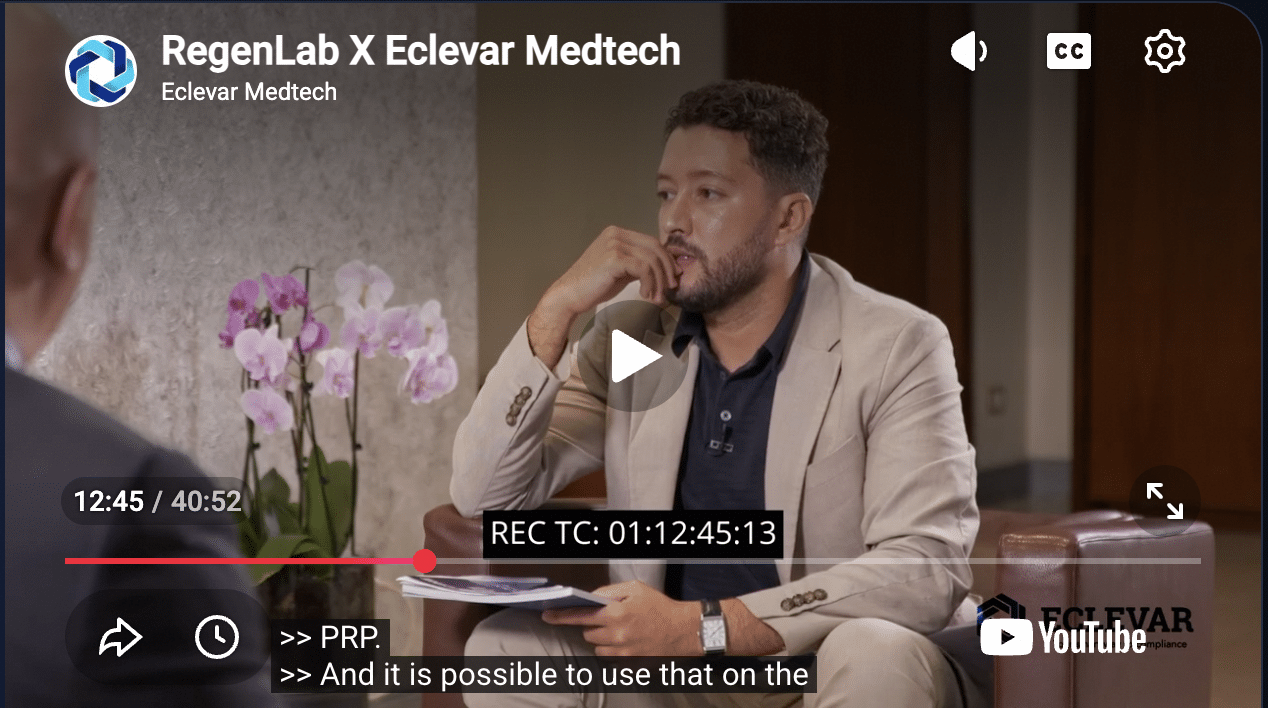
RegenLab and Eclevar discuss regenerative medicine, PRP applications and the clinical evidence required to support responsible market access.
Watch the RegenLab × Eclevar discussionWhere autologous PRP is used


The 160 participants, 14 clinical sites and six European countries described on this page relate solely to the chronic wound care programme. They do not apply to musculoskeletal or aesthetic applications.
Multicountry post-market clinical follow-up programme. The devices are developed and owned by RegenLab. Eclevar contributed to programme architecture, European clinical delivery, digital data capture and statistical methodology. Assessments are described as designed, not as completed. No clinical outcome, comparative claim or regulatory decision is stated or implied, and no endorsement of Eclevar by RegenLab is implied. Participating institutions are withheld.
Eclevar, with its tailor-made approach and advanced Milo Studio platform, represents a major strategic asset.
Antoine Turzi, CEO, RegenLab
The approved transcript of this discussion is being prepared and will be published here. In the meantime it can be requested from the wound-care team.
Illustrative programme scenarios
Each programme is adapted to the device, intended purpose, target wound population, standard of care and regulatory evidence gap.
The scenarios below illustrate how a programme may be structured. They are not descriptions of completed client projects. Delivered work is shown separately under Experience.

Generate safety and performance evidence across heterogeneous populations while controlling for standard of care and concomitant treatment.
Evidence supporting PMCF, clinical evaluation and portfolio-level planning.

Evaluate a regenerative treatment in a complex DFU population where vascular status, infection and background care materially affect healing.
Integrated clinical, safety and health-economic evidence for ongoing clinical evaluation.

Create consistent longitudinal evidence across centres and visits.
Consistent, audit-ready measurement and clinical data across sites.
Endpoint architecture
Illustrative endpoint domains by wound population. None is universally appropriate.
Healing depends on perfusion, infection, offloading and glycaemic control as much as on the device, so eligibility criteria and the definition of standard care decide whether the effect can be interpreted.
Illustrative endpoint domains
Compression is the backbone of care, so the regimen and adherence are documented alongside the device.
Illustrative endpoint domains
Populations are often frail and settings vary between hospital, community and long-term care. Category, depth and undermining need one consistent assessment method.
Illustrative endpoint domains
Questions centre on healing by secondary intention, dehiscence and surgical-site infection, in populations recruited through a surgical pathway.
Illustrative endpoint domains
Scope note. Final endpoints, instruments and assessment schedules depend on the device, intended purpose, study question, population, standard of care and the regulatory evidence gap. Third-party instruments remain the property of their authors and are used under their licensing conditions.
Investigators and sites
Access to wound-care specialists through Eclevar's European network, subject to programme-specific feasibility.
Identifying an investigator is rarely the hard part. What decides whether a programme recruits is patient flow, clinic capacity and the contracting route for your protocol. Feasibility is therefore built around the protocol, not around a directory.
Scope note. Access to specialists is built programme by programme and is not a contracted investigator network. Feasibility does not guarantee site availability, patient access or recruitment.
European delivery
The markets below are among those in which Eclevar has delivered wound-care clinical programmes. Other European countries are assessed on a programme-specific basis.
Technology and imaging
A wound dataset is only as good as the discipline applied at the moment of assessment. We build that discipline into the protocol, the site training and the data system rather than correcting for it afterwards.
Clinical data is captured in MILO Studio, configured for each study by the data management and biostatistics team.
Discuss data and imaging requirementsScope note. Unless separately contracted and confirmed, the capability described here does not include automated wound-area calculation, algorithmic tissue classification or independent central imaging review.
xShare and the European CRO Federation, for clinical-data innovation through the MILO platform. The assessment concerned clinical-data innovation and is not an assessment of Eclevar's wound-care clinical delivery.
Accountability
Wound expertise, regulatory experience and delivery capacity are different things. Each sits with a named person.
Supported by named regulatory, clinical operations, data and medical writing leads inside Eclevar.

Chief Operating Officer
Former Notified Body review experience integrated into the clinical evidence strategy. On wound programmes his role is regulatory: how the clinical investigation, PMCF and registry outputs are structured for EU MDR clinical evaluation and Notified Body review. He is not the wound clinical specialist on this page.

Head of Clinical Operations, DACH region
Accountable for study start-up and clinical operations across the DACH region, including site identification, feasibility, contracting and the monitoring model applied to wound sites in hospital and outpatient settings.

Project Delivery Lead, France and United Kingdom
Day-to-day delivery of multicountry wound programmes: timelines, site performance, visit compliance and sponsor reporting.

Chief Data Officer
Data architecture, EDC and ePRO configuration, imaging and measurement data quality control, statistical analysis of healing trajectories.

Head of Medical Writing
Protocols, clinical investigation reports, PMCF documentation and the integration of study results into the clinical evaluation.

UK Site Delivery Lead and Lead CRA
UK site identification, activation and monitoring across hospital and community wound services.
Former positions are stated for biographical context only. Eclevar MedTech is independent and is not affiliated with, or endorsed by, any Notified Body. The experts presented above are engaged in an advisory capacity and are not employees of Eclevar MedTech.
Relevance over volume
Only organisations relevant to wound care and tissue repair, in the category that describes the actual relationship.
Scope note. Listing an organisation implies no other relationship and no endorsement of Eclevar's services.
Resources

Whitepaper · BSI and Eclevar
Written with the Notified Body BSI: a practical reading of the clinical evidence expectations under EU MDR 2017/745, including real-world evidence for advanced wound-care devices.
Read the whitepaper
Client perspective · RegenLab
RegenLab's chief executive on working with Eclevar across a multicountry PMCF programme in chronic-wound populations.
Watch the testimonialFurther wound-specific content is added here only once authorship, title and any co-branding are approved.
Related therapeutic areas
FAQ
Ask for named people: who designs the endpoint architecture, who owns the assessment conventions, who runs the sites in each country, and who writes the clinical documentation. Then ask what that team has delivered in wound indications, in which countries, and how much of the work fell back on the sponsor.
It follows from the residual questions in your clinical evaluation, and can range from structured surveys and literature surveillance to a prospective study, a registry or a PMCF clinical investigation. Device class, existing data, identified risks and any conditions attached to certification decide what is proportionate.
Decide the conventions before enrolment and write them into the protocol and site documentation: positioning, distance, lighting, a calibration reference in frame, and who performs the assessment. Training and review during data cleaning matter as much as the technology. Some variability remains, so the analysis plan should account for it.
Complete closure and time to closure are common primary endpoints in diabetic foot ulcer and venous leg ulcer studies, with wound-area reduction, recurrence, infection, pain, quality of life and resource use as secondary domains. Pressure-injury populations are often frailer, so area reduction and safety may be more informative than closure.
They can contribute if the data answers the question in the clinical evaluation. Routine wound documentation is often incomplete for the variables a PMCF plan needs. A registry can be strong for safety, recurrence and real-world use, but needs a defined data model, consistent definitions and a realistic view of site burden.
They are frequently the strongest determinants of healing, so they cannot sit in the background. The protocol should specify the expected regimen, how it is documented, and how deviations and adherence are captured, with variation between countries and care settings reflected in eligibility, stratification and the analysis plan.
Eclevar has delivered wound-care clinical programmes in Western Europe, including France, Germany, Italy, Spain and the United Kingdom, and can assess other European markets on request. Country selection is decided during feasibility, using patient pathways, site capacity, approval routes and contracting timelines for your protocol.
PMCF questions are traced back to the residual uncertainties in the clinical evaluation, so the endpoints collected map onto the claims and risks that need supporting. Results are reported in the PMCF evaluation report and carried into the clinical evaluation report update. The outcome of any conformity assessment remains with the Notified Body.
Next step
Receive an initial view of the evidence gap, the likely programme route, the feasibility questions and the workstreams required before protocol development.
Tell us the device category, the target wound indication, your development or certification stage and the evidence question you need answered.
Request a wound evidence scoping call Email clientcare@eclevar.com
Information you send is used to respond to your enquiry, in line with the privacy policy.


