US IDE data and registries can answer EU MDR Annex XIV. ISO 14155 European investigations and PMCF can answer the FDA. Eclevar co-designs a single dataset for both regulators, so you stop paying for two redundant trials, with former Notified Body reviewers structuring the evidence each authority expects to read.
 US & EU corridor · one team
Former Notified Body reviewers and FDA-literate regulatory leads build the evidence once and defend it on both sides, on the MILO Studio platform that won the Platinum Award at the xShare & EUCROF 2026 Open Call.
Horizon Europe · Grant Agreement No. 101136734 · Amsterdam, 2 Feb 2026
Device leaders across cardiovascular, orthopedics, wound care and more choose Eclevar to move between the US and EU markets. Read all client success stories.





The US corridor is a co-designed clinical and regulatory pathway that lets a single medical device dataset serve both the US FDA and the EU MDR, instead of running two separate, redundant trials.
The US is the largest medical device market in the world, which makes it a near-mandatory destination for European MedTechs planning to scale, and Europe is the destination US manufacturers most often underestimate. Most companies assume the two systems are incompatible and budget for two clinical programs. In reality, a manufacturer holding US IDE trial data or robust registry information already possesses evidence that speaks directly to EU MDR Annex XIV, and a European manufacturer with a strong post-market clinical follow-up program already holds data that can support an FDA 510(k). The decisive factor is not new data, it is correctly structuring the data you have.
The bridge is standards-based. The FDA explicitly recognises ISO 14155:2026 and routinely accepts compliant Outside-US (OUS) clinical data in 510(k) and PMA submissions. Conversely, EU Notified Bodies accept prospective outcome data from a well-run FDA IDE trial when it is mapped to Annex XIV Part B, because a rigorous IDE study is closely aligned with ISO 14155. Where the frameworks diverge, and they do, the divergence is predictable and can be engineered around from protocol version one.
Eclevar runs the corridor in both directions as one connected service: an evidence inventory, an Annex XIV and substantial-equivalence gap analysis, Clinical Evaluation Report authoring or FDA Q-Submission preparation, and management of the Notified Body or FDA interaction, all captured on a data platform built for both regulators.


Eclevar's model brings the regulatory perspective inside the CRO, eliminating the gap between what manufacturers submit and what assessors expect, on both sides of the Atlantic. Dr Mark Da Costa, COO and former TÜV SÜD reviewer, and Dr Nikhil Khadabadi, CMO for orthopedics and spine and also a former TÜV SÜD senior reviewer, lead a team that maps US data to Annex XIV and structures European evidence for FDA acceptance, exactly the way Notified Bodies and FDA reviewers expect to read it, from the first protocol version.
The single most expensive assumption in cross-market MedTech is that FDA and EU MDR require unrelated evidence. They don't. The gap between duplicating everything and engineering one dataset for both is structural, and it costs years.
US IDE trials, national registries and the MAUDE database are rich sources of evidence that, structured correctly, answer EU MDR Annex XIV and feed the Clinical Evaluation Report, frequently without any new European trial.
FDA IDE clinical trials carry prospective outcome data that can satisfy EU MDR Annex XIV Part B. Because IDE is closely aligned with ISO 14155, we map it directly into the Clinical Evaluation Report.
US national registries such as ACC/NCDR and VQI hold massive datasets. We reformat them into compliant EU real-world evidence and PMCF reports for the Notified Body.
Safety signals extracted from the FDA MAUDE database, re-graded to MEDDEV 2.7/1 rev.4 criteria, strengthen the benefit-risk section of the CER with real post-market safety data.
A strict, documented assessment of US evidence against EU MDR Annex XIV, including where MDR equivalence rules are tighter than FDA substantial equivalence, so gaps are known before submission, not after.
Where direct clinical evidence is short, a targeted PMCF investigation under ISO 14155 supplies exactly the data the Notified Body demands, and nothing redundant.
We submit the CER and manage every Notified Body interaction, defending the acceptability of the US data through the audit, backed by our ISO 13485 quality system.
ISO 14155 European investigations and mature PMCF registries are exactly the Outside-US evidence the FDA recognises. Structured through a Q-Submission, they can become the primary clinical basis for a 510(k), De Novo or PMA.
The FDA officially recognises ISO 14155:2026, so EU clinical investigations run to that standard are routinely accepted as Outside-US evidence for 510(k) or PMA submissions.
Where the FDA mandates post-market surveillance under a Section 522 order, robust EU PMCF data can satisfy the reporting obligation without a duplicate US registry.
Before filing, we build the Pre-Submission briefing package that negotiates acceptance of the European dataset with FDA reviewers and mitigates the risk of a refuse-to-accept decision.
An upfront review of ISO 14155 investigation data and PMCF outputs against FDA OUS expectations, identifying whether any small US bridging study is genuinely needed, or not.
We prepare and run the formal FDA meeting to confirm data acceptability and scope, converting the Pre-Sub feedback into a locked, agreed clinical basis for the filing.
Final submission built on the pre-agreed European dataset, from clean data management through to the formal FDA filing and review support.
Three requirements decide a dual program. Two overlap heavily and can be bridged. One, equivalence, is the classic trap. Knowing which is which up front is the whole game.
FDA: IDE clinical trials, and OUS ISO 14155 data accepted when valid. EU MDR: ISO 14155:2026 investigations, with Notified Bodies accepting US IDE data mapped to Annex XIV. Verdict: high overlap, highly bridgeable.
FDA: core to 510(k), built on technical characteristics and predicate comparison. EU MDR: equivalence heavily restricted under Annex XIV; direct clinical data usually required. Verdict: the gap, engineer around it early.
FDA: Section 522 orders and specific required registries. EU MDR: active PMCF plus PMSR/PSUR, continuous proactive collection. Verdict: high overlap, one PMCF engine can feed both.
The critical gap. US manufacturers frequently assume that FDA 510(k) clearance, granted on substantial equivalence to a predicate, is enough for a CE Mark. It is not. Under EU MDR the equivalence route is exceptionally strict, and the Notified Body will usually demand direct clinical evidence for the device itself. Eclevar specialises in translating a 510(k)-cleared product into MDR compliance by structuring PMCF studies and existing literature into the direct clinical evidence the assessors require.
One accountable team covers every stage of the clinical and regulatory lifecycle, so nothing is lost between a US filing, an EU submission and the one dataset that has to satisfy them both.
Regulatory strategy that co-designs the FDA and CE Mark pathways together, defining the single evidence plan that clears both from the outset.
Pre and post-market investigations under ISO 14155, from feasibility and site selection and study start-up through on-site and remote clinical monitoring.
The Clinical Evaluation Report under MDCG 2020-6, with Annex XIV mapping and ISO 14155 bridging arguments, authored by clinicians and reviewed by former Notified Body assessors.
100% in-house clinical data management and EDC on MILO Studio, compliant with both 21 CFR Part 11 and GDPR, so one dataset outputs packages for both bodies.
Structured post-market clinical follow-up and registry-based real-world evidence engineered to feed EU PMSR/PSUR and FDA Section 522 duties at once.
A quality management system certified to ISO 13485 that underpins every submission, keeping the corridor evidence audit-ready on both sides.
US → EU · Structural heart, Class III. A US cardiovascular manufacturer running a large FDA IDE trial wanted a CE Mark and assumed it faced a completely new clinical investigation in Europe. Eclevar architected the Clinical Evaluation Report around the existing FDA data, validating population equivalence and mapping the IDE dataset to Annex XIV Part B. The outcome: the Notified Body accepted 100% of the US data, no new EU trial was required, roughly 18 months were saved and the manufacturer avoided millions in duplicate clinical cost.
EU → US · Orthopedics, Class IIb. A European orthopedic company lacked a clear predicate for a standard 510(k). Eclevar prepared and managed an FDA Q-Submission demonstrating that three years of EU PMCF registry data met the FDA's Outside-US standard. The FDA agreed to accept the European dataset as the primary clinical evidence, and the device was cleared through the 510(k) route without a fresh US trial.
The pattern: in both directions the evidence already existed. What unlocked each market was structuring that evidence to the standard the receiving regulator recognises, and defending it through the review.
Former Notified Body reviewers from TÜV SÜD. We know what fails an MDR audit and structure US data so it doesn't.
Q-Submission and OUS data expertise. We negotiate acceptance of European evidence before you file, not after a refusal.
Proprietary EDC compliant with both 21 CFR Part 11 and GDPR, so a single global study serves both regulators.
Evidence built once and bridged both ways, eliminating the second redundant trial and the reconciliation overhead.
Platinum Award winner, EUCROF 2026, ranked first for clinical innovation and data strategy.
ISO 13485 certified, with a track record of no major non-conformances across submissions on both sides of the corridor.
A network of employed CRAs and regulatory leads, not subcontractors, gives manufacturers consistent quality and one accountable team across the US, EU, UK and Japan corridors.
Whitepapers, client testimonials and publications produced by our teams and partners (BSI, TÜV SÜD, RegenLab).
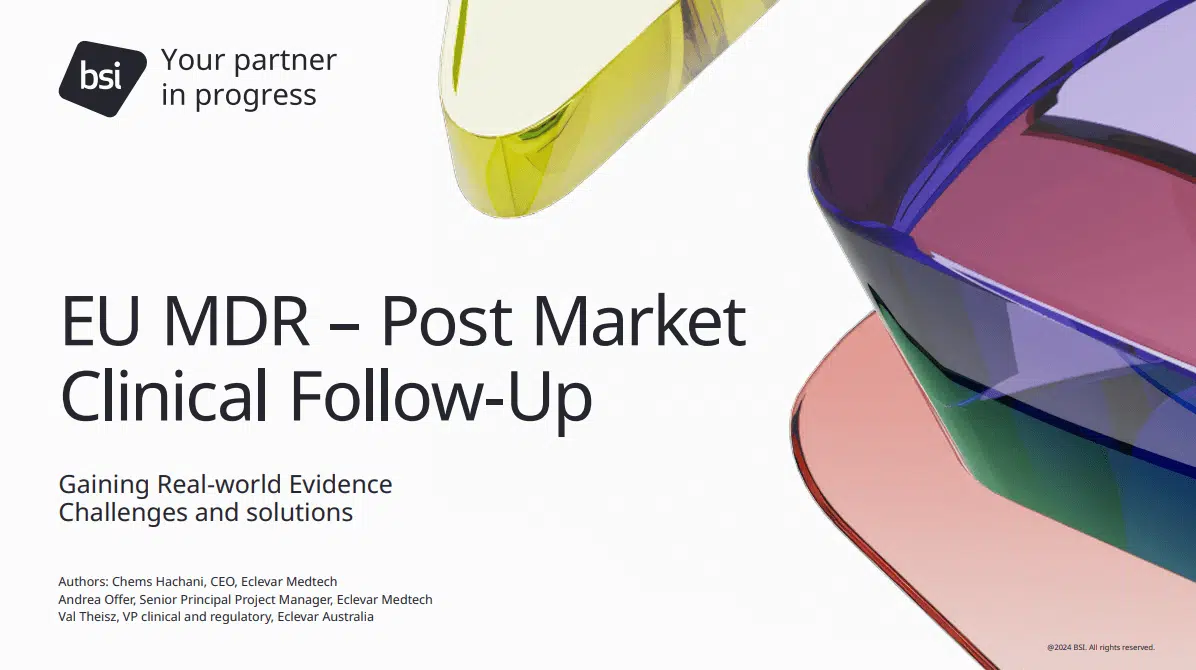
Written with Notified Body BSI: a practical reading of the clinical evidence expectations under EU MDR 2017/745, relevant to any high risk device program.
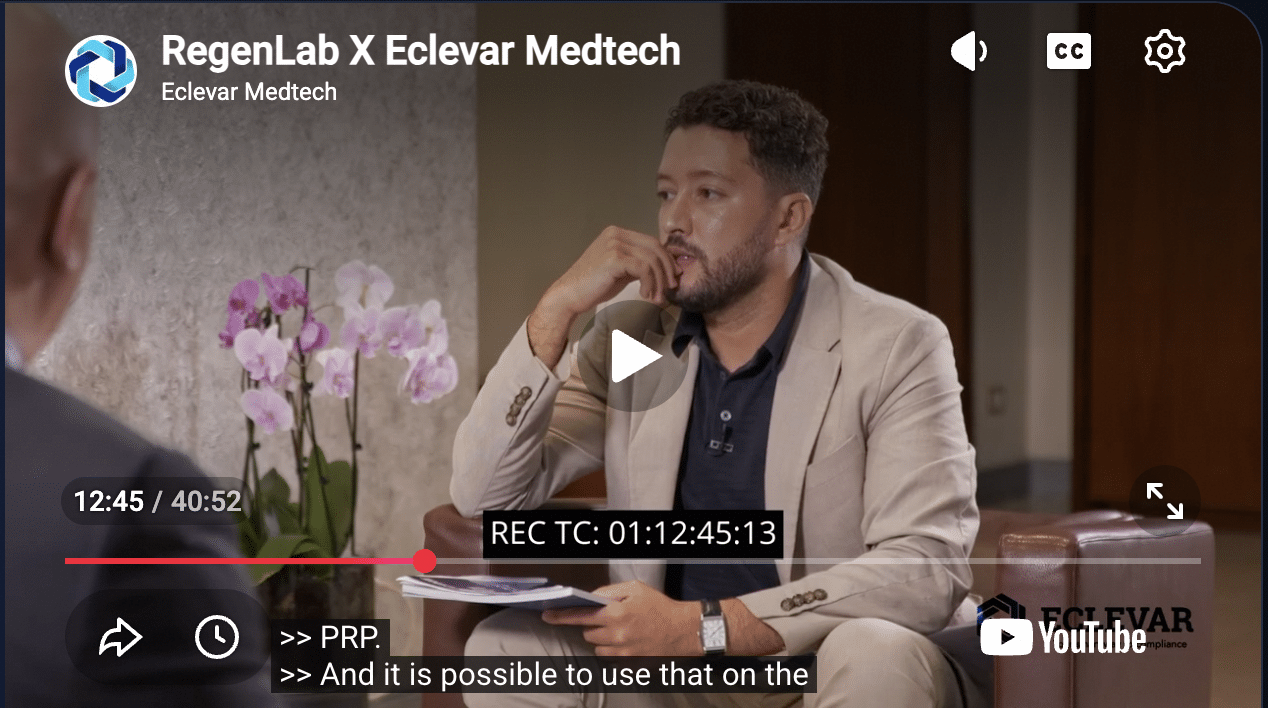
Eclevar manages RegenLab's PMCF program on chronic wound devices. This is a randomized study of 160 patients across 14 sites in 5 EU countries, covering both diabetic foot ulcer (DFU) and venous leg ulcer (VLU) indications. The partnership combines Eclevar's ISO 14155 clinical expertise with the Milo Studio platform to deliver post-market clinical follow-up evidence that supports both Notified Body scrutiny and reimbursement endpoints, from protocol design through to final study report.
« Eclevar, with its tailor-made approach and advanced Milo Studio platform, represents a major strategic asset. »
It is a co-designed clinical and regulatory pathway that lets a single medical device dataset serve both the US FDA and the EU MDR, instead of running two separate trials. US IDE trial data and national registries can be structured as EU MDR Annex XIV evidence, while ISO 14155 European investigations and PMCF can be presented as FDA Outside-US (OUS) evidence for 510(k), De Novo or PMA. The critical factor is correctly structuring the data you already have for each regulator.
Yes. The FDA accepts Outside-US (OUS) clinical data, particularly when it is collected under ISO 14155:2026, which the FDA explicitly recognises for 510(k) and PMA submissions. The Pre-Submission (Q-Submission) process is used to obtain formal FDA agreement on the acceptability of the European dataset before filing, which reduces the risk of a refusal or a demand for a fresh US bridging study.
No, and assuming it does is a common and costly misconception. FDA 510(k) relies heavily on substantial equivalence to a predicate device, focusing on technical characteristics. EU MDR restricts clinical equivalence far more tightly under Annex XIV and generally demands direct clinical evidence for the device. Data restructuring, literature analysis and usually a PMCF strategy are required to meet the Notified Body's expectations.
Often yes. An FDA IDE clinical trial contains prospective outcome data that can satisfy the requirements of EU MDR Annex XIV Part B when it is mapped correctly, because a well-run IDE study is closely aligned with ISO 14155. Eclevar performs an Annex XIV gap analysis, applies ISO 14155 bridging arguments and authors the Clinical Evaluation Report around the US data, then defends its acceptability with the Notified Body.
A Q-Submission, or Pre-Submission, is a formal briefing package and meeting through which a manufacturer asks the FDA to agree, in advance, on the acceptability of its clinical evidence and testing plan. For a European manufacturer using EU MDR data, the Q-Sub is where you negotiate acceptance of ISO 14155 and PMCF data as primary evidence and establish whether any small US bridging study is needed, before committing to a 510(k), De Novo or PMA filing.
Yes. MILO Studio, Eclevar's clinical data management and EDC platform, is compliant with 21 CFR Part 11 for the FDA and with GDPR for the EU. That lets a single global study capture one dataset and output regulator-specific packages for both bodies, avoiding the duplication and reconciliation cost of running separate US and European data systems.
Eclevar co-designs the clinical strategy so one investigation meets both frameworks: an evidence inventory, an Annex XIV and substantial-equivalence gap analysis, CER authoring or Q-Submission preparation depending on direction, and management of the Notified Body or FDA interaction. Because the team includes former Notified Body reviewers, the evidence is built the way assessors expect to read it on both sides of the corridor. Talk to our medical device CRO team to scope your program.
Talk to our specialists about your existing US or EU evidence and a corridor strategy that bridges both regulators, engineered from day one.
Book a consultation