SaMD · EU MDR · IMDRF
SaMD is a medical device in its own right, and EU MDR treats it accordingly. Understand the IMDRF definition, why Rule 11 raises the stakes, and the clinical evidence standalone software actually needs.

European Champion
Platinum Award 2026
Eclevar MedTech & Milo Health · xShare × EUCROF Open Call
Led by authority
SaMD is judged like any other device, and reviewed like one. Our teams build the evidence a Notified Body expects for standalone software.

CERs and PMCF plans under EU MDR and MEDDEV 2.7/1 Rev 4, and Notified Body deficiency response.
in LinkedIn
Cardiac surgeon and former lead Notified Body reviewer at TÜV SÜD. 400+ devices CE-certified.
in LinkedInAwards, funding, accountability
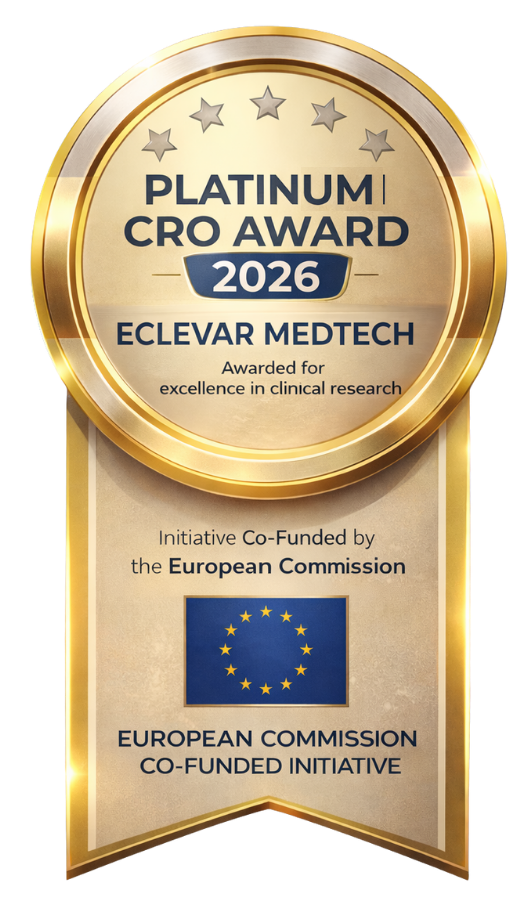
Top tier at the xShare × EUCROF Open Call, awarded to Eclevar MedTech and its Milo Health platform, presented at EUCROF 2026 in Amsterdam.
The announcement →Selected through the xShare Open Call for clinical research innovation, Horizon Europe.
xShare results →Distinction confirmed by an independent third party, the CVBF, also an awardee of the xShare × EUCROF Open Call.
CVBF coverage →The framework
When software has a medical purpose without being part of a hardware device, it is SaMD, and EU MDR and the FDA regulate it as a device, with classification driving everything that follows.
01
The IMDRF defines Software as a Medical Device as software intended for one or more medical purposes that performs those purposes without being part of a hardware medical device. A wellness or general-fitness app is not SaMD; software that diagnoses, screens, monitors or informs treatment is. That single distinction decides whether you are in scope at all.
02
In the US the FDA applies a risk-based Class I/II/III model. In the EU, MDR Rule 11 governs software, and it is demanding.
Why Rule 11 matters
03
The IMDRF clinical evaluation framework for SaMD rests on three levels: a valid clinical association (is the output meaningfully linked to the clinical condition?), analytical validation (does the software process inputs correctly?), and clinical validation (does it achieve the intended purpose in the target population?). Alongside sits the IEC 62304 software lifecycle, risk management to ISO 14971, and cybersecurity, all feeding the Clinical Evaluation Report (CER).
04
SaMD evolves through updates, and each material change can affect safety, performance and even classification. A robust PMCF plan for software tracks real-world performance, model drift where AI is involved, and the impact of new versions, keeping the clinical evaluation and CE mark valid over time.
SaMD at a glance
Talk to a specialist
Book a free scoping call. We confirm whether you are in scope, apply Rule 11, and map the clinical evidence your SaMD needs.
Book a free scoping callAn expert read confirms your SaMD classification under Rule 11 and builds the clinical evaluation, IEC 62304 file and PMCF a Notified Body will expect.
Book a free scoping callQuestions we hear first