Insight · EU MDR · Orthopedics
For decades, an orthopedic implant's long, clean market history was the heart of its clinical argument. Under EU MDR, that argument no longer carries the file on its own, and many orthopedic CER dossiers are failing on exactly this point.

European Champion
Platinum Award 2026
Eclevar MedTech & Milo Health · xShare × EUCROF Open Call
Led by authority
The people accountable for your orthopedic file have sat on both sides of the submission: building devices and reviewing them for a Notified Body.

Cardiac surgeon and former lead Notified Body reviewer at TÜV SÜD. 400+ devices CE-certified.
in LinkedIn
Former clinical reviewer at TÜV SÜD for Class III implants; orthopedic PMCF and CER methodology.
in LinkedIn
CERs under MEDDEV 2.7/1 Rev 4 and EU MDR, and Notified Body deficiency response.
in LinkedInAwards, funding, accountability

Top tier at the xShare × EUCROF Open Call, awarded to Eclevar MedTech and its Milo Health platform, presented at EUCROF 2026 in Amsterdam.
The announcement →Selected through the xShare Open Call for clinical research innovation, Horizon Europe.
xShare results →Distinction confirmed by an independent third party, the CVBF, also an awardee of the xShare × EUCROF Open Call.
CVBF coverage →Trusted by global manufacturers





Proof in practice
Real programs built on endpoints and statistics that hold up with Notified Bodies and reimbursement reviewers. See client success stories →
A multicentre transcatheter aortic valve implantation study across eight UK sites, feeding the clinical evidence a CER and reimbursement dossier rely on.
A within-patient crossover RCT versus marketed compact catheters. Data captured in a validated EDC to 21 CFR Part 11, under ISO 14155:2026.
Proof, not adjectives
What this article covers
The market-history problem
The market-history problem is simple to state and expensive to fix: long use is necessary, but no longer sufficient. Here is what a Notified Body now expects instead.
01 / 06
Joint replacements and many spinal implants are Class III under Annex VIII, Rule 8, carrying the highest evidence requirements. A joint replacement CER built on "we have sold these for 20 years" does not demonstrate, in MDR terms, that the clinical evidence supports the specific claims for the specific device. Long-term real-world data has to be structured into actual evidence, not cited as reassurance.
Under the previous directive, a long, uneventful market history did much of the work of a clinical evaluation: an implant that had sold for years with low complaint rates was largely taken to be safe. EU MDR changed that logic. Absence of complaints is not the same as evidence of performance. Complaint data is passive and incomplete, and it says little about how the device performs against the current state of the art or in the outcomes that matter clinically.
This catches established manufacturers hardest, precisely because their market history feels like their strongest asset. The implants with the longest track records often have the thinnest structured clinical evidence, and the transition exposes that gap exactly where the company felt most secure. The regulation is not dismissing a genuine track record; it is asking for it to be expressed as analyzed evidence rather than assumed from longevity.
What changed under MDR
02 / 06
A reviewer now expects structured clinical evidence that demonstrates the implant's performance and safety against the current state of the art, with the outcomes that matter for orthopedics, revision, survival and patient-reported function, captured and analyzed rather than assumed. The clinical evaluation has to make an argument from data, not from reputation. Aligning the evidence to the outcomes the field actually judges is half the battle in an orthopedic evaluation, and it is where our orthopedics and spine solutions focus first.
What a reviewer expects to see
03 / 06
Registries are central to meeting this expectation, because they capture exactly the long-term revision and survival outcomes that orthopedic implants are judged on, at a scale no single study could match. But the reviewer expects the registry data to be genuinely integrated and analyzed, with its limits acknowledged, not merely cited as a reassuring name, and that distinction is where many orthopedic CERs fall short. Handled properly, this is where real-world evidence turns market presence into a quantitative argument.
Talk to a reviewer
Book a free scoping call with an orthopedics and spine lead who reviewed these files at a Notified Body. Get a checkable read on where it now falls short, and how to turn that history into evidence that holds.
Book a free scoping call04 / 06
Equivalence is not a shortcut to reuse another device's history. Under Article 61(4) and (5), an equivalence claim across designs or manufacturers that does not hold up on clinical, technical and biological characteristics becomes a Notified Body finding rather than a saving. Our regulatory affairs strategy team scopes what equivalence can honestly carry before it is written into the file, so the CER does not rest on a claim a reviewer will reject.
05 / 06
The post-market dimension is no longer optional. A reviewer expects each residual gap in the evaluation to route to a specific post-market activity, so the evidence keeps maturing across the implant's long life. An orthopedic CER that names open questions without a credible plan to close them reads as incomplete, however strong the device's history. We draft the plan so a reviewer can trace each objective to a specific evidence gap during the MDR technical review.
06 / 06
The work is to convert long use into structured evidence: pull the revision and survival signal from registries, benchmark it against the state of the art, and let PMCF carry what the historical data cannot. Doing this well means engineering the registry data into the evaluation, defining the cohort, the endpoints and the analysis, stating the observational limits honestly, and feeding the results into both the clinical evaluation and the periodic safety reporting. Handled early and methodically, the transition turns a long market history from a liability under the new rules into one of the strongest evidence assets a CER can carry. Eclevar rebuilds orthopedic implant CERs with former Notified Body reviewers and registry-integration expertise; meet the team on the leadership page.
The transition in one view
Long use is the raw material. Registry analysis converts it into evidence, and a PMCF plan keeps that evidence maturing across the implant's life.
See how we turn registries into evidence
Explore how we turn NJR and EPRD revision and survival data into the quantitative evidence a Notified Body accepts, integrated and analyzed, not merely cited.
Explore our registry approachOfficial Eclevar resources
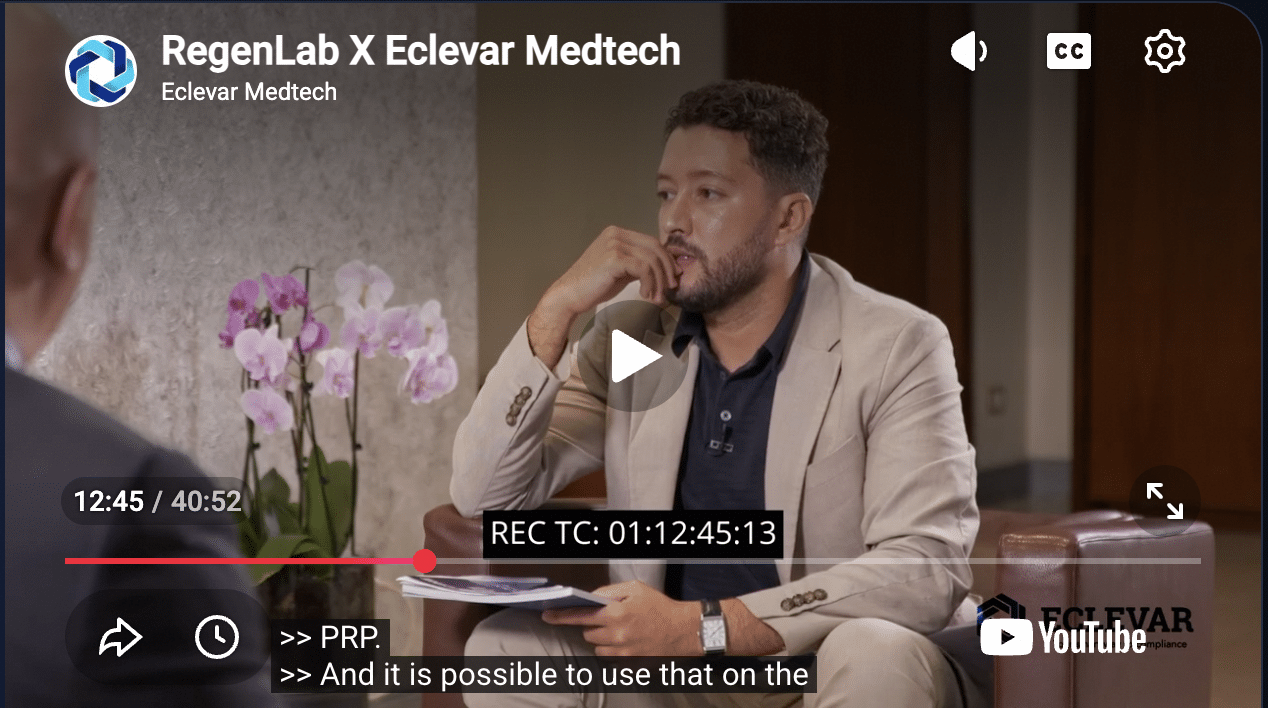
PMCF Studies · Regenerative Medicine · 5 EU Countries
Eclevar manages RegenLab's PMCF program on chronic wound devices: a randomized study of 160 patients across 14 sites in 5 EU countries, covering diabetic foot ulcer (DFU) and venous leg ulcer (VLU) indications. The partnership combines Eclevar's ISO 14155 clinical expertise with the Milo Studio platform.
"Eclevar, with its tailor-made approach and advanced Milo Studio platform, represents a major strategic asset."Antoine Turzi, CEO, RegenLab
A whitepaper co-signed by BSI and Eclevar on the clinical requirements of EU MDR.
Read the whitepaper →Clinicians and a former Notified Body reviewer, named, not handed to a junior account team. Meet the full leadership team →


If your orthopedic CER still leans on market history, an expert read shows where it now falls short, and how to turn that history into evidence that holds at review. Prefer email? Write to clientcare@eclevar.com.
Book a free scoping callQuestions we hear first