Specialist review of technical documentation, clinical evaluation and regulatory strategy for medical device manufacturers under EU MDR 2017/745, from Class I instrumentation to Class III implants, led by former Notified Body reviewers.
 Platinum Award 2026
Top prize in the xShare x European CRO Federation "EHDS & Clinical Research" Open Call, awarded to Eclevar MedTech and its Milo Health platform, presented at the EUCROF 2026 conference in Amsterdam.
Horizon Europe · Grant Agreement No. 101136734 · Amsterdam, 2 Feb 2026
Device leaders rely on Eclevar for EU MDR technical review and Notified Body submission. Read all client success stories.









Eclevar's technical review is led by people who assessed dossiers from inside a Notified Body. Dr Mark Da Costa, COO and former TÜV SÜD reviewer, knows the most common failure mode is misalignment between sections. We make sure your clinical evaluation, risk file and technical documentation tell one consistent, defensible story.
EU MDR 2017/745 has transformed technical documentation from a simple certification deliverable into a living regulatory system. Sections must stay aligned throughout the lifecycle, and capacity is constrained.
The most common failure mode is misalignment between sections, for example a clinical evaluation claiming equivalence to a device that the risk management file treats as novel. We review for internal consistency first.

Classification, Notified Body selection and regulatory roadmap.
Technical file, CER, biological evaluation and risk management.
Submission file compilation and Notified Body query management.
ISO 14155 trial design and site management.
From Class I to Class III, across cardiovascular, orthopedics and spine, dental and wound care.
Systematic review of technical documentation against MDR requirements, evaluating internal consistency and identifying evidence gaps. Deliverables: gap analysis, roadmap, NB readiness.
Review and authoring of risk management files aligned with MDR GSPRs, ensuring risk conclusions align with clinical evidence. Deliverables: risk analysis, residual risk, GSPR checklist.
Full CER authoring across therapeutic areas, with a structured literature search, PICO-based appraisal and equivalence analysis.
Authoring of the Biological Evaluation Plan (BEP) and Report (BER), with biocompatibility assessment, chemical characterisation and toxicological risk.
PMCF plan design and evaluation report production, plus annual PSUR authoring synthesising post-market surveillance data.
Actor and device registration in EUDAMED, UDI assignment support and PMS plan authoring.
Manufacturers with CE-marked portfolios needing MDR certification.
Asian, American or other non-EU manufacturers entering the European market.
MDR-certified manufacturers requiring an ongoing regulatory partnership.
Review of device portfolio, classification and NB status, provided within 5 business days at no cost.
Systematic review against MDR requirements with a prioritized remediation plan.
Remediation of technical file, CER, biological evaluation, PMCF and risk management.
Submission package preparation and NB query management.
Whitepapers, client testimonials and publications produced by our teams and partners (BSI, TÜV SÜD, RegenLab).
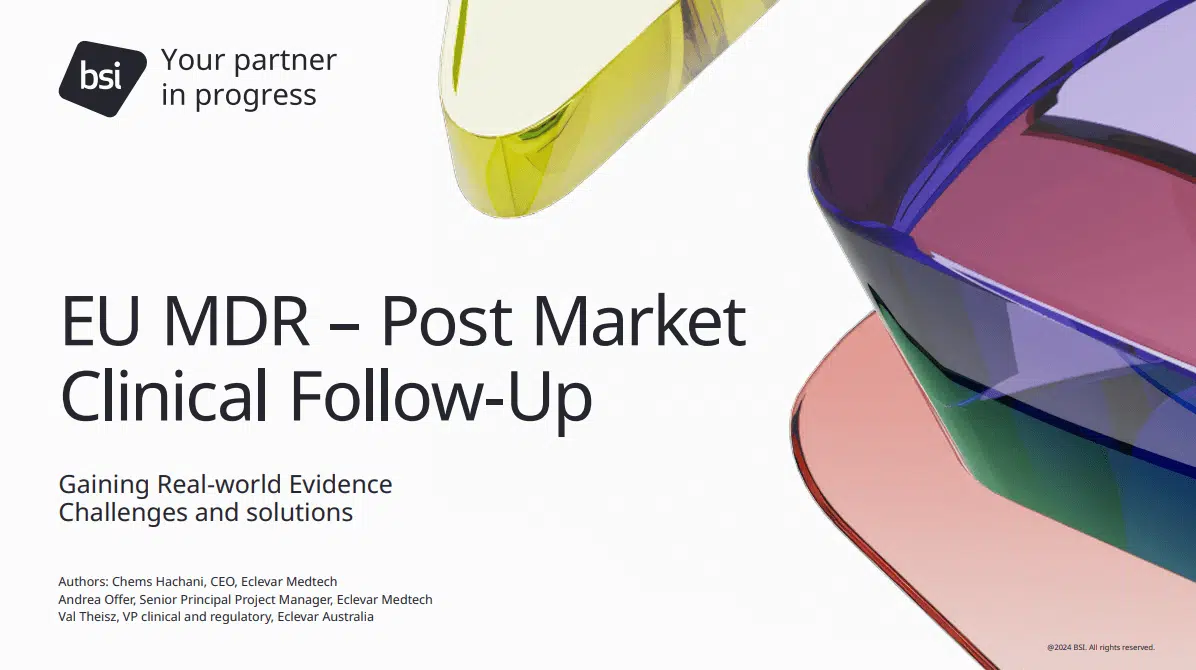
Written with Notified Body BSI: a practical reading of the clinical evidence expectations under EU MDR 2017/745, relevant to any technical file review.
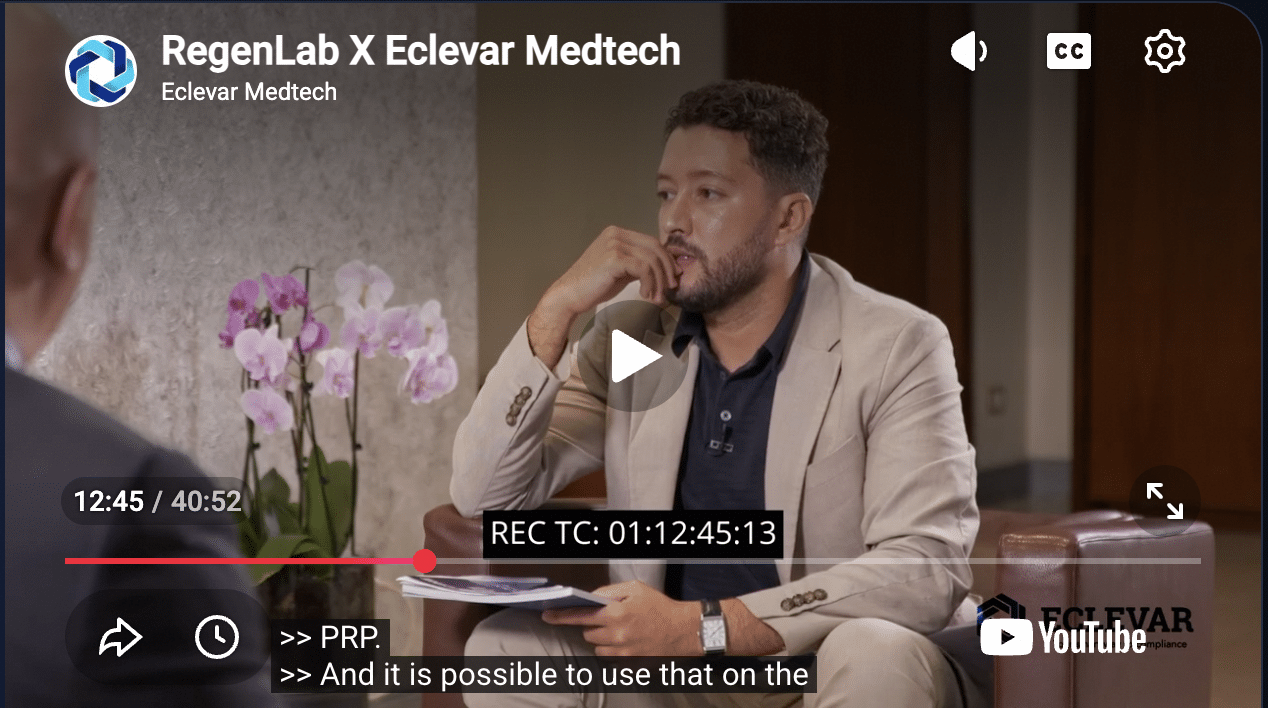
Eclevar manages RegenLab's PMCF program on chronic wound devices. This is a randomized study of 160 patients across 14 sites in 5 EU countries, covering both diabetic foot ulcer (DFU) and venous leg ulcer (VLU) indications. The partnership combines Eclevar's ISO 14155 clinical expertise with the Milo Studio platform to deliver post-market clinical follow-up evidence that supports both Notified Body scrutiny and reimbursement endpoints, from protocol design through to final study report.
« Eclevar, with its tailor-made approach and advanced Milo Studio platform, represents a major strategic asset. »
EU MDR 2017/745 has turned technical documentation from a simple certification deliverable into a living regulatory system. The most common failure mode is misalignment between sections, for example a clinical evaluation claiming equivalence to a device the risk management file treats as novel.
The final MDR transition deadline for Class IIb legacy devices is 2027. With only 49 MDR-accredited Notified Bodies operational versus 75 under the MDD, and more than 8,000 new MDR applications submitted, capacity is constrained and early remediation is essential.
With an initial scoping of your device portfolio, classification and Notified Body status, provided within 5 business days at no cost, followed by a systematic gap analysis and a prioritized remediation plan.
From Class I instrumentation to Class III implants, across cardiovascular, orthopedics and spine, dental and wound care.
Send us your device portfolio and classification. We assess your Notified Body readiness and return a prioritized remediation roadmap.
Request a scoping call