Stop treating RWE like a pharma requirement. We leverage European registries and real-world data to secure your EU MDR compliance and power your PMCF strategy, with MedTech methodology that accounts for surgical learning curves, device iteration and procedural variability.
Real-world evidence is one of the services Eclevar runs as a full medical device CRO in Europe, alongside clinical investigation, CER and PMCF under the EU MDR.
 Platinum Award 2026
Top prize in the xShare x European CRO Federation "EHDS & Clinical Research" Open Call, awarded to Eclevar MedTech and its Milo Health platform, presented at the EUCROF 2026 conference in Amsterdam.
Horizon Europe · Grant Agreement No. 101136734 · Amsterdam, 2 Feb 2026
Device leaders rely on Eclevar for registry-based PMCF and real-world evidence. Read all client success stories.









Dr Mark Da Costa, COO and former TÜV SÜD reviewer, leads a team that knows what Notified Bodies expect from real-world evidence. We design registry-based PMCF and RWE so data quality, completeness and traceability hold up to scrutiny, with in-house CRAs rather than outsourced monitoring.
Under the Medical Device Directive, real world evidence was supplementary. Under EU MDR 2017/745, it has become the regulatory backbone for post-market clinical follow-up. Notified Bodies no longer accept proactive literature searches alone as sufficient continuous evidence for legacy or high-risk devices.
MedTech RWE differs fundamentally from pharma approaches: it must account for surgical learning curves, device iteration, procedural variability and highly specific clinical outcomes.
We align your PMCF endpoints with the data capture capabilities of these massive national databases, and with the broader EUDAMED registry strategy.
Orthopedic implant survivorship and revision rates, ODEP-rating compliant.
Coverage across Germany's largest healthcare system for endoprosthetic devices.
Longitudinal spinal surgery outcomes for Class IIb and III implants.
Eclevar deploys in-house Clinical Research Associates across the UK, Germany, France and Sweden, ensuring seamless site initiation, ethics committee submissions (for example CPP in France) and high-quality real-world data capture.
Mining electronic health records for legacy device validation.
ISO 14155-compliant physician and patient surveys (PROMs).
Lightweight real-world studies deployed via the MILO EDC platform.
Continuously track adverse events and safety signals.
Evaluate performance across diverse patient populations.
Gather medium to long-term outcome data, months to years.
Meet EU MDR clinical evaluation requirements.
Compare with predicate devices or standard-of-care.
Identify and manage potential risks systematically.
Data quality encompasses completeness, consistency and accuracy across all investigational centers.
Evaluate data source quality, completeness and consistency.
Design a robust protocol aligned with ISO 14155:2026 and GCP.
Systematically collect real-world data from hospitals and registries.
Rigorous statistical analysis of safety and performance.
Deliver comprehensive PMCF and Clinical Evaluation Reports.
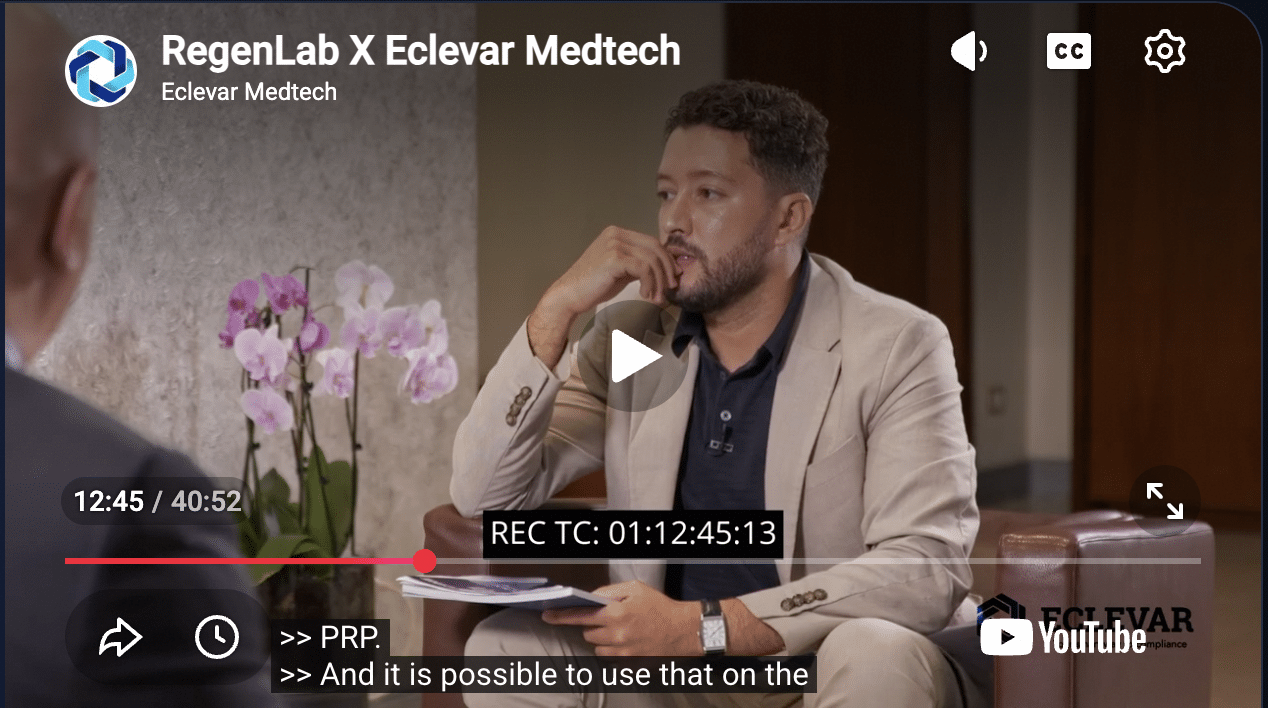
RegenLab required PMCF data for CE marking renewal without disrupting clinic workflows. Eclevar designed a targeted RWE PMCF registry study on the MILO EDC platform, capturing wound-healing trajectories and adverse-event tracking.
Multicentre RWE study with retrospective and prospective chart data across French university hospitals (CHU Valenciennes, Nantes, Brest), covering carotid and femoral locations to 3 years post-surgery, meeting EU MDR requirements for CE certification.
Real-world evidence is only one route to post-market data. To see how registries, surveys and prospective follow-up fit together under EU MDR, read our full guide to PMCF studies under EU MDR.
Whitepapers, client testimonials and publications produced by our teams and partners (BSI, TÜV SÜD, RegenLab).
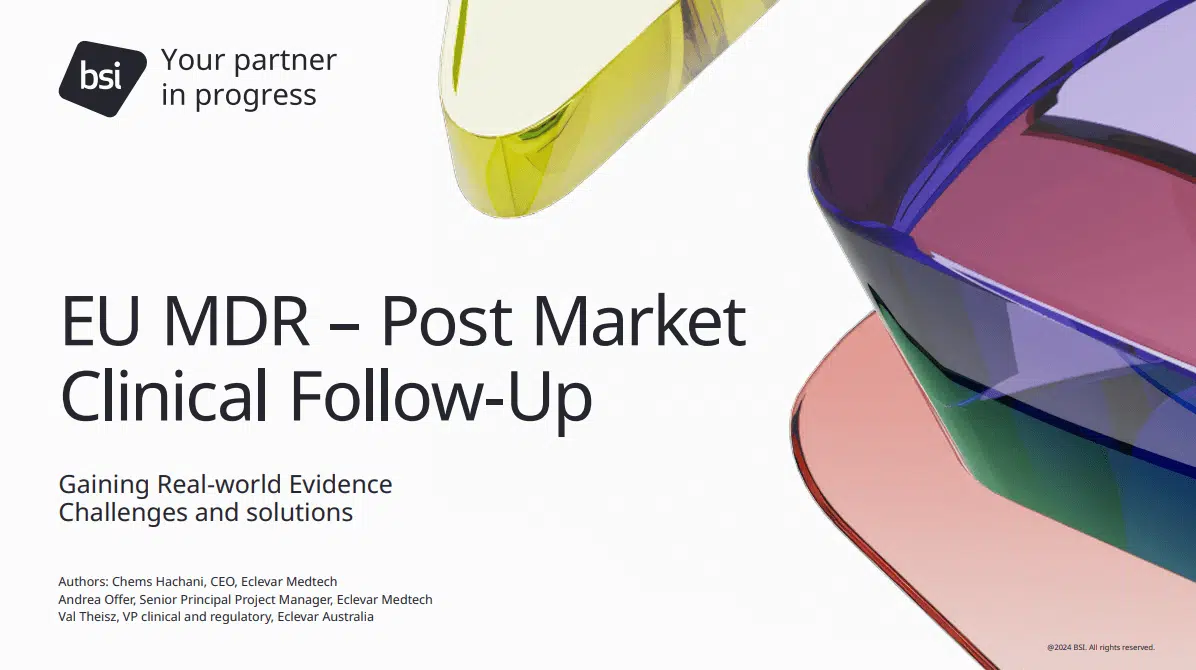
Written with Notified Body BSI: a practical reading of the clinical evidence expectations under EU MDR 2017/745, relevant to any registry-based PMCF program.
Eclevar manages RegenLab's PMCF program on chronic wound devices. This is a randomized study of 160 patients across 14 sites in 5 EU countries, covering both diabetic foot ulcer (DFU) and venous leg ulcer (VLU) indications. The partnership combines Eclevar's ISO 14155 clinical expertise with the Milo Studio platform to deliver post-market clinical follow-up evidence that supports both Notified Body scrutiny and reimbursement endpoints, from protocol design through to final study report.
« Eclevar, with its tailor-made approach and advanced Milo Studio platform, represents a major strategic asset. »
Under the MDD, RWE was supplementary. Under EU MDR 2017/745 it is the backbone of Post-Market Clinical Follow-up. Notified Bodies no longer accept proactive literature searches alone as sufficient continuous evidence for legacy or high-risk devices.
National Joint Registry (NJR, UK), Endoprothesenregister Deutschland (EPRD, Germany) and Swespine (Sweden), with PMCF endpoints aligned to these databases and to the broader EUDAMED strategy.
MedTech RWE must account for surgical learning curves, device iteration, procedural variability and highly specific clinical outcomes, which generic pharma approaches do not capture.
Retrospective EHR data extraction for legacy device validation, ISO 14155-compliant clinical surveys and PROMs, and lightweight prospective observational studies via the MILO EDC platform.
No. Eclevar deploys in-house CRAs across the UK, Germany, France and Sweden, ensuring seamless site initiation, ethics committee submissions (for example CPP in France) and high-quality real-world data capture.
Talk to our team about registry access, EHR extraction or an observational study, and the fastest compliant route to a Notified Body ready PMCF Evaluation Report.
Book a free consultation