Evidence Strategy / US and Europe
Align FDA and EU MDR evidence objectives before protocols, countries, sites, and budgets become difficult to change.
Eclevar helps medical device sponsors map the intended regulatory and clinical uses of their evidence, compare US-only, Europe-led, and hybrid study models, and translate the selected strategy into an executable European clinical program. US regulatory leadership remains with the sponsor's FDA regulatory lead or a separately retained qualified FDA specialist.
The commercial problem
Few sponsors set out to run two separate programs. They arrive there one reasonable decision at a time: a US consultant advises on the submission, a European partner is engaged to start a study, engineering releases a design change. By the time the two threads meet, the endpoints, follow-up periods, and safety definitions no longer line up, and reconciling them is a budget line nobody planned.
The objective is not to make the two pathways identical, because they are not. It is to decide, in advance and on the record, where evidence may be shared and where divergence has to be planned and funded.
Evidence architecture
One evidence architecture may support both development pathways, but the regulatory uses, thresholds, documentation, and authority decisions remain jurisdiction-specific. A workable architecture therefore has three layers: a shared clinical foundation both pathways can draw on, a set of FDA-specific considerations, and a set of EU MDR-specific considerations.
Integrated clinical development plan
Convergence and divergence
Every element of a study can be examined for what the two pathways may hold in common and what has to be handled separately. The table below is the working structure used in a strategy review. It is a starting frame rather than a ruling on any specific device.
| Evidence component | Potentially shared | May require jurisdiction-specific treatment |
|---|---|---|
| Clinical question | Core safety and clinical outcome question | Regulatory wording and the evidentiary threshold applied |
| Population | Common target population | Relevance to US practice, or regional representation in the cohort |
| Device | Common configuration | Bridging after design or manufacturing changes |
| Endpoints | Common clinical assessments | Definitions, hierarchy, timing, or relationship to a specific claim |
| Safety | Common event collection foundation | Reporting categories, timelines, and authority pathways |
| Follow-up | Shared long-term follow-up | Submission-specific duration or milestones |
| Data | Common EDC and analysis foundation | Submission formats, analyses, and supporting documentation |
| Reporting | Shared evidence base | FDA-specific and EU-specific presentation and conclusions |
Prospectively aligned evidence may reduce avoidable duplication, while jurisdiction-specific analyses, documentation, or additional evidence may still be required. The value of planning early lies in identifying avoidable duplication, reducing late redesign, protecting the usability of evidence already funded, clarifying dependencies, and making tradeoffs visible before execution rather than after it.
Geography is an output of the strategy, not an input to it. Once the intended evidence uses are agreed, three architectures are worth comparing. A fuller comparison belongs to the article US, Europe, or Hybrid: Where Should You Run Your Medical Device Clinical Study.
Consider when US clinical practice is central to the claim and the intended FDA submission calls for meaningful US evidence.
Main advantage. Evidence is generated in the setting the FDA submission describes.
Principal risk. European objectives are addressed late, and funded separately.
Consider when European sites can answer the clinical question and European market access is an objective in its own right.
Main advantage. Access to relevant sites and operators, with the European pathway advanced directly.
Principal risk. Relevance to a later FDA submission is assumed rather than assessed prospectively.
Consider when both settings add evidence value and one harmonized protocol can operate without compromising regional requirements.
Main advantage. Selected US representation alongside European recruitment and operator experience.
Principal risk. Coordination, monitoring, and data complexity increase, and have to be funded.
Program sequence
Each stage exists to close a defined set of uncertainties. The discipline is simple to state and hard to hold: a stage closes its uncertainties before the next budget is committed, and the gate between stages is an explicit decision rather than a calendar date. Not every program runs every stage.
Delivery of the individual stages is described on the early feasibility and pilot investigation and pivotal and pre-market clinical investigations pages, and lifecycle evidence on the PMCF page. Planning of first clinical use in Europe is covered on First-in-Human Studies in Europe, in preparation.
Eclevar's operating scope varied between these programs, and the figures are not presented as full-service responsibility for every program, as US studies, or as evidence accepted by any authority.
The engagement
A structured engagement with five workstreams and one written output. It is not an audit and not a general consultancy report. It is the document a management team and a board can use to commit or withhold a clinical budget. Scope and commercial terms are agreed in advance, per engagement.
What exists today, stated plainly: device, intended use, development stage, evidence already generated, risk management position, and the regulatory interactions that have already shaped the program.
What each jurisdiction needs the evidence to do, separated question by question, with gaps and dependencies made explicit rather than assumed.
US-only, Europe-led, hybrid, and sequential models developed to a comparable level of detail, then tested against European feasibility assumptions rather than against a preference.
The questions worth putting to an authority, framed around a specific decision, together with the sequence and critical path that follow from the answers.
Options tested with your team in a working session, then the reasoning and the recommendation written down so that the decision survives the people who made it.
How it runs
The first conversation is a scoping discussion. It establishes whether a review is justified, what it would cover, and which functions need to be in the room.
What decision is open, what has already been committed, and whether a review would change anything.
Device, intended use, evidence to date, and authority interactions, collected once.
Clinical, regulatory, medical, engineering, and data in the same session.
Evidence-use mapping, then candidate architectures tested against European feasibility.
Options tested against your constraints, with tradeoffs made explicit.
The recommendation, the reasoning, and what remains unresolved.
A separate proposal for the European clinical program, scoped and priced separately.
Recommended sponsor participants are Clinical Affairs, Regulatory Affairs, Medical, engineering, Quality, and biostatistics, with an executive sponsor and the sponsor's FDA regulatory lead or separately retained qualified FDA specialist. Decisions about endpoints and device configuration are made jointly, or they are made twice.
The team
The final team is selected according to the device, therapeutic area, jurisdictions, evidence stage, and scope of the engagement. The profiles below are the roles a US-Europe strategy review typically draws on.

Chief Operating Officer and Head of Cardiovascular, Senior Consultant Surgeon
Mark leads cardiovascular clinical strategy, combining 25 years of Consultant Cardiac Surgery experience with first-hand senior leadership Notified Body experience. He tests whether the intended clinical claims, endpoints, operator assumptions, and study sequence remain credible in procedural practice.

Chief Medical Officer, Orthopedics and Spine, Senior Consultant Surgeon
Brings operator learning and device maturity into the sequence decision, including how learning-curve considerations shape an early stage and the assumptions carried into a pivotal study.

Strategic Clinical Advisor, US Clinical Operations
Provides a US clinical operations perspective on study planning, site and investigator considerations, operational feasibility, and execution interfaces between US and European clinical programs.
External strategic advisor to Eclevar.

Chief Data Officer
Owns the data architecture and statistical assumptions: whether one EDC and analysis foundation can serve both intended uses, and where submission-specific analyses and documentation have to be planned.

Project Delivery Lead, France and United Kingdom
Translates the recommended evidence architecture into a deliverable European program, connecting country and site assumptions, submissions, activation, contracting, operational sequencing, and the critical path.
Clinical Operations, Medical Writing, and European Regulatory Affairs leads are assigned by therapeutic area and by the countries in scope. Full profiles are on the executive team page. Eclevar can formulate the clinical evidence questions, connect them to the European operating plan, and coordinate with the sponsor's FDA regulatory lead or separately retained qualified FDA specialist. Eclevar does not act as the sponsor's FDA regulatory representative unless a separate, verified scope is explicitly established.
Relevant experience
Eclevar's documented European programs demonstrate the disciplines required to translate an evidence objective into a multicountry protocol, aligned endpoints, coordinated delivery, and decision-ready data. The example below illustrates that foundation. It is not presented as a complete FDA and EU MDR case.
Public registration: NCT05814211. Study status and design are stated from the public registration. Eclevar's contribution to this program covers clinical evidence architecture, European delivery, and statistical methodology.
Further programs are described on the client success stories page.
Fit
A strategy review earns its cost when it changes a near-term decision. When it would not, we say so and propose the smaller piece of work that would.
Questions
It may, in part, where it is planned that way. A shared foundation of population, assessments, safety collection, and analysis can be designed to serve both intended uses, while jurisdiction-specific elements are planned separately. The regulatory uses, thresholds, documentation, and authority decisions remain jurisdiction-specific, so a program designed for one system should not be assumed to satisfy the other.
Clinical data generated outside the United States may support an FDA submission when the investigation is well designed and well conducted, the applicable regulatory conditions under 21 CFR 812.28 are met, and the evidence is relevant to the intended US use. When a PMA relies solely on foreign clinical data, the additional considerations under 21 CFR 814.15(b) apply. The relevance and applicability of the evidence should therefore be addressed prospectively for the intended FDA submission.
No. A Pre-Submission is one type of interaction within the FDA Q-Submission Program, and it is not a legal prerequisite for conducting a study in Europe. It can provide formal FDA feedback before an intended medical device submission, which is useful where European evidence is meant to contribute to it. The feedback is advisory. It does not constitute approval of a protocol, an IDE, or a future marketing submission, and it does not guarantee that the resulting evidence will be accepted.
Shared evidence answers a clinical question both systems ask in substantially the same way, such as whether the device performs as intended in the target population. Jurisdiction-specific evidence exists where one system applies a requirement, threshold, definition, or framework the other does not. Prospectively aligned evidence may reduce avoidable duplication, while jurisdiction-specific analyses, documentation, or additional evidence may still be required.
Where both settings add evidence value rather than only geographic coverage: selected US representation supports relevance for the intended FDA use, European sites bring relevant operators or recruitment, and one harmonized protocol can run in both regions without compromising regional requirements. A hybrid design adds coordination, monitoring, and data complexity, so it should be chosen for a reason rather than as a default.
A written decision package: a recommended operating model, the alternatives considered and their tradeoffs, an evidence map separating shared from jurisdiction-specific requirements, claim-to-endpoint traceability, a proposed study sequence, principal European country and site assumptions, the questions to put to each authority, and the decisions that remain unresolved with the recommended next-step scope.
Regulatory references reviewed 8 August 2026. Requirements and feedback remain device- and submission-specific. This page is general information, not legal advice, and does not determine FDA acceptance.
Official content
Whitepapers, client voices and publications produced by our own teams and by our partners: BSI, TÜV SÜD and RegenLab.
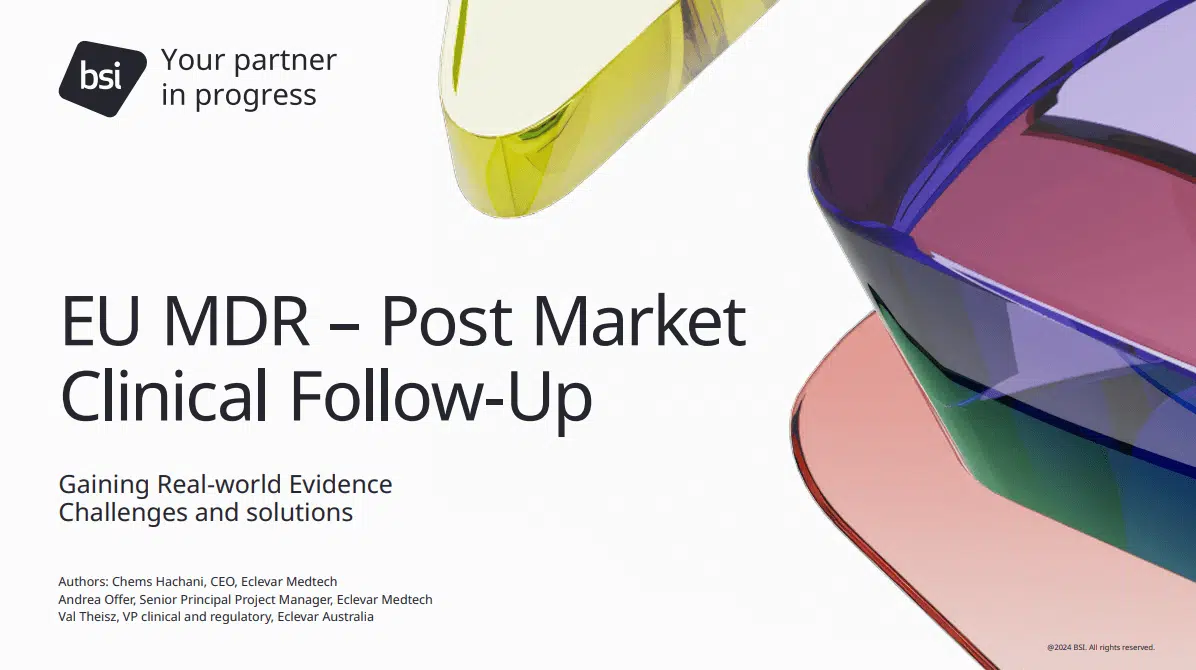
Whitepaper · BSI x Eclevar
Written with the notified body BSI: a practical look at what clinical evidence has to show under EU MDR 2017/745, and at the quality bar the data have to clear. It is the same bar a European dataset meets before it is put in front of any reviewer.
PMCF studies · Regenerative medicine · 5 EU countries
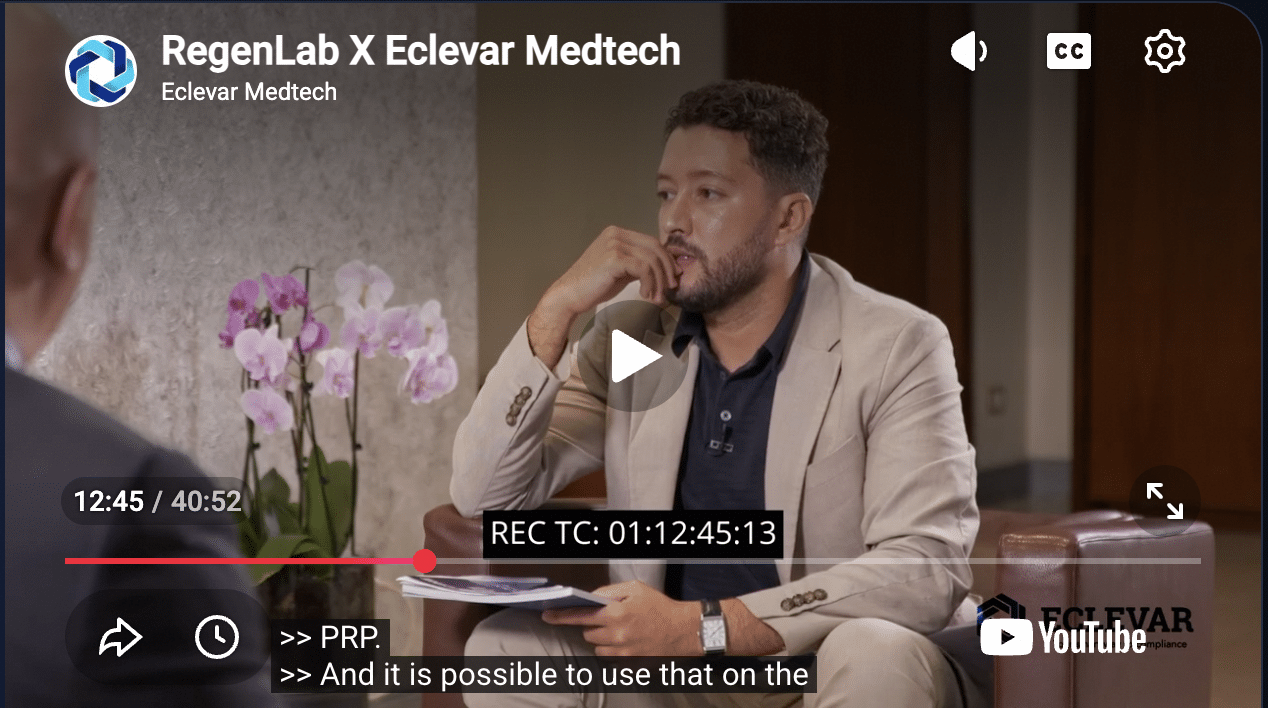
Eclevar runs RegenLab's PMCF program on chronic wound products. It is a randomized study of 160 subjects across 14 centers in 5 EU countries, covering both diabetic foot ulcer and venous leg ulcer. The partnership combines Eclevar's ISO 14155 expertise with the Milo Studio platform, from study design through to the final study report.
« Eclevar, with its tailored approach and the advanced Milo Studio platform, represents a significant strategic advantage. »Antoine Turzi, CEO, RegenLab
Coming soon. Breakthrough Device Technology under the EU MDR, a whitepaper written with TÜV SÜD, co-authored by Dr Nikhil Khadabadi.
Next step
The initial discussion establishes whether a strategy review is justified, what it would cover, and which functions need to participate. If it is not justified yet, we will say what to resolve first.
Please do not send confidential technical documentation through the general contact form. Document-sharing arrangements can be agreed after the initial discussion.