A guide for US sponsors: what a defensible European orthopedic or spine study depends on, from surgeon selection and learning curves to imaging, patient-reported outcomes, rehabilitation, and the intended FDA and EU MDR uses of the data.
Expert reviewed by

CMO & Head of Orthopedics & Spine
Practicing orthopedic surgeon with senior clinical review experience within a European Notified Body and investigator experience in a multicenter surgical robotics trial.
Publication
Platinum Award, xShare Clinical Research Open Call 2026
Eclevar MedTech and MILO received the Platinum Award through the xShare Clinical Research Open Call, organized by EUCROF and co-funded by the European Union.
Europe may provide relevant surgeons, centers, imaging, patient populations, and registry infrastructure for orthopedic and spine device studies. Whether it should host your study depends on factors you must control by design: technique standardization, surgeon qualification, learning effects, traceability, rehabilitation pathways, imaging, patient-reported outcomes, and long-term follow-up. Europe is a candidate geography, to be assessed against your device, your procedure, your intended US use, and your regulatory plan.
None of these is a default. The right model is a function of the device, the procedure, and the intended regulatory use, not a geographic preference; Eclevar designs both Europe-led and hybrid orthopedic studies and integrates either with the sponsor's intended FDA pathway.
European centers can host most stages of orthopedic and spine clinical development. Fit depends on device maturity, the decision the study must inform, and where the evidence will be used; a further feasibility step, or US-style early feasibility design, is one of these stages, not a separate track.
This is not a mandatory sequence: a program may enter at pivotal or post-market stage, and not every device passes through all four. Early clinical use, including US-style early feasibility designs, is covered in our guide to early feasibility studies.
Which surgical specialty does the procedure require?
Subspecialty, not just the broad category.
How much relevant procedural experience is needed?
Count the specific operation, not the broad category.
Is the technique standardized and trainable?
Written down, not left to individual habit.
How will surgeon learning be documented?
Across the case sequence, per surgeon.
What imaging is required, and when?
Baseline, postoperatively, and through follow-up.
What rehabilitation pathway will patients follow?
And how it affects the outcomes you measure.
Which patient-reported outcomes are relevant?
With validated instruments available in each study language.
How will implants and instruments be traced?
Down to size, lot, and configuration.
Can the site complete long-term follow-up?
Including revision capture years after surgery.
Does local practice reflect the intended US use?
Closely enough for the data to transfer; one of the questions FDA may consider when assessing applicability.
Every measured orthopedic outcome is produced by a system, with the device as one contributor among several; study design exists to control, document, and where possible standardize the others.
Conceptual framework. These contributions cannot always be statistically separated; site qualification assesses each function against the protocol, with no scoring system implied.
The Orthopedic Outcome Is a Treatment-System Result
Six contributing domains that shape every measured outcome around the patient.
Selection is an assessment of fit between a specific operation, a specific protocol, and a specific team: subspecialty, exact procedure volume, comparable-implant experience, and willingness to report technical problems and deficiencies. A high-volume surgeon can still be an unsuitable investigator if technique varies case by case.
First cases with a new implant or instrument system behave differently from the fiftieth. For robotic and navigation systems, the learning curve extends beyond the surgeon's hands: setup time, registration, planning, and user-interface effects all belong in the dataset.
Imaging provides the objective spine of most orthopedic evidence: baseline imaging, defined acquisition standards, and follow-up capable of detecting migration, fusion, loosening, subsidence, or wear. Rehabilitation is part of the intervention, whether or not the protocol says so.
Orthopedic data architecture must trace every implant to the patient, including device version, and monitor PROM completeness, the most common quiet failure of long orthopedic studies. Analysis planning anticipates rehabilitation variation and site and surgeon effects.
Orthopedic evidence spans procedural success, revision and reoperation, complications, pain, function, quality of life, imaging, durability, and long-term implant survival. The discipline is selection: the endpoints that drive the next decision, defined precisely, measured with validated instruments, and followed long enough to mean something. Widely used patient-reported instruments include joint-specific scores and generic health-status instruments such as EQ-5D-5L, selected to match the device and claim.
Swipe sideways to view all columns.
| Endpoint domain | Study role | Key control |
|---|---|---|
| Procedural outcome | Feasibility and technical performance | Standardized definition and operative record |
| Revision/reoperation | Safety and durability | Clear event definitions and follow-up |
| Pain | Patient benefit | Validated scale and consistent timing |
| Function | Clinical benefit | Validated instrument and rehabilitation context |
| Imaging | Placement, healing, or durability | Acquisition protocol and controlled review |
| Device deficiency | Product and procedure learning | Traceability and rapid escalation |
| Quality of life | Broader patient impact | Validated instrument and interpretation plan |
Orthopedic evidence accrues over years, and each stage draws on specific data sources; the pipeline must be designed before the first operation.
| Dimension | Europe-led | Hybrid US-Europe |
|---|---|---|
| Investigator / site access | European surgical expertise and patients accessible for the specific operation | Selected US sites added where applicability to US practice must be demonstrated |
| Population & standard of care | Care pathways and rehabilitation reflect European practice | Regional cohorts separated where pathways differ too much to pool |
| FDA & commercial market | Serves a European market objective with the same evidence | FDA feedback or US investigator adoption for launch argue for US sites |
When a US-led study may remain appropriate: when the intended use, technique, and rehabilitation are distinctly American in practice, a US-only program may serve the evidence question better than either European option. Eclevar designs both Europe-led and hybrid orthopedic studies and integrates either model with the sponsor's intended FDA pathway.
 JRI Orthopaedics
Two-part clinical investigation program for the JRI Orthopaedics ceramic hip resurfacing system. Eclevar designed the clinical investigation architecture of a two-part pre-market program: an initial part addressing early safety and performance, and a second part addressing long-term clinical performance.
Eclevar's contribution:
This is a pre-market clinical investigation program, not a US IDE or FDA study, and Eclevar did not sponsor it or conduct all of its operations. No clinical outcomes or regulatory decisions are reported, and no endorsement by JRI Orthopaedics is implied.
The manufacturer name, logo and product image are shown solely to identify the program described. Their display does not imply endorsement of Eclevar MedTech.

Practicing Orthopedic Surgeon
Dr. Nikhil Khadabadi, CMO & Head of Orthopedics & Spine, combines operative experience with former senior clinical review experience within a European Notified Body and investigator experience in a multicenter surgical robotics trial.
Around that physician leadership, orthopedic and spine programs are delivered by named functional leads:
Former positions are stated for biographical context only. Eclevar MedTech is independent of, and not endorsed by, any Notified Body, and no endorsement by any device manufacturer or robotics company is implied. Eclevar's European team works with Dawn Heimer's US clinical and FDA-interaction experience to keep European study design aligned with the sponsor's intended FDA pathway, while overall US regulatory strategy remains with the sponsor and its US advisors.
The Study Strategy Review provides a documented assessment of the clinical, operational, and regulatory decisions shaping your European program.
Official content
Whitepapers, client voices and publications produced by our own teams and by our partners: BSI, TÜV SÜD and RegenLab.

Whitepaper · BSI x Eclevar
Written with the notified body BSI: a practical look at what clinical evidence has to show under EU MDR 2017/745, and at the quality bar the data have to clear. It is the same bar a European dataset meets before it is put in front of any reviewer.
PMCF studies · Regenerative medicine · 5 EU countries
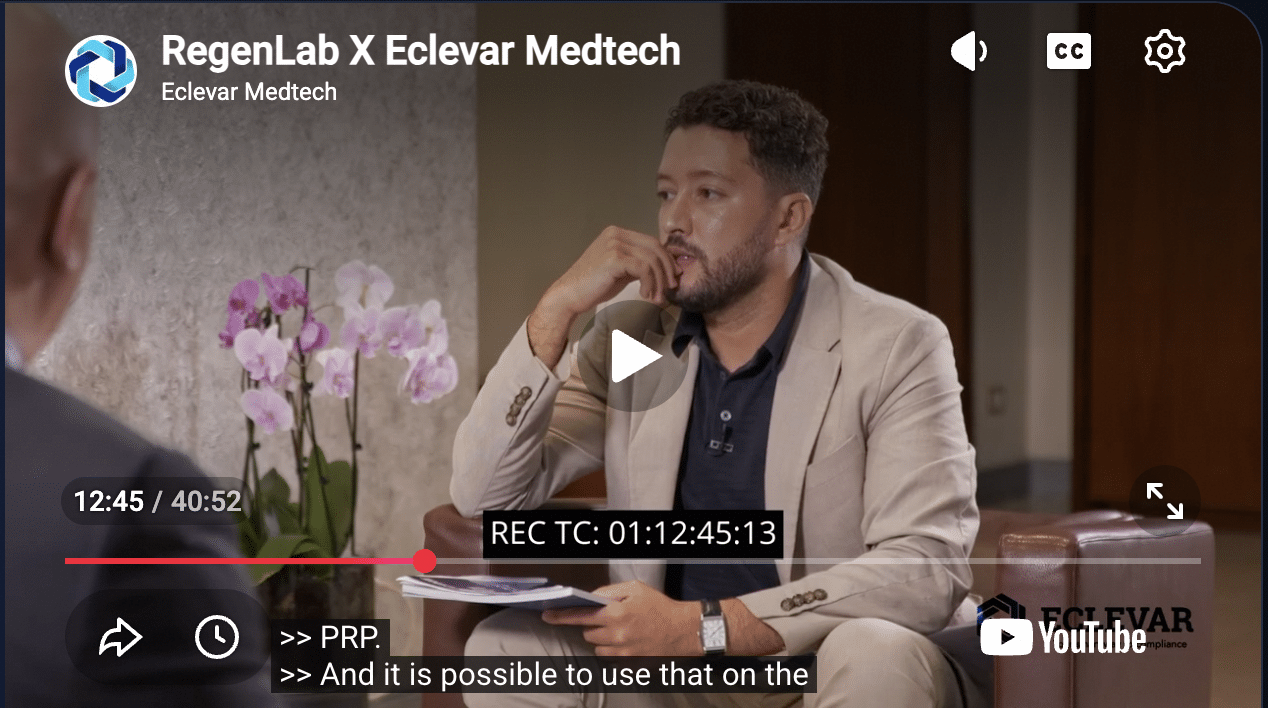
Eclevar runs RegenLab's PMCF program on chronic wound products. It is a randomized study of 160 subjects across 14 centers in 5 EU countries, covering both diabetic foot ulcer and venous leg ulcer. The partnership combines Eclevar's ISO 14155 expertise with the Milo Studio platform, from study design through to the final study report.
« Eclevar, with its tailored approach and the advanced Milo Studio platform, represents a significant strategic advantage. »Antoine Turzi, CEO, RegenLab
Coming soon. Breakthrough Device Technology under the EU MDR, a whitepaper written with TÜV SÜD, co-authored by Dr Nikhil Khadabadi.
Yes, across most stages of development, subject to competent authority and ethics approval under EU MDR. Whether it should be depends on surgeon access, technique standardization, rehabilitation comparability, and the intended use of the evidence.
European clinical data may support an FDA submission when the study is designed, conducted, and documented for its intended regulatory use; final acceptability remains subject to FDA review. The governing provisions include 21 CFR 812.28 and, for applications based solely on foreign data, 21 CFR 814.15. Conformity with ISO 14155:2026 does not by itself establish FDA acceptability.
When applicability to US practice, technique, or rehabilitation must be demonstrated inside the study, when FDA feedback points that way, or when US investigator adoption matters for launch, while European sites contribute surgeons, patients, or a European market objective.
Against the specific operation and protocol: subspecialty, exact procedure volume, comparable-implant experience, research discipline, imaging, rehabilitation resources, and realistic long-term follow-up, with commercial conflicts assessed openly.
Device and intended use, the procedure, target anatomy and population, development status, existing evidence, proposed endpoints, imaging and rehabilitation assumptions, surgeon relationships, intended FDA and European pathways, and the target timeline. That is the input set of the Study Strategy Review.
Yes. Eclevar supports surgical robotics and navigation studies, imaging workflows and central review coordination, monitoring, data management, biostatistics, safety support, and clinical investigation reporting, with submissions to authorities and ethics committees prepared in-house.