
DCT · ePRO · Remote
Decentralized clinical trials, without losing compliance.
Decentralized and hybrid trials bring the study to the patient, improving recruitment and retention. Done right, they do it without compromising ISO 14155 or GDPR.

European Champion
Platinum Award 2026
Eclevar MedTech & Milo Health · xShare × EUCROF Open Call
Led by authority
Decentralized, but audit-ready.
A DCT still has to survive a Notified Body audit. Ours are designed by data and clinical-operations specialists who keep the trail intact.

Sébastien Meier
Endpoints, statistics and RWE; architect of the MILO EDC, 21 CFR Part 11 and real-time dashboards.

Charline Petitdemange
ISO 14155 study conduct, EUDAMED registration and multi-country site monitoring across Europe.
Awards, funding, accountability
Europe’s best-rated medical device CRO.
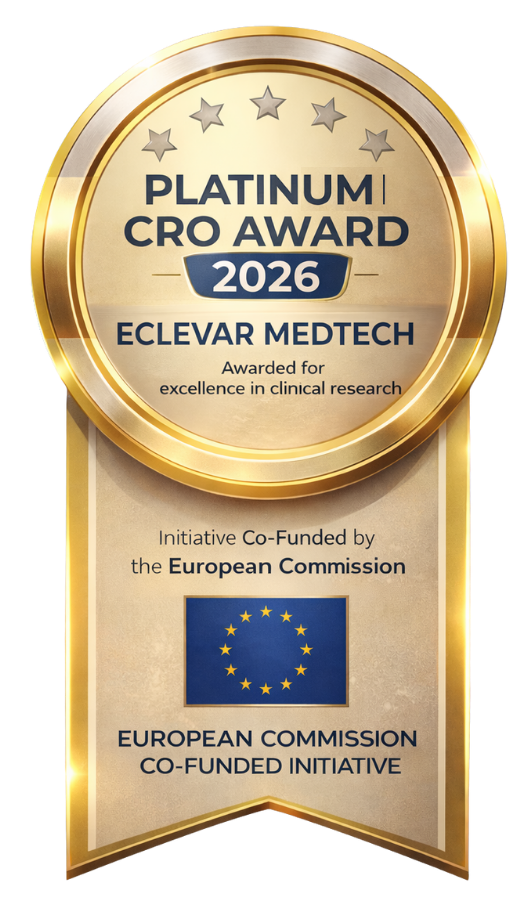
Platinum Award 2026
Top tier at the xShare × EUCROF Open Call, awarded to Eclevar MedTech and its Milo Health platform, presented at EUCROF 2026 in Amsterdam.
The announcement →Co-funded by the European Union
Selected through the xShare Open Call for clinical research innovation, Horizon Europe.
xShare results →Independently reported
Distinction confirmed by an independent third party, the CVBF, also an awardee of the xShare × EUCROF Open Call.
CVBF coverage →The approach
Bring the trial to the patient.
Decentralized and hybrid designs replace some or all site visits with remote and connected data capture, cutting the burden on patients and sites.
01
What a DCT actually changes
A decentralized clinical trial moves elements of a study out of the traditional site: remote or home visits, telemedicine assessments, direct-to-patient logistics and connected devices. A hybrid design keeps some site visits and decentralises the rest. The aim is less burden, better recruitment and stronger retention.
02
The technology stack
DCTs run on a small set of validated tools working together.
The stack
- eConsent for compliant, version-controlled informed consent
- ePRO for patient-reported outcomes on the patient’s own device
- Remote monitoring and connected devices for objective data
- A validated EDC drawing it all into one auditable record
03
Staying compliant
Decentralisation does not relax ISO 14155 or GDPR. Consent must still be traceable and re-consent handled on protocol amendments; data must be pseudonymised and hosted compliantly; and the audit trail must be complete end to end. The design has to bake compliance in, not bolt it on.
04
Where DCT wins
DCT is strongest for post-market studies, PMCF surveys and long-term follow-up, where site visits are the main barrier to retention. We match the degree of decentralisation to the endpoints, so objective measurements stay rigorous while everything else gets easier.
DCT at a glance
Less burden, same rigour.
Talk to a specialist
Could a decentralized design fix your recruitment?
Book a free scoping call. We tell you which parts of your study to decentralise, and how to keep the ISO 14155 and GDPR trail intact.
Book a free scoping callDecentralize the burden, not the compliance.
An expert read tells you which elements of your study can go remote, which endpoints must stay controlled, and how to keep it all audit-ready.
Book a free scoping callQuestions we hear first