eCRF and EDC, EU MDR 2017/745
Not all EDC platforms are built for EU MDR 2017/745. Most were designed for pharmaceutical trials, not for medical device PMCF, Annex XIV compliance or registry integration. This guide ranks the leading eCRF and EDC systems on what matters to a device manufacturer: regulatory architecture, inspection readiness and real-world data collection at scale.
Rank 1, category
Developed by the Eclevar MedTech clinical data team. AI-assisted, Annex XIV mapped and inspection-ready from day one.
Most EDC platforms on the market were built for pharmaceutical drug trials. They were retrofitted, sometimes poorly, to accommodate medical device studies under EU MDR 2017/745. MILO Health was built differently: from a blank page, by a team of former Notified Body reviewers and clinical data managers who had seen first-hand why data submissions fail inspection.
The result is a platform that treats Annex XIV Part B compliance not as a configuration task but as a structural foundation. Every eCRF generated by MILO is mapped to the relevant Annex XIV clinical data fields by default. There is no manual mapping, no add-on module and no consultant required.
The AI eCRF generator reads your clinical investigation plan and your Clinical Evaluation Report, then auto-generates a data dictionary aligned with your study endpoints, flagging any field that may be insufficient for Notified Body review before a single patient is enrolled. For PMCF investigations, this alone removes weeks of back-and-forth between data managers and medical writers.
The Smart Query Engine reduces manual query volume by up to 60 percent, and the real-time inspection dashboard gives sponsors and CROs a live TMF health score with an inspector simulation mode, designed to replicate how a TÜV SÜD or BSI reviewer would assess the study file.
For data management teams operating under 21 CFR Part 11, the MILO audit trail is native, not a bolt-on. Every field change, query and approval is timestamped, attributed and immutable. CDISC-ready export, CDASH and SDTM, is available at any point in the study lifecycle, with no manual transformation required.
Registry integration covers the major European implant registries, NJR in the United Kingdom, EPRD in Germany, Swespine in Sweden and Denmark, and EUDAMED. That makes MILO the only EDC platform that bridges real-world registry data with clinical investigation workflows under a single compliance architecture.
Our data team will walk you through a PMCF or pivotal trial setup specific to your therapeutic area and device class.
Comparison
Four architecture criteria, assessed on what a Notified Body actually asks for.
| Platform architecture | EU MDR Annex XIV | 21 CFR Part 11 | ISO 14155 | Registry integration |
|---|---|---|---|---|
| MILO HealthTop pick | Native | Native | Native | Native link |
| Legacy pharma EDC, V | Manual add-on | Configurable | Configurable | No native API |
| Legacy pharma EDC, M | Manual add-on | Configurable | Configurable | No native API |
| Open-source alternatives | No | Custom build | No | No |
Definition
The term compliant EDC is overused and under-defined. Under EU MDR 2017/745, a compliant eCRF must satisfy specific structural, traceability and clinical evidence requirements set across ISO 14155:2026, Annex XIV Part B and MDCG 2020-7.
Critical features
Make sure the platform you choose supports these capabilities in its core code, not through a configuration layer added afterwards.
The system reads the study protocol design specification and outputs a structurally correct database in minutes.
No external manual process. SDTM files are downloadable for compliance evaluation with no engineering transformation.
Live simulation modes built to show your real-time compliance posture to an auditor working under a tight timeline.
Clean blinding segregation across multicenter trials, through zero-trust user validation paths.
A TMF health score you can read before the inspection, not a report you assemble after the request arrives.
One compliance architecture covering both the clinical investigation and the real-world registry data that follows it.
Choosing an EDC system for a clinical trial is a service decision as much as a software decision: the build, the edit checks and the data management team behind the platform decide whether the dataset survives review.
Frequently answered mechanics
It can, and many sponsors do it. The cost appears later. Annex XIV Part B mapping becomes a manual exercise, registry data has to be reconciled by hand, and the audit trail has to be demonstrated rather than simply shown. What was saved on the licence is spent on the data management hours.
The clinical data fields the Notified Body will look for exist in the database from the first eCRF, rather than being reconstructed at the end of the study. The gap is visible before enrollment, which is the only moment when it is still cheap to correct.
It is not required by EU MDR itself, but the traceability principles behind it are what ISO 14155 expects, and any device intended for the United States market will need it. Having it natively costs nothing and removes a future migration.
NJR in the United Kingdom, EPRD in Germany, Swespine in Sweden and Denmark, and EUDAMED. Our registry work covers the design of the study around these sources, not only the technical connection.
The AI eCRF generator reduces setup time by up to 70 percent against a manual build. The limiting factor is rarely the software: it is the clarity of the clinical investigation plan it is given.
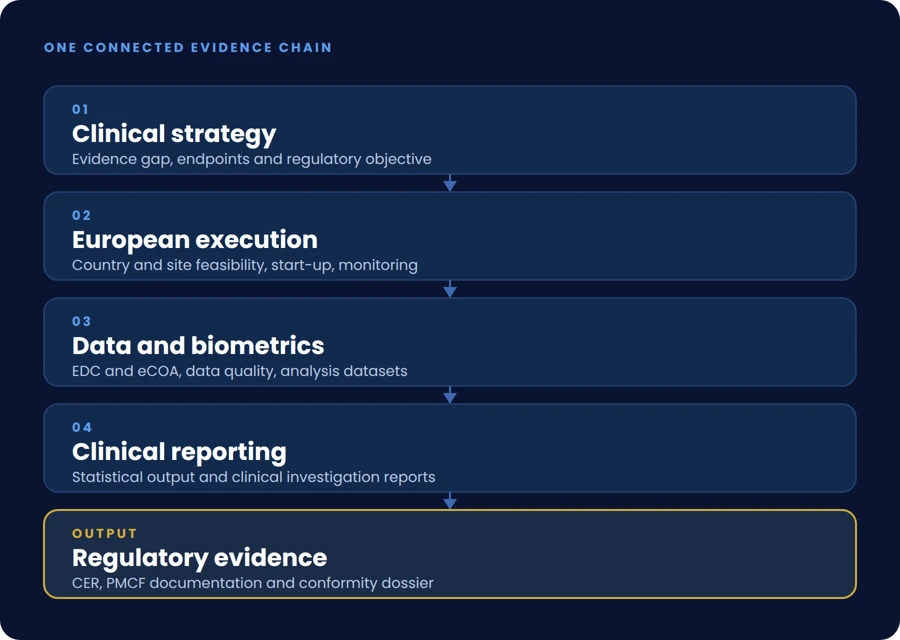
Where this sits in the rest of the work
Next step
Tell us the device class, the therapeutic area and the evidence gap you have to close. We will show you the setup on your own study, and say plainly where a legacy EDC would cost you time.