FDA Early Feasibility Studies | Structural Heart Devices
Structural Heart Early Feasibility Study CRO
Build the clinical, imaging, site, safety, and data architecture required for the controlled early evaluation of a novel structural heart device in the United States.
As a specialist medical device CRO, ECLEVAR combines cardiovascular physician leadership, FDA clinical strategy support, program-specific US site and monitoring resources, imaging, data, safety governance, and planning for the next evidence milestone.
Former Notified Body cardiovascular review leadership
Named US FDA and EFS advisor
Structural heart site and imaging strategy
Integrated data, quality, and safety governance
The five domains that decide whether an early case can be run under control, and interpreted afterward.
Section 01 | What makes it different
Why a structural heart EFS is different
Early structural heart cases often carry disproportionate learning and operational risk. Their value depends on how patient selection, imaging, procedure, safety governance, and data review are designed to work together before enrollment begins.
Treating these dimensions as separate workstreams can make early findings harder to interpret. ECLEVAR plans them as one connected system under program governance.
Patient and anatomical selection
Eligibility may depend on disease severity, anatomy, prior intervention, surgical risk, comorbidities, imaging, and the alternative treatment realistically available to that patient.
Device and procedure
Early outcomes may reflect device design, access, sizing, positioning, deployment, retrieval, repositioning, operator technique, or anatomy.
Imaging
Imaging may determine eligibility, procedural planning, device sizing, procedural guidance, and follow-up assessment.
Operator and site readiness
The first cases may be influenced by training, proctoring, case sequence, site experience, and device-specific learning.
Safety, data, and cohort review
Safety planning establishes predefined review and escalation pathways across the investigator, sponsor, medical monitor, safety committee, regulatory team, and device-development team.
Section 02 | Start here
Structural Heart EFS Readiness and Site Strategy Workshop
A working session that turns a device and an intention into a testable early clinical plan, with the site, imaging, and data model behind it.
Stage-gated EFS method and device-specific decisions
Six stages, each ending in a documented decision gate. The sponsor retains decision authority at each gate, and the work is scoped to the individual technology: transcatheter aortic, mitral, tricuspid, and pulmonary valve systems, left atrial appendage closure, septal, shunt, and structural closure devices, annuloplasty and remodeling systems, delivery, access, and embolic-protection technologies, and other novel implantable structural heart systems.
The clinical strategy, endpoints, imaging, risk controls, and site profile must be adapted to the individual device. A generic valve-study template is not sufficient.
For a significant-risk structural heart device, enrollment must not begin until the sponsor has an FDA-approved IDE and each participating site has IRB approval. The sponsor remains the IDE applicant and retains regulatory accountability. ECLEVAR supports clinical strategy, protocol architecture, operational planning, and the FDA interface only within the agreed scope and alongside the sponsor's designated FDA regulatory lead.
Five layers designed against one another, resolving to controlled early clinical use
1
Device and evidence readiness
ECLEVAR assesses intended use, development stage, nonclinical testing, risk analysis, prior clinical use, and the device changes still anticipated, against what an early cohort can realistically resolve.
Decision gateIs the remaining uncertainty appropriate for controlled early clinical use? Work product: Structural Heart EFS Readiness Map.
2
FDA Pre-Submission and IDE clinical strategy
ECLEVAR assesses the clinical rationale, proposed population, risk mitigations, and study synopsis, so that the questions submitted to FDA focus on decisions that could materially affect the study design, risk controls, or evidence plan.
Decision gateWhich questions go to FDA, and what position does the sponsor take on each? Work product: EFS Pre-Submission and IDE clinical strategy.
3
Protocol, population, anatomy, and endpoints
ECLEVAR assesses objectives, eligibility, anatomical criteria, endpoints, follow-up, staged enrollment, stopping rules, and device accountability, written so an early finding can be traced to a cause.
Decision gateWhich patients, which anatomy, and which measurements? Work product: protocol and endpoint architecture.
4
Investigator, site, training, and proctoring readiness
ECLEVAR assesses candidate centers against the procedure and the anatomy, then the training, proctoring, and escalation model that will support their first cases.
Decision gateWhich operators and centers, supported how? Work product: Site and Investigator Qualification Scorecard.
5
Imaging, data, safety, and first-patient readiness
ECLEVAR assesses the imaging charter, data capture, reconciliation, and safety escalation together, then verifies readiness item by item before the first case is scheduled.
Decision gateWhat must be true before the first case? Work product: First-Patient Readiness Dossier.
6
Study conduct, cohort review, and next-study decision
ECLEVAR assesses safety, imaging, procedural observations, device deficiencies, and deviations at each review point, and any proposed change is routed through the applicable FDA and IRB pathway before implementation.
Decision gateWhat evidence has the study produced, and what does the next study need? Work product: cohort review and EFS-to-pivotal decision pack.
Procedure volume tells you what a center does routinely. It does not show whether patients with the required anatomy, the heart team, imaging capability, and research bandwidth are available at the same time.
Each dimension is assessed separately: a center may qualify on infrastructure and still be the wrong first site for a technology.
Qualification dimensions assessed for every candidate structural heart center.
Qualification dimension
What ECLEVAR assesses
Patient access
Eligible anatomy and indication, not only general disease prevalence
Investigator fit
Experience with the relevant procedure, access route, imaging, and device type
Heart team
Interventional cardiology, cardiac surgery, imaging, anesthesia, nursing, and research coordination
Infrastructure
Cath lab or hybrid room, imaging, ICU, emergency and surgical resources where applicable
Research delivery
Start-up capacity, documentation, data quality, monitoring responsiveness
Early-case governance
Training, proctoring, staged enrollment, rapid review and escalation
Ability to retain patients and complete imaging and clinical assessments
Site readiness: the functions that must be available together, in the same institution, for the same patient pathway. Interventional cardiology brings device and access experience, cardiac surgery provides rescue capability where relevant, imaging covers echocardiography and computed tomography, and monitoring carries escalation and reconciliation.
Imaging is part of eligibility, procedure, and evidence
Imaging frequently decides who is eligible, how the procedure is planned, and what the follow-up data are worth. The modalities and their role depend on the device.
Computed tomography may support anatomical screening, sizing, access planning, and anatomical characterization.
Transesophageal or transthoracic echocardiography may support selection, procedural guidance, and follow-up.
Fluoroscopy and angiography may document procedural and device-positioning information.
An imaging core laboratory or independent review may improve consistency where the study question requires it.
Acquisition quality must be planned and tested before site activation, because inconsistent images cannot be reconciled afterward.
Site qualification informs a shortlist. Enrollment depends on patient presentation, institutional review, contracting, and clinical judgment at each center, and enrollment pace is an outcome rather than a commitment.
Section 05 | Endpoints and safety
Endpoints, safety, and sequential review
An early dataset is small, closely observed, and influenced by case sequence. Endpoint families are selected so device behavior stays distinguishable from operator and site learning, and so serious events have predefined review and escalation pathways.
Endpoint families
Procedure and device success
Delivery, deployment, retrieval, or repositioning performance
Acute device function
Mortality, serious clinical events, and neurological events
Bleeding and vascular complications
Conduction disturbance and pacemaker implantation where relevant
Device migration, embolization, thrombosis, malfunction, or deficiency
Residual regurgitation, shunt, gradient, or hemodynamic measures where relevant
Rehospitalization, reintervention, functional status, and quality of life where informative
Imaging-derived performance and longer-term function planning
Endpoint definitions follow the device, indication, development stage, and applicable consensus or regulatory expectations. No single endpoint framework applies to every structural heart device.
Governance that may be required
Independent medical monitor
Data and Safety Monitoring Board (DSMB) or Data Monitoring Committee (DMC)
Clinical Events Committee
Independent imaging review
Staged or paused enrollment and predefined stopping rules
Immediate review of serious events and device-deficiency escalation
Cohort-review meetings and reporting workflows
These structures are not required in every study. Their use depends on the device, risk profile, protocol, and applicable FDA and IRB requirements. The sponsor retains responsibility for study governance and decisions to modify the device or protocol; investigators remain responsible for patient care and site reporting; independent bodies review or adjudicate where established by the protocol; and ECLEVAR coordinates the monitoring, escalation, and cohort-review activities included in the contracted scope.
Section 06 | The next evidence decision
EFS-to-pivotal or transatlantic transition
An EFS is worth what the next study can do with it. Each case is documented against the assumptions a later protocol relies on.
What early data can inform
Population refinement
Device configuration
Procedure standardization
Training model
Endpoint selection
Imaging charter
Site profile
Safety assumptions
Sample-size assumptions
Follow-up and pivotal operational model
Four routes out of an EFS
Additional or traditional feasibility work
A US pivotal IDE study
A European confirmatory clinical investigation
A coordinated US-European program
Data generated in one jurisdiction are not automatically accepted in the other. Each route is planned against the requirements that apply to it. See EFS to Pivotal Medical Device Study.
Official content
Our content, signed by Eclevar
Whitepapers, client voices and publications produced by our own teams and by our partners: BSI, TÜV SÜD and RegenLab.
Whitepaper · BSI x Eclevar
A whitepaper by BSI and Eclevar on the EU MDR
Written with the notified body BSI: a practical look at what clinical evidence has to show under EU MDR 2017/745, and at the quality bar the data have to clear. It is the same bar a European dataset meets before it is put in front of any reviewer.
PMCF studies · Regenerative medicine · 5 EU countries
A client voice on Eclevar's ability to run complex studies
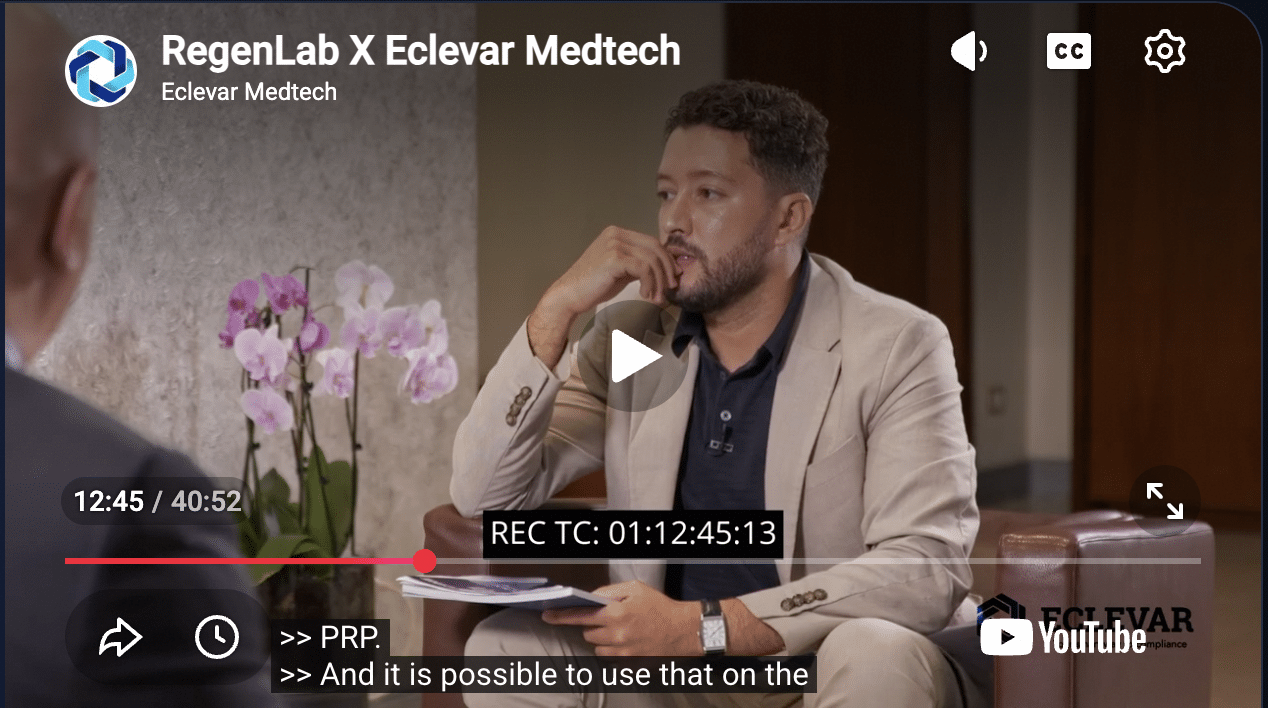
Eclevar runs RegenLab's PMCF program on chronic wound products. It is a randomized study of 160 subjects across 14 centers in 5 EU countries, covering both diabetic foot ulcer and venous leg ulcer. The partnership combines Eclevar's ISO 14155 expertise with the Milo Studio platform, from study design through to the final study report.
« Eclevar, with its tailored approach and the advanced Milo Studio platform, represents a significant strategic advantage. »Antoine Turzi, CEO, RegenLab
Structural heart clinical leadership is supported by named contributors in FDA clinical strategy, data governance, and quality. The contracted team is confirmed for each device and program.
Dr Mark Da Costa
Chief Operating Officer and Head of Cardiovascular, Senior Consultant Surgeon
Mark leads the cardiovascular and structural heart practice, combining 25 years of Consultant Cardiac Surgery experience with first-hand senior leadership experience in Notified Body clinical review. During his previous career as a Notified Body clinical reviewer, he assessed more than 400 cardiovascular devices.
In the EFS: benefit-risk framing, clinical plausibility, patient and anatomical selection, structural heart clinical strategy, and senior medical input during cohort review. Leadership
Dawn Heimer
Strategic Clinical Advisor, United States
Dawn advises medical-device sponsors on FDA clinical engagement and the transition from early feasibility learning to the next clinical-development stage. Her experience includes planning and executing approximately 15 FDA Pre-Submission and Q-Submission interactions and managing an Early Feasibility Study over the past three years. She contributes to ECLEVAR programs when included in the contracted advisory scope.
Sébastien Meier Piantanida
Chief Data Officer
Sébastien leads the data architecture, case report form design, and reconciliation of imaging, safety, and adjudication data within the clinical database.
In the EFS: data model, capture design, and cohort-review data traceability. Clinical data management
Jimmy Andrew Hayek
Head of Quality and Compliance
Jimmy provides quality oversight of study documentation, device-accountability records, deviations, and documentation traceability.
In the EFS: first-patient and cohort-review quality controls.
Program-specific interventional, imaging, FDA regulatory, US project management, monitoring, and biostatistics resources are confirmed in the proposal and contract according to the device and agreed scope. The sponsor remains the IDE applicant and retains regulatory accountability through its designated FDA regulatory lead.
What is a structural heart EFS, and is it always first-in-human?
It is a limited clinical investigation of a structural heart device early in development, typically enrolling a small number of subjects to evaluate the design concept with respect to initial clinical safety and device functionality, and its findings may guide device modifications. It is not automatically a first-in-human study: the device may already have been used clinically outside the United States, or in a different configuration or indication.
Why are specialized sites required?
Because the procedure, the imaging, and the rescue capability all have to exist in one institution for the same patient. The center needs interventional and imaging expertise for that anatomy, a functioning heart team, appropriate procedural facilities, critical-care support, and the research capacity to document early cases in detail. Few centers hold all of that for every technology.
What imaging or independent-review capabilities may be required?
It depends on the device. Computed tomography may support screening, sizing, and access planning; echocardiography may support selection, procedural guidance, and follow-up; fluoroscopy and angiography may document procedural information. An imaging core laboratory or independent review may improve consistency where the study question requires it, and acquisition standards are defined and tested before site activation.
Can ECLEVAR support the clinical content of an FDA Pre-Submission and IDE?
Yes. ECLEVAR prepares the clinical strategy, the study synopsis, the population and endpoint rationale, the risk mitigations, and the clinical content of the package. The sponsor remains the IDE applicant and retains regulatory accountability. ECLEVAR supports clinical strategy, protocol architecture, operational planning, and the FDA interface only within the agreed scope and alongside the sponsor's designated FDA regulatory lead.
Can ECLEVAR support US monitoring?
ECLEVAR can support US monitoring through a program-specific team confirmed before contract signature. The proposal identifies the US project lead, CRA coverage, monitoring model, first-case presence, device-accountability controls, and escalation pathway. Early-study monitoring is designed around first-case observation, rapid data review, and predefined escalation rather than routine periodic visits alone.
Can a US EFS inform a later European confirmatory clinical investigation?
It can inform one. Early data may refine the population, endpoints, imaging charter, site profile, and safety assumptions that a European confirmatory clinical investigation would rely on. It does not create automatic acceptance. A European confirmatory clinical investigation is authorized under the EU MDR and applicable national procedures, and the applicability of earlier data is assessed on its own merits.
Related pages
FDA IDE Clinical Study CRO
FDA Pre-Submission Strategy for EFS and IDE Studies
References reviewed on 8 August 2026. Device-specific decisions should be confirmed against current FDA guidance and the facts of the individual program.