
AI · Real-world data
AI on real-world data, promise and the fine print.
AI can find signals in real-world data that manual analysis misses, but only if the data and the method hold up. Here is what medical device teams need to know before they rely on it.

European Champion
Platinum Award 2026
Eclevar MedTech & Milo Health · xShare × EUCROF Open Call
Led by authority
AI with a scientific spine.
AI on weak data produces confident nonsense. We keep the method, and the caution, that make the output trustworthy.

Sébastien Meier
Endpoints, statistics and RWE; architect of the MILO EDC, 21 CFR Part 11 and real-time dashboards.

Dr Mark Da Costa
Cardiac surgeon and former lead Notified Body reviewer at TÜV SÜD. 400+ devices CE-certified.
in LinkedInAwards, funding, accountability
Europe’s best-rated medical device CRO.
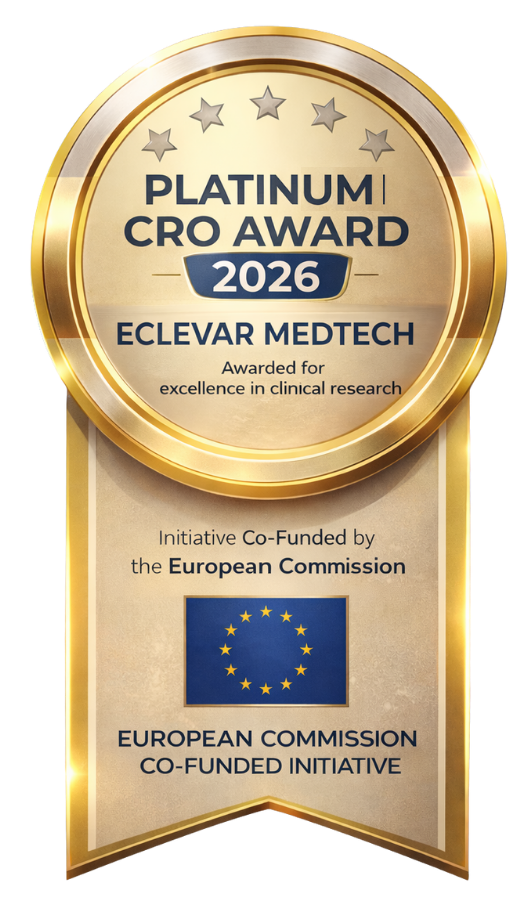
Platinum Award 2026
Top tier at the xShare × EUCROF Open Call, awarded to Eclevar MedTech and its Milo Health platform, presented at EUCROF 2026 in Amsterdam.
The announcement →Co-funded by the European Union
Selected through the xShare Open Call for clinical research innovation, Horizon Europe.
xShare results →Independently reported
Distinction confirmed by an independent third party, the CVBF, also an awardee of the xShare × EUCROF Open Call.
CVBF coverage →The reality
What AI can, and cannot, do with real-world data.
AI can accelerate pattern-finding and signal detection across large real-world datasets. What it cannot do is fix poor data or remove the need for validation and human judgment.
01
Where AI genuinely helps
Applied to large real-world datasets, AI can surface patterns, flag potential safety signals and structure unstructured records faster than manual review. For post-market surveillance and real-world evidence, that speed can be a real advantage, when the inputs are sound.
02
The prerequisites teams underestimate
AI amplifies whatever it is fed, including the flaws.
Before you trust the output
- Data quality and provenance you can defend
- Representative data, so bias is understood not hidden
- Validation of the model against known outcomes
- Transparency: being able to explain how a result was reached
03
The regulatory context
Real-world data used for regulatory purposes still has to meet GDPR and evidentiary standards, and if an AI tool itself influences clinical decisions it may fall under medical-device software rules. Using AI to help build evidence is different from placing an AI device on the market, and the two should not be conflated.
04
How Milo helps, responsibly
Eclevar’s Milo platform applies AI to real-world data within a governed, validated pipeline, so speed does not come at the cost of traceability. The principle is simple: AI accelerates the analysis, but the evidence still rests on sound data and human oversight.
AI + RWD
Fast, but grounded.
Talk to a specialist
Thinking about applying AI to your real-world data?
Book a free scoping call. We tell you what your data and method need before AI results can be trusted, and how to keep it compliant.
Book a free scoping callAI on real-world data is only as good as the data underneath it.
An expert read checks whether your data and method can support AI-driven analysis, and how to apply it responsibly for real-world evidence and PMCF.
Book a free scoping callQuestions we hear first