EU MDR 2017/745 demands a different kind of CRO: one where the clinical evidence strategy is designed the way regulators expect to see it, from protocol version 1. Eclevar delivers clinical operations, medical writing and data management 100% in-house, with former Notified Body reviewers on the team.
 Platinum Award 2026
Top prize in the xShare x European CRO Federation "EHDS & Clinical Research" Open Call, awarded to Eclevar MedTech and its Milo Studio platform, presented at the EUCROF 2026 conference in Amsterdam.
Horizon Europe · Grant Agreement No. 101136734 · Amsterdam, 2 Feb 2026
Device leaders across cardiovascular, orthopaedics, wound care and more choose Eclevar. Read all client success stories.




A medical device CRO (contract research organisation) is a specialist partner that designs, runs and reports the clinical evidence a manufacturer needs to CE mark a device and keep it on the market.
Unlike a pharmaceutical CRO, which works to the ICH-GCP framework built for drugs, a medical device CRO operates under EU MDR 2017/745 and the device-specific standard ISO 14155, where endpoints are mapped to the General Safety and Performance Requirements and post-market follow-up is proactive rather than passive. It owns the full clinical investigation lifecycle: clinical strategy and gap analysis, study design and protocol, ethics committee and competent authority submissions, feasibility and site selection, patient recruitment, on-site and remote monitoring, clinical data management, medical writing (the clinical evaluation report and the clinical investigation report), and post-market clinical follow-up (PMCF).
For higher-risk Class IIb and Class III devices, that evidence must satisfy a Notified Body, so a device CRO also anticipates how assessors will read the file. In short, a medical device CRO turns a manufacturer's engineering and clinical intent into regulator-ready evidence, from first protocol to lifelong surveillance.
Manufacturers typically engage a device CRO at three moments: before a first submission, to design a defensible clinical strategy and avoid a costly Notified Body deficiency letter; during the MDR transition, to upgrade legacy evidence that no longer meets Annex XIV; and after CE marking, to run the ongoing PMCF that keeps a certificate valid. The earlier the CRO is involved, the fewer expensive reworks appear later, because endpoints, sample size and follow-up are set to the regulatory standard from day one.


Eclevar's model brings the regulatory perspective inside the CRO, eliminating the gap between what manufacturers submit and what assessors expect. Dr Mark DaCosta, COO and former TÜV SÜD reviewer, and Dr Nikhil Khadabadi, CMO for orthopaedics and spine and also a former TÜV SÜD senior reviewer, lead a team that designs clinical evidence exactly the way Notified Bodies expect to read it, from the first protocol version.
Under EU MDR, a device programme run on a pharma template is a programme built to fail inspection. The difference is structural, and it decides whether a Notified Body accepts your clinical evidence the first time.
Every franchise is led with dedicated senior attention and, where relevant, former Notified Body insight. We concentrate on higher-risk Class IIb and Class III devices, where the clinical evidence bar and PMCF obligations are highest.
From complex TAVI pivotal programmes to IIS conversion, clinical evidence aligned with Notified Body expectations for Class III structural heart devices.
Explore ↗EWMA collaboration, chronic wound endpoints and PMCF strategies for NPWT systems and bioengineered tissue substitutes, with deep KOL networks across the EU.
Explore ↗Led by former TÜV SÜD assessors: Class IIb / III implants, registry-based PMCF and Annex XIV compliance for joint reconstruction and fusion.
Explore ↗Class III active implantable devices face rigorous requirements. We build 10-year PMCF architectures with AIMD-specific methodology.
Explore ↗We also run dedicated programmes for vascular and interventional devices, from peripheral access to endovascular implants, with the same ISO 14155 and Annex XIV rigour.
One accountable team covers every stage of the clinical investigation lifecycle, so nothing is lost between a protocol, a monitoring visit and a Notified Body submission.
Pre and post-market trials under ISO 14155, from feasibility and site selection and study initiation through multi-country ethics submissions and on-site and remote monitoring.
The clinical evaluation report under MDCG 2020-6, PMCF Plans and SSCP, written by clinicians and reviewed by former Notified Body assessors.
100% in-house clinical data management and EDC: eCRF design, DMP and DVP, powered by MILO Studio, natively built for EU MDR.
Structured post-market clinical follow-up meeting MDCG 2020-7 Level 4 criteria, with validated questionnaires and MILO Studio capture.
National registry integration (NJR, EUDAMED) for long-term real world evidence and PMCF follow-up of implantable devices.
Regulatory affairs and clinical strategy for CE mark pathways and equivalence, backed by a quality management system certified to ISO 13485.
A European manufacturer of a Class III active implantable came to Eclevar after a Notified Body review flagged insufficient clinical evidence for its legacy CE certificate during the MDR transition. We began with a clinical evidence gap analysis against Annex XIV, then rebuilt the strategy: a focused pre-market clinical investigation under ISO 14155 to close the highest-risk performance and safety claims, paired with a registry-based PMCF plan designed to generate real world evidence over the full service life of the device.
Eclevar handled protocol design, competent authority and ethics submissions across three countries, in-house monitoring, and clinical data management on MILO Studio, then wrote the clinical evaluation report and PMCF plan the way former Notified Body reviewers know assessors expect to read them. The sponsor entered its Notified Body assessment with a coherent, defensible file and a follow-up architecture already running.
Outcome: a clear, evidence-led route to CE marking under EU MDR, with a PMCF engine feeding the next certificate cycle rather than starting from zero.
Former Notified Body reviewers from TÜV SÜD. We know what fails inspection and design programmes to avoid it.
Clinical ops, writing and data management. One point of accountability, no handoff fragmentation.
Proprietary EDC built natively for EU MDR, with Annex XIV mapping and AI eCRF generation.
Paris, London, Tokyo and Pune. In-house CRAs in seven countries, not a network of subcontractors.
Platinum Award winner, EUCROF 2026, ranked first for clinical innovation and data strategy.
ISO 13485 certified. Every programme structured for TMF completeness and Notified Body inspection readiness.
A network of employed CRAs and project leads, not subcontractors, gives sponsors consistent quality and one accountable team across the EU, the UK and Japan corridors.
Whitepapers, client testimonials and publications produced by our teams and partners (BSI, TÜV SÜD, RegenLab).
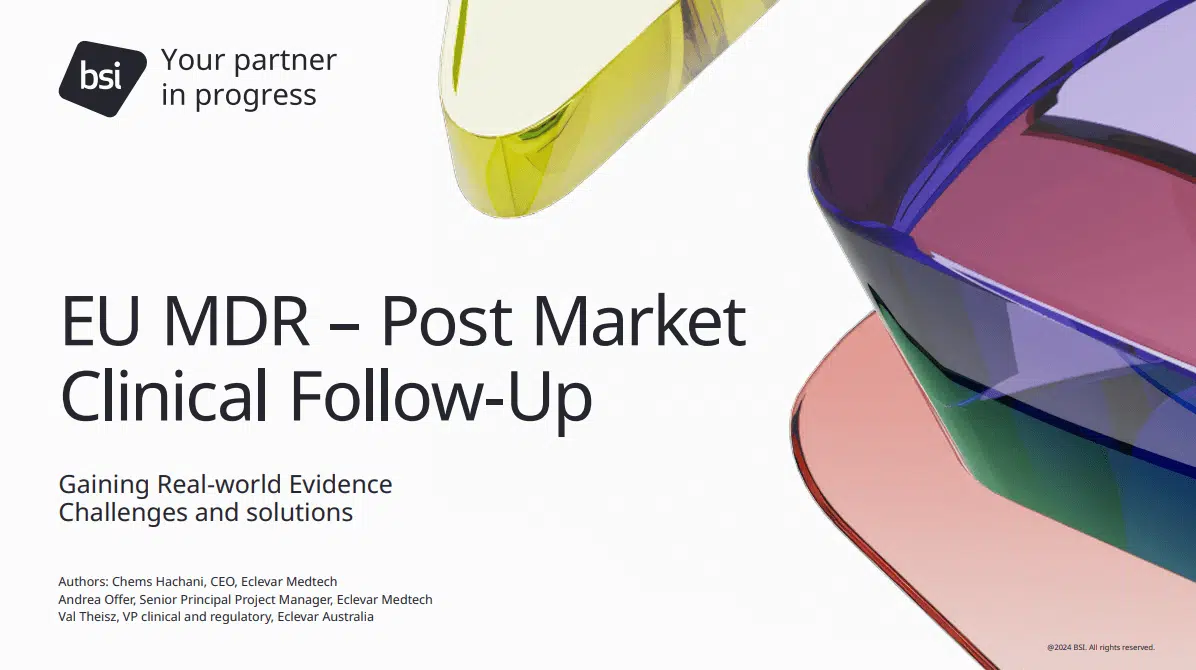
Written with Notified Body BSI: a practical reading of the clinical evidence expectations under EU MDR 2017/745, relevant to any high risk device programme.
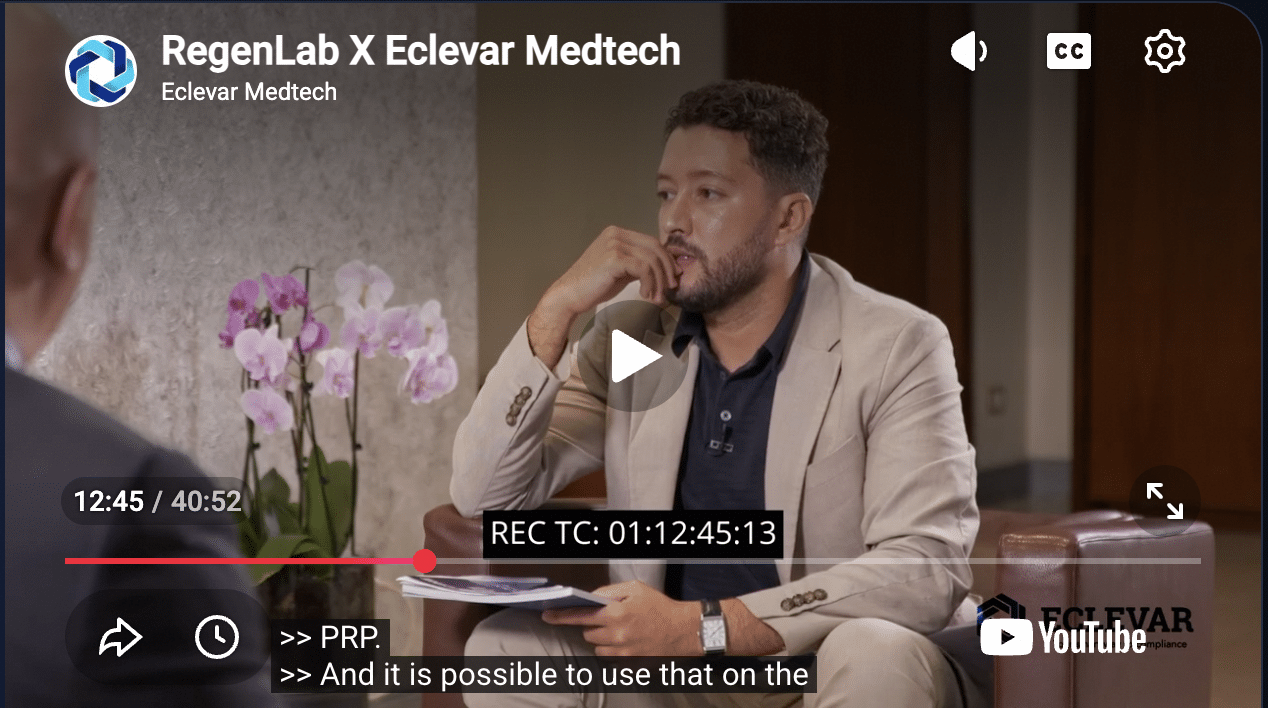
Eclevar manages RegenLab's PMCF programme on chronic wound devices. This is a randomized study of 160 patients across 14 sites in 5 EU countries, covering both diabetic foot ulcer (DFU) and venous leg ulcer (VLU) indications. The partnership combines Eclevar's ISO 14155 clinical expertise with the Milo Studio platform to deliver post-market clinical follow-up evidence that supports both Notified Body scrutiny and reimbursement endpoints, from protocol design through to final study report.
« Eclevar, with its tailor-made approach and advanced Milo Studio platform, represents a major strategic asset. »
A medical device CRO is a contract research organisation that plans, runs and reports the clinical investigations a manufacturer needs to CE mark a device and keep it compliant. It works under EU MDR 2017/745 and ISO 14155 rather than the pharma ICH-GCP framework, and covers the full lifecycle: clinical strategy, study design, ethics and competent authority submissions, site selection, recruitment, monitoring, data management, medical writing (CER and clinical investigation report) and post-market clinical follow-up.
It turns a device manufacturer's clinical intent into regulator-ready evidence. In practice that means designing the clinical evidence strategy, writing protocols and the clinical evaluation report, securing ethics and competent authority approvals, selecting and monitoring investigation sites, managing clinical data on a validated EDC, and running proactive PMCF so the evidence keeps supporting the CE certificate over the life of the device.
Qualify on device-specific capability, not headcount. Ask whether the CRO works natively to ISO 14155 and EU MDR rather than a pharma template, whether it has handled your device class and therapeutic area, whether clinical operations, medical writing and data management are in-house or subcontracted, whether it understands Notified Body expectations, and whether it can run registry-based PMCF. Eclevar meets all five, with former TÜV SÜD reviewers on the team.
Cost depends on device class, study design, the number of sites and countries, endpoint complexity and the length of post-market follow-up: a single-country PMCF survey sits at one end, a multi-country Class III pre-market investigation at the other. Eclevar scopes each programme to the minimum defensible evidence a Notified Body will accept, so budget is driven by regulatory need rather than a fixed catalogue. We provide a transparent, itemised proposal after a short scoping call.
A pharma CRO defaults to ICH-GCP and models built for drugs, and typically treats post-market work as passive Phase IV surveillance. A specialist medical device CRO works to ISO 14155, maps endpoints to the General Safety and Performance Requirements, handles operator-dependent variables and device learning curves, and runs proactive registry-based PMCF under Annex XIV. Running a device programme on a pharma template is a programme built to struggle at Notified Body review.
ISO 14155 is the international standard for the good clinical practice of clinical investigations of medical devices in human subjects, and it is the reference EU MDR expects device trials to follow. Eclevar designs every protocol, monitoring plan and data flow to ISO 14155 from version 1, with in-house CRAs, ISO 13485 certified quality processes and trial master file completeness structured for inspection readiness.
EU MDR 2017/745 requires manufacturers to demonstrate conformity with the General Safety and Performance Requirements through sufficient clinical evidence, documented in a clinical evaluation report under MDCG 2020-6, and to maintain that evidence through a post-market clinical follow-up plan under Annex XIV Part B and MDCG 2020-7. Higher-risk and implantable devices also need a Summary of Safety and Clinical Performance. Eclevar builds all of these as one connected evidence system.
Eclevar runs dedicated specialist practices in cardiovascular and structural heart, orthopaedics and spine, neuromodulation and neuro-implants, vascular and interventional devices, and advanced wound care, regenerative and aesthetic devices. We focus on higher-risk Class IIb and Class III devices, including active implantables, where Notified Body scrutiny and PMCF requirements are most demanding.
Clinical operations, medical writing and clinical data management are 100% in-house, giving one point of accountability and no handoff fragmentation, with in-house CRAs across seven countries rather than a network of subcontractors. Data is captured on MILO Studio, our EU MDR native platform recognised with the Platinum Award at the xShare and EUCROF 2026 Open Call.
Talk to our specialists about your device, your target markets and the fastest compliant route to Notified Body ready clinical evidence.
Book a consultationMedical device CRO by country: Medical Device CRO in France, Medical Device CRO in the UK, Spain and Europe.