From IDE clinical strategy and study planning through US site qualification, coordinated execution, data management, biostatistics, and reporting, with the next US or European evidence milestone considered from the outset.
An investigational device exemption (IDE) is the regulatory framework that permits an investigational device to be used in a clinical study. A significant risk (SR) study requires FDA approval of the IDE application and IRB approval before it begins. A nonsignificant risk (NSR) study follows abbreviated IDE requirements, with no IDE application to FDA.
ECLEVAR delivers the clinical side: strategy, protocol and endpoint work, US site qualification, start-up, monitoring coordination, safety workflow, data management, biostatistics and reporting.
Under the medical device IDE framework, the sponsor retains its regulatory responsibilities. ECLEVAR performs the contracted clinical, operational, data, and reporting activities under a documented responsibility and governance model.
Program-specific US regulatory and operational resources are confirmed during study scoping and documented before study activities begin.
Four situations bring sponsors to us, each changing what we do first.
You want FDA feedback before committing to a design. We help decide which questions are worth asking, and build the clinical content behind them.
The device and the plan exist. Clinical sections, risk analysis inputs and prior-investigation evidence still have to be assembled and kept consistent. We produce those inputs with your regulatory lead.
Nothing is enrolling yet. Contracts, IRB submissions, training, device accountability and monitoring setup have to land in the right order. We coordinate that sequence under a documented responsibility and governance model.
Enrollment is behind, data quality is drifting, or responsibilities were never assigned. We assess what is recoverable and rebuild oversight.
Medical device IDE study support runs from clinical strategy to final reporting. Scope is set per program, and not every activity below applies to every study.
Each stage closes on a decision and a document, not a status call. Site outreach does not begin until the device, the evidence base, the population, the procedure and the endpoints are understood.
| Stage | Decision to make | Deliverable | Senior owner | Risk avoided | Gate to the next stage |
|---|---|---|---|---|---|
| 1. Readiness and evidence review | Is the device ready for a US study, and at what stage? | Development-stage assessment, evidence gap list | Therapeutic physician lead, clinical operations | A study built on assumptions the data do not support | Stage, intended use and gaps agreed in writing |
| 2. Pre-Submission and IDE planning | Which questions belong in front of FDA? | Question strategy and clinical content for the package | Clinical strategy lead, with the sponsor's regulatory lead | An FDA interaction spent on questions that change nothing | Sponsor approves the question set |
| 3. Protocol, risk controls, and operational design | Can these endpoints be collected consistently at real sites? | Protocol inputs, endpoint rationale, risk analysis inputs | Therapeutic physician lead, biostatistics | A protocol defensible on paper, unworkable in the procedure room | Endpoints, visit burden and analysis assumptions aligned |
| 4. Investigator and site feasibility | Which sites have the patients, volume and capacity? | Site profile, feasibility report, investigator shortlist | US clinical project lead | Sites activated that cannot enroll the population | Shortlist accepted, enrollment assumptions documented |
| 5. FDA, IRB, and site start-up coordination | What is required before this study may begin? | Activation plan, IRB submission support, training and accountability workflow | Study start-up lead | FDA and IRB decisions treated as one; an unauthorized site started | Applicable authorizations documented per site |
| 6. Study conduct, monitoring, safety, and data oversight | Is the study producing usable data, and running as approved? | Monitoring plan and visit reports, safety escalation workflow | Clinical project lead, data management, quality | Late discovery of protocol drift or missing source data | Enrollment, deviations and data quality within thresholds |
| 7. Database lock, reporting, and next-study transition | What does this study support, and what still has to be shown? | Clean database, statistical outputs, clinical study report | Data and biostatistics lead, medical writing | A finished study that answers no decision the sponsor faces | Report accepted, next evidence step defined |
Decision to make. Is the device ready for a US study, and at what stage?
Senior owner. Therapeutic physician lead, clinical operations
Risk avoided. A study built on assumptions the data do not support
Decision to make. Which questions belong in front of FDA?
Senior owner. Clinical strategy lead, with the sponsor's regulatory lead
Risk avoided. An FDA interaction spent on questions that change nothing
Decision to make. Can these endpoints be collected consistently at real sites?
Senior owner. Therapeutic physician lead, biostatistics
Risk avoided. A protocol defensible on paper, unworkable in the procedure room
Decision to make. Which sites have the patients, volume and capacity?
Senior owner. US clinical project lead
Risk avoided. Sites activated that cannot enroll the population
Decision to make. What is required before this study may begin?
Senior owner. Study start-up lead
Risk avoided. FDA and IRB decisions treated as one; an unauthorized site started
Decision to make. Is the study producing usable data, and running as approved?
Senior owner. Clinical project lead, data management, quality
Risk avoided. Late discovery of protocol drift or missing source data
Decision to make. What does this study support, and what still has to be shown?
Senior owner. Data and biostatistics lead, medical writing
Risk avoided. A finished study that answers no decision the sponsor faces
Enrollment does not begin until all applicable authorizations are in place. For a significant risk study, FDA approval of the IDE application and IRB approval are two independent reviews; requirements depend on the SR or NSR determination.
Even scientifically sound studies can be delayed or weakened by preventable execution problems. Six recur, and each has a control that belongs earlier than sponsors expect.
Control. Feasibility findings go back into the protocol before it is finalized, so the design is tested against how the procedure is scheduled and staffed.
Control. Each endpoint is walked through its source, its timing and who records it. Equipment-dependent endpoints are addressed through protocol refinement, equipment planning, centralized assessment or site selection.
Control. Site selection uses documented procedure volume and a described referral route, not interest in the technology.
Control. Shipment, storage, use, return and reconciliation are defined with the training record before a site is activated.
Control. A written responsibility model names who decides, executes and escalates for each activity, including those the sponsor keeps.
Control. The next milestone is stated at design time, and the variables it needs are collected here.
An early feasibility or initial IDE study is rarely the last one. The next step may be a US pivotal study, a European pivotal clinical investigation, or a coordinated program across both. That choice changes what this study should collect: population, endpoints, follow-up duration and data standards.
Requirements remain specific to each jurisdiction. FDA approval does not imply European acceptance, and European authorization does not imply FDA acceptance. What can be planned in advance is the design, never the outcome of a review.
Related work: early feasibility studies, EFS-to-pivotal evidence planning, FDA Pre-Submission and EFS strategy, and structural heart early feasibility studies.
Each program is governed by senior medical, data, and quality leaders. The delivery model is then configured according to the device, therapeutic area, study stage, geography, and contracted scope.

Former Notified Body team leader and senior clinical reviewer · Cardiac surgeon
Mark leads cardiovascular and structural heart clinical strategy on IDE programs, combining 25 years of consultant cardiac surgery experience with first-hand senior leadership experience inside a Notified Body. He tests the study against the intended use, the claims, the population and the procedure before a site is approached.
Stages 1 and 3, and the relevant cardiovascular checkpoints. Leadership team

Stages 1 and 3, and the relevant orthopedic and spine checkpoints. Leadership team
Stages 3, 6 and 7, and the database lock review. Clinical data management

Stages 5 and 6, and the start-up and database lock reviews. Leadership team
Full biographies are on the leadership team page. Former positions are stated for biographical context only. ECLEVAR MedTech is independent and is not affiliated with or endorsed by any notified body.
FDA IDE study management does not stop at contract signature. Five formal checkpoints are built into the delivery model, with the leaders who scoped the study participating in the relevant decisions.
| Checkpoint | Who participates |
|---|---|
| Initial device and evidence review | Therapeutic physician lead, clinical operations, clinical strategy lead |
| Protocol and endpoint approval | Therapeutic physician lead, biostatistics, clinical operations |
| IDE and start-up readiness review | Clinical operations, quality, study start-up, sponsor regulatory function |
| First-patient and early-enrollment review | Clinical operations, therapeutic physician lead, safety |
| Database lock and final-report review | Data, biostatistics, medical writing, quality |
A short, defined engagement that tells you what your IDE study is today, what it is missing, and the likely timeline, scope and budget implications of the next step.
Pathway assumptions here are working assumptions for your regulatory lead to confirm, not a regulatory determination.
An investigational device exemption is the regulatory framework that permits an investigational device to be used in a clinical study. Unless exempt, a device investigation must comply with 21 CFR Part 812. Significant risk studies require FDA approval of an IDE application and IRB approval before initiation. Nonsignificant risk studies follow abbreviated IDE requirements and do not require an IDE application to FDA.
When a study involves a significant risk device, FDA approval of the IDE application and IRB approval are required before the investigation may begin. A nonsignificant risk study follows abbreviated IDE requirements and does not require an IDE application to FDA. The sponsor makes the initial significant risk or nonsignificant risk assessment and presents it to the IRB. The IRB reviews that assessment. FDA has final authority when it makes a risk determination.
Yes, within the contracted clinical, operational, data and reporting scope. An early feasibility study informs device and design decisions in a small number of participants. A pivotal study supports a defined regulatory decision and carries different statistical, monitoring and operational demands.
Development-stage assessment, IDE protocol development inputs, endpoint work, risk analysis inputs, coordination of prior-investigation evidence, US site and investigator feasibility, and the clinical content behind Pre-Submission questions. Design changes are generally less disruptive before the package is assembled.
No. The sponsor retains responsibility for the IDE and regulatory accountability. ECLEVAR performs only the clinical, operational, data, reporting and advisory activities included in the contracted scope, under a documented responsibility model. A consultant or correspondent may support or transmit submission material without becoming the sponsor.
Yes, but FDA requires the sponsor of a US IDE study to be located in the United States. A non-US manufacturer therefore needs an appropriate US-based sponsor structure before the study begins. ECLEVAR does not assume the sponsor role through a standard CRO engagement.
It can, if the European study is planned for its own regulatory purpose from the start. European requirements are assessed under their own framework, and FDA approval does not imply European acceptance. What transfers is design work: population definition, endpoints, follow-up duration, and data standards agreed in advance.
A review of the device and its development stage, the existing evidence, the protocol and endpoints, and the US site and investigator profile, plus a responsibility-gap assessment and preliminary SR or NSR pathway assumptions for your regulatory lead to confirm. It closes with an indicative next-step plan and its timeline, scope and budget implications.
An investigational device exemption is the regulatory framework that permits an investigational device to be used in a clinical study. Unless exempt, a device investigation must comply with 21 CFR Part 812. Significant risk studies require FDA approval of an IDE application and IRB approval before initiation. Nonsignificant risk studies follow abbreviated IDE requirements and do not require an IDE application to FDA.
When a study involves a significant risk device, FDA approval of the IDE application and IRB approval are required before the investigation may begin. A nonsignificant risk study follows abbreviated IDE requirements and does not require an IDE application to FDA. The sponsor makes the initial significant risk or nonsignificant risk assessment and presents it to the IRB. The IRB reviews that assessment. FDA has final authority when it makes a risk determination.
Yes, within the contracted clinical, operational, data and reporting scope. An early feasibility study informs device and design decisions in a small number of participants. A pivotal study supports a defined regulatory decision and carries different statistical, monitoring and operational demands.
Development-stage assessment, IDE protocol development inputs, endpoint work, risk analysis inputs, coordination of prior-investigation evidence, US site and investigator feasibility, and the clinical content behind Pre-Submission questions. Design changes are generally less disruptive before the package is assembled.
No. The sponsor retains responsibility for the IDE and regulatory accountability. ECLEVAR performs only the clinical, operational, data, reporting and advisory activities included in the contracted scope, under a documented responsibility model. A consultant or correspondent may support or transmit submission material without becoming the sponsor.
Yes, but FDA requires the sponsor of a US IDE study to be located in the United States. A non-US manufacturer therefore needs an appropriate US-based sponsor structure before the study begins. ECLEVAR does not assume the sponsor role through a standard CRO engagement.
It can, if the European study is planned for its own regulatory purpose from the start. European requirements are assessed under their own framework, and FDA approval does not imply European acceptance. What transfers is design work: population definition, endpoints, follow-up duration, and data standards agreed in advance.
A review of the device and its development stage, the existing evidence, the protocol and endpoints, and the US site and investigator profile, plus a responsibility-gap assessment and preliminary SR or NSR pathway assumptions for your regulatory lead to confirm. It closes with an indicative next-step plan and its timeline, scope and budget implications.
Sources reviewed August 8, 2026. General information, not regulatory or legal advice.
Official content
Whitepapers, client voices and publications produced by our own teams and by our partners: BSI, TÜV SÜD and RegenLab.
Whitepaper · BSI x Eclevar
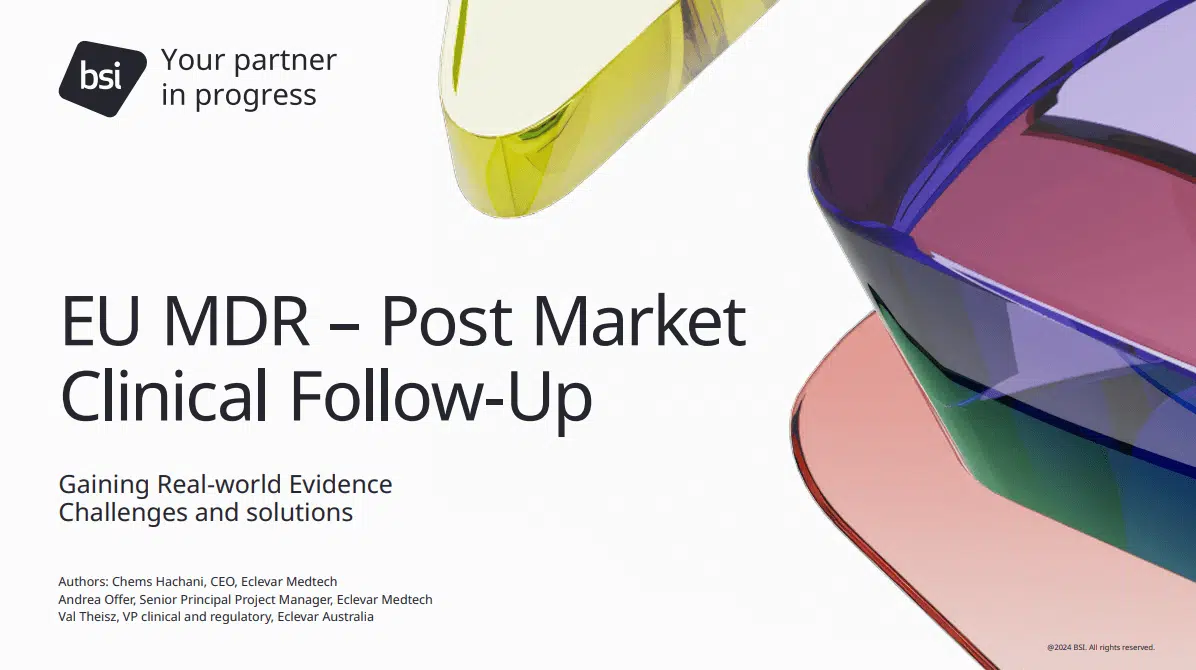
Written with the notified body BSI: a practical look at what clinical evidence has to show under EU MDR 2017/745, and at the quality bar the data have to clear. It is the same bar a European dataset meets before it is put in front of any reviewer.
PMCF studies · Regenerative medicine · 5 EU countries
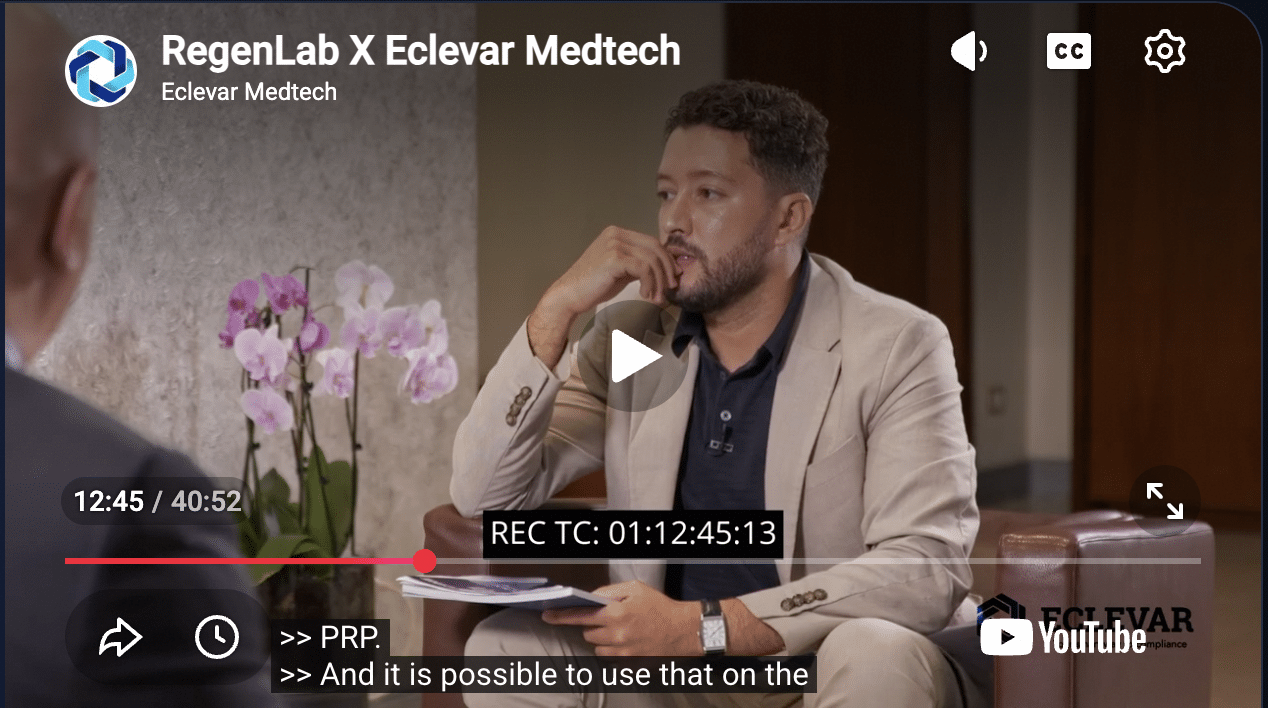
Eclevar runs RegenLab's PMCF program on chronic wound products. It is a randomized study of 160 subjects across 14 centers in 5 EU countries, covering both diabetic foot ulcer and venous leg ulcer. The partnership combines Eclevar's ISO 14155 expertise with the Milo Studio platform, from study design through to the final study report.
« Eclevar, with its tailored approach and the advanced Milo Studio platform, represents a significant strategic advantage. »Antoine Turzi, CEO, RegenLab
Coming soon. Breakthrough Device Technology under the EU MDR, a whitepaper written with TÜV SÜD, co-authored by Dr Nikhil Khadabadi.
Send the device, the development stage and the decision the evidence has to support. We will tell you what we would do first.