Arthroplasty PMCF · Registries · Real-world evidence · DACH

Arthroplasty PMCF, registries and real-world evidence in the DACH region

A joint replacement implant may stay in the patient for decades, while the initial clinical investigation captures only part of its performance lifecycle. Post-market clinical follow-up has to address what remains open after market access: long-term fixation, revision, survivorship, rare complications, broader patient groups and outcomes under routine care.

EPRD (Germany)SIRIS (Switzerland)Survivorship & revisionPROMs & imagingEU MDR 2017/745
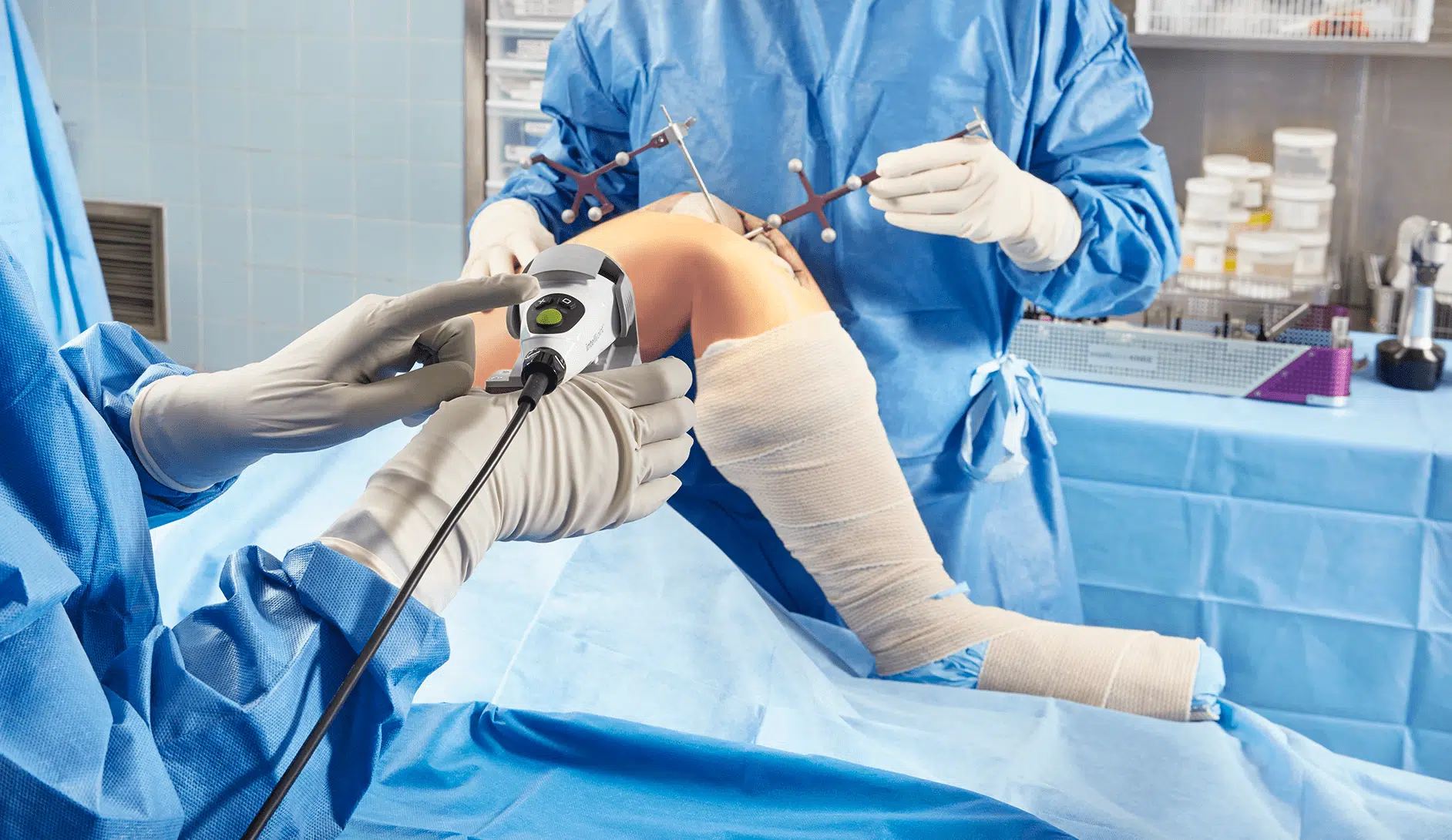
Joint replacement surgery in a European investigational site
The core decision chain
1
Residual uncertainty
2
Clinical question & population
3
Data source
4
Endpoint & follow-up period
5
Analysis
6
PMCF Evaluation Report & CER
The cheapest or easiest PMCF method is not the most proportionate if it cannot answer the residual clinical question.
Trusted by

Leading medical device teams

TERUMOMerilNIHON KOHDENVYGONColoplastSHOFUASAHI INTECCRegenLabTERUMOMerilNIHON KOHDENVYGONColoplastSHOFUASAHI INTECCRegenLab
Who reviews the evidence

Orthopedic clinical expertise and Notified Body review experience

EUCROF Platinum Award 2026
EUCROF Platinum Award 2026xShare Open Call for Clinical Research, co-funded by the European Union
Dr Nikhil Khadabadi

Dr Nikhil Khadabadi

CMO · Orthopedics & Spine
NHS orthopedic surgeon

Former reviewer atTUV SUD
20+yrs

in orthopedic surgery & Class III implant evidence

  • Assesses Class III orthopedic & spinal evidence under EU MDR
  • Former Principal Investigator, Stryker robotic surgery trial
  • Leads CERs, PMCF & registries for Orthopedics & Spine
LinkedIn
Dr Mark Da Costa

Dr Mark Da Costa

Chief Operating Officer · former TÜV SÜD Senior Reviewer · Senior Consultant Surgeon

25+yrs

in device evaluation & Notified Body review

  • Assessed 400+ medical devices in Europe
  • Brings the reviewer perspective to protocol & CER design
  • Oversees delivery across the full evidence program
LinkedIn
Sébastien Meier Piantanida

Sébastien Meier Piantanida

Chief Data Officer · Biometrics & Data Systems

30yrs

in clinical data management, EDC & biometrics

  • Leads EDC, data management & biostatistics
  • Expertise in CDISC, CDASH, SDTM & ADaM
  • Validated data flows between sites, core lab & statistics
LinkedIn
Who this page is for

Deciding what post-market evidence your implant actually needs

This page is for teams choosing between a survey, a cohort, a prospective study and a registry analysis, and needing to justify that choice.

The initial study did not cover the device lifetime

Follow-up stopped long before the implant will.

The Notified Body has asked for more evidence

Additional post-market data have been requested explicitly.

Revision or survivorship is a material uncertainty

The residual risk sits in the long tail.

A new coating, fixation or design is in wider use

Routine practice now exceeds the studied population.

PMCF relies mainly on literature or complaints

No device-specific clinical data are being generated.

Registry publications exist but not for your device

Category-level data cannot substantiate your implant.

You need registry data combined with PROMs or imaging

No single source answers the whole question.

A retrospective dataset may already exist at sites

Existing records may or may not be fit for purpose.

You are planning a prospective post-market cohort

The design and endpoints need to be settled first.

The PMCF survey is not answering the key question

The method does not match the uncertainty.

Results must reach the CER, PSUR and risk file

The activity has to end in a regulatory conclusion.

You need one DACH plan, not three country activities

A shared question with three access routes.

Clinical evidence for arthroplasty medical devices, the parent hub, where the full evidence architecture is set out.

Start with the uncertainty

Do not choose the PMCF method before defining the question

Under EU MDR, PMCF is a continuous process that updates the clinical evaluation. The PMCF plan defines the methods used to address the remaining clinical questions, and the results are assessed in the PMCF Evaluation Report and fed back into the wider post-market system. That sequence only works if the uncertainty is named first.

What to review before naming the uncertainty

  • Preclinical and biomechanical testing
  • Pre-market clinical investigation data and existing literature
  • Comparable-device evidence
  • PMS and vigilance information, and complaints
  • Previous PMCF findings and risk-management conclusions
  • Notified Body feedback
  • Any change to the device, procedure or intended use

Typical residual uncertainties in arthroplasty

  • Long-term implant survivorship; early or late revision
  • Aseptic loosening, infection, periprosthetic fracture
  • Dislocation or instability; wear and osteolysis
  • Fixation of a cementless component
  • Performance in younger or more active patients
  • Outcomes in revision surgery; a new size or configuration
  • Use across different hospitals and surgeons
  • Patient-reported pain and function
  • Imaging findings not captured in routine registries

MDCG 2020-7 addresses the PMCF plan and MDCG 2020-8 the PMCF Evaluation Report template. Our PMCF services and orthopedic PMCF strategy pages cover the general framework; this page covers the arthroplasty-specific decisions.

Method selection

Match the PMCF model to the question

  • Long-term revision risk: registry or long-term prospective cohort
  • Early fixation of a new implant: prospective imaging or RSA study
  • Pain and functional improvement: prospective PROM collection
  • Performance in routine clinical use: multicenter observational study
  • Outcomes from previously treated patients: retrospective cohort
  • Rare but serious complication: registry, vigilance and pooled longitudinal data
  • Surgeon handling or usability: focused healthcare-professional survey
  • New indication or patient subgroup: indication-specific prospective study
  • Comparison with an established implant: registry analysis or comparative observational study
  • Device-specific imaging finding: prospective imaging cohort or core-lab review

Key message. A robust PMCF program may combine several methods, because no single source is likely to answer every short-term and long-term question.

Five methods

Complementary, not a ranking of quality

Each answers a different class of question.

1 · Focused PMCF survey

Device handling, clinical usage patterns, surgeon experience, known low-frequency issues and confirmation of routine use.

2 · Retrospective clinical cohort

Existing treated populations, medium-term outcomes, revision and complication data, and feasibility assessment before a prospective study.

3 · Prospective observational PMCF study

Defined clinical outcomes, PROMs, imaging, consistent follow-up, and device-specific safety and performance.

4 · Registry or registry-linked evidence

Large populations, revision and survivorship, rare outcomes, and performance across routine care.

5 · Focused imaging or RSA study

Fixation, migration, radiolucency, loosening and device-specific radiographic uncertainty.

Hip and knee radiographic follow-up used in post-market survivorship analysis
Large numbers do not remove confoundingA large retrospective dataset is not automatically stronger than a smaller prospective study if device identity, revision completeness or outcome definitions are unreliable.
Prospective and retrospective models

Two very different fitness-for-purpose tests

Prospective observational PMCF

  • Device-specific enrollment and defined follow-up timepoints
  • Standardized endpoint collection, PROMs and imaging
  • Adverse-event capture and clear denominator data
  • Direct traceability to the implant; population aligned with intended purpose
  • Strengths: purpose-built data, consistent endpoints, control over completeness
  • Limits: longer start-up, site burden, loss to follow-up, selection bias, cost of long follow-up, possible overlap with registry collection

Retrospective: eleven questions before you commit

  • Was the exact implant identifiable?
  • Is the index procedure date available?
  • Are revisions captured if performed elsewhere?
  • Is there a usable denominator?
  • Are follow-up intervals consistent?
  • Are adverse events documented adequately?
  • Are PROMs available? Are images retrievable and evaluable?
  • Are data-access permissions achievable?
  • Can missingness and loss to follow-up be explained?
  • Is the dataset representative of the intended-use population?

Potential retrospective sources include hospital electronic records, theatre records, implant logs, revision databases, radiographs, local PROM systems, discharge records, follow-up clinic records, national or regional datasets, and manufacturer-supported previous studies.

Fitness for purpose

Size is not the same as strength

A large retrospective dataset is not automatically stronger than a smaller prospective study if device identity, revision completeness or outcome definitions are unreliable.

Fitness for purposeLarge numbers do not remove confoundingA large retrospective datasetMany records, uneven inputsDevice identity, revision completeness and outcome definitions may all be unreliable.A smaller prospective studyFewer records, defined inputsDevice-specific enrollmentDefined follow-up timepointsStandardized endpoints and imagingClear denominator dataThe comparison that matters is fitness for the question, not sample size.
A large retrospective dataset compared with a purpose-built prospective study.
Registry evidence

« Registry » covers five different things

The distinction determines what the evidence can actually support.

Registry-informed

Public registry evidence informs benchmarks and study design. PMCF value: context and state of the art.

Registry-aligned

A separate study using compatible variables and outcome definitions. PMCF value: future comparability.

Registry-based

The analysis is performed within the registry dataset. PMCF value: large-scale real-world outcomes.

Registry-linked

Study data are connected to registry or claims data. PMCF value: enhanced follow-up and revision capture.

Registry-embedded

Prospective study processes are incorporated into registry infrastructure. PMCF value: efficient long-term evidence where feasible.

Key message. Published registry results may support context and benchmarking, but they do not automatically demonstrate the safety and performance of the manufacturer’s own device. Access to a national registry, or the existence of published registry evidence, does not by itself provide device-specific PMCF evidence. The terminology matters too: « registry study » should not be used to describe a literature review of a registry annual report, and an analysis cannot become device-specific simply by naming a brand after the data have already been grouped at category level.

See our general pages on device registries under EU MDR and PMCF and real-world evidence.

DACH operational model

One clinical question, three country-specific data routes

A DACH plan is not three unrelated country activities, and it is not one activity copied three times. The question can be shared; the data-access route cannot.

ARTHROPLASTY POST-MARKET EVIDENCE - DACH ARTHROPLASTY POST-MARKET EVIDENCE · DACH DEATCH One shared questionSame residual uncertainty, endpoints andrevision definitions across the three marketsWatch: data-access route and permissionsdiffer country by countryGermany · EPRDHip and knee registry linked to routinehealthcare data; follow-up to ~10 yearsWatch: voluntary participation; access isnot automatic for manufacturersAustriaSite-led prospective or retrospectiveevidence; institutional implant databasesWatch: no EPRD or SIRIS equivalent toassume: confirm what existsSwitzerland · SIRISHip, knee, shoulder and spine modules;PROMs incl. OHS, OKS and OSSWatch: device representation, permissionsand multilingual consent

Registry access, data-use permissions and device representation are confirmed before any plan is allowed to depend on them.

Country by country

What each source can and cannot contribute

Germany · EPRD

The German Arthroplasty Registry collects hip and knee information and systematically links procedural and implant data with routine healthcare data. It describes survival analysis as central to evaluating arthroplasty outcomes and currently reports follow-up extending to approximately ten years for eligible data. Participation is voluntary, and the methodology acknowledges differences in participation by hospital volume and limits in the proportion of data suitable for linked survival analysis.

Switzerland · SIRIS

The Swiss national implant-registry system. Current public materials cover hip, knee, shoulder and spine programs, with procedure, follow-up and PROM documentation for the relevant modules, including primary and revision forms and patient-reported measures such as OHS, OKS and OSS.

Austria

Austria should not be treated as a registry copy of Germany or Switzerland. Options may include prospective multicenter PMCF studies, retrospective hospital cohorts, institution-level implant databases, local quality datasets, PROM programs, imaging follow-up, routine-care data where accessible, and registry sources only where their current status, coverage and access are confirmed.

Ask before planning an EPRD analysis

  • Is the device identifiable at component level?
  • Is the exact device family represented, with adequate sample size?
  • How complete are index-procedure and revision capture?
  • Which insurance-linked data and what follow-up duration are available?
  • Can the proposed analysis distinguish confounding?
  • Is manufacturer-specific access possible, with publication and data-use permissions?

Ask before planning a SIRIS analysis

  • Is the exact implant identifiable and the procedure in the relevant module?
  • Are the required PROMs available, with complete baseline and follow-up?
  • Are revision causes sufficiently detailed?
  • Is direct data access possible and are device-specific analyses permitted?
  • Can the data be linked with imaging or site-level information?
  • Are all language and consent requirements satisfied?

Important limitation. EPRD- and SIRIS-based analyses may be considered where the device, sample size, access route and data permissions allow. Neither is a guaranteed source of manufacturer-specific PMCF evidence, and neither is automatically available to every manufacturer.

DACH data sources

One shared question, three country-specific routes

Germany, Austria and Switzerland do not offer the same post-market data. The route is chosen from the residual uncertainty, not from whichever dataset is easiest to obtain.

DACH data sourcesOne shared question, three country-specific routesGermanyEPRDThe German arthroplasty registry.Component-level device identity,index-procedure and revision capture,insurance-linked follow-up.Ask first: is the exact device familyrepresented, with adequate sample size?AustriaNo registry copy of its neighborsProspective multicenter PMCF studies,retrospective hospital cohorts,institution-level implant databases,PROM programs and imaging follow-up.Registry sources only where status,coverage and access are confirmed.SwitzerlandSIRISThe Swiss national implant-registry system.Public materials cover hip, knee,shoulder and spine programs, withPROMs such as OHS, OKS and OSS.Ask first: is the exact implant identifiableand the follow-up long enough?The country route is chosen from the residual uncertainty, not from the data that happen to be easiest to obtain.
Post-market data sources across Germany, Austria and Switzerland.
Survivorship

More than reporting a revision percentage

A survivorship analysis depends on definitions that are easy to leave implicit: the index arthroplasty, the start of follow-up, the revision endpoint, censoring, death, loss to follow-up, bilateral procedures, component-level versus construct-level analysis, all-cause versus cause-specific revision, the follow-up distribution and the completeness of revision capture.

Knee arthroplasty radiographs used for implant survivorship and revision analysis
Survivorship, revision and reoperation

Define the event before analyzing it

Possible survivorship outputs

  • Revision-free survival and the cumulative revision rate
  • Time to first revision; cause-specific revision
  • Component-specific and construct-level survival
  • Reoperation-free survival
  • Competing-risk estimates
  • Survivorship by implant configuration and by patient subgroup

Four events that are not synonyms

  • Revision: removal, exchange or addition of one or more implant components
  • Reoperation: a further procedure on the operated joint that may leave components unchanged
  • Closed or non-operative intervention: for example closed reduction after dislocation
  • Planned staged procedure: may need separate treatment in the analysis
  • Cause-specific events: infection, aseptic loosening, instability or dislocation, periprosthetic fracture, wear, osteolysis, implant breakage, malposition, pain, stiffness, soft-tissue failure

Key message. A reported survival percentage is difficult to interpret without its follow-up duration, confidence interval, endpoint definition and data-completeness assessment. Revision, reoperation and complication rates should never be used interchangeably.

Revision burden & component attribution

Nine rules to write down before the first analysis

  • Whether partial component exchange counts as a revision
  • Whether liner or head exchange is attributed to the full construct
  • How modular components are identified
  • How mixed-manufacturer constructs are handled
  • Whether the revision cause is primary or multiple, and how uncertain causes are classified
  • How staged revisions are counted
  • Whether the same patient can contribute more than one revision
  • How later revision episodes are analyzed

A practical asymmetry worth planning around. A registry may identify the implant construct more reliably than routine records, while clinical notes may give more detail about the reason for revision. The optimal analysis therefore often needs more than one source.

Device identification and traceability. Registry evidence depends on being able to identify the manufacturer, product family, component, catalog number, size, lot or serial number where relevant, fixation method, bearing combination, modular construct, laterality, primary or revision use, and the UDI where available. The recurring problems: legacy product names, multiple catalog-number formats, product-family pooling, mixed-manufacturer constructs, unrecorded component exchange, incomplete revision records, changes in branding and merged device generations.

PROMs and imaging alongside registry data

Revision-free survival does not describe the full patient outcome

PROMs

  • Pain, function, activities of daily living, joint-specific quality of life
  • Satisfaction, return to activity, patient acceptable symptom state, meaningful improvement
  • Hip: OHS or HOOS · Knee: OKS or KOOS · Shoulder: OSS, ASES or another justified measure · EQ-5D for general health
  • Define: baseline availability, follow-up timepoint, licensing, validated language version, bilateral procedures, post-revision interpretation, responder definition, missingness

Where imaging explains what the registry only detects

  • Increased revision rate → possible mechanism of failure
  • Low revision but persistent pain → alignment, loosening or other structural findings
  • Early revision cluster → implant position or fixation review
  • New cementless design → migration and interface assessment
  • Device change → comparison of pre-change and post-change imaging

The instrument logic is covered on arthroplasty endpoints and PROMs; acquisition, core-lab reading and RSA on imaging, core lab and RSA for arthroplasty studies.

Key message. Registry and imaging data should be connected only where patient, implant, timepoint and outcome linkage are reliable.

PMCF surveys

When a survey is proportionate, and when it is not

A survey may be appropriate for

  • Device usage patterns and surgeon experience
  • Handling and instrumentation; training needs
  • Known low-frequency issues
  • Confirmation of intended-use conditions
  • Structured observations not available in routine datasets

A survey is unlikely to be sufficient for

  • Implant survivorship and revision incidence
  • Long-term fixation and radiographic loosening
  • Comparative performance
  • Rare events requiring a defined denominator
  • Patient-level pain and function
  • High-risk residual uncertainties

Where a survey is used, quality depends on a clear respondent population, a defined denominator, device-specific experience, a stated recall period, avoidance of leading questions, duplicate-response controls, defined handling of incomplete responses, a prespecified analysis and transparent limitations. See PMCF surveys for medical devices.

Key message. A survey should not be selected simply because it is faster than a clinical study.

Combining evidence streams

Several sources, one integrated PMCF conclusion

Registry or claims data

Revision and survivorship at scale, across routine care.

Prospective PROMs

Pain, function and patient-perceived benefit.

Imaging

Fixation, migration and loosening: the mechanism behind a signal.

Survey data

Handling, usage patterns and surgeon experience.

Vigilance and complaints

Safety signals arising outside the study.

Literature

State of the art and comparator context.

Key message. Each stream carries a defined role, and together they feed one integrated PMCF conclusion. The same outcome should not be counted twice merely because it appears in more than one dataset.

Comparative real-world evidence

Comparison is where real-world evidence most often fails

Possible comparator approaches

  • A contemporary implant or a previous device generation
  • A registry benchmark or a historical control
  • A matched cohort or a propensity-score approach
  • A risk-adjusted national average
  • An expected performance threshold
  • Before comparing: similar population? comparable follow-up? aligned revision definitions? comparable constructs? hospital and surgeon effects? channeling bias? key confounders available? exploratory or confirmatory?

Recurring sources of bias

  • Selection bias and confounding by indication
  • Surgeon preference and hospital-volume effects
  • Patient age, frailty and bone quality
  • Primary versus revision surgery; fixation method; surgical approach
  • Bilateral procedures and competing mortality
  • Differential follow-up and the new-device learning curve
  • Missing PROMs and incomplete revision capture
  • Mitigations: restriction, stratification, matching, regression adjustment, propensity scores, sensitivity analyses, negative controls, and a transparent discussion of residual confounding

Key message. Large numbers do not remove confounding.

Data quality & missing data

Grade the dataset before you build a plan on it

Any dataset proposed for PMCF should be assessed for relevance, representativeness, completeness, accuracy, consistency, traceability, timeliness, device granularity, endpoint validity, follow-up completeness, revision completeness, missingness, data provenance and quality-control processes.

  • Suitable for the primary PMCF objective: the dataset can answer the residual question as the main evidence source
  • Suitable for supportive analysis: it strengthens, but cannot carry, the conclusion
  • Suitable for context only: it informs the state of the art or benchmarking, not device-specific claims
  • Not suitable without remediation: device identification, completeness or definitions must be resolved first

Missing data are not all the same. Distinguish a patient lost to clinical follow-up, no PROM response, no imaging, a revision performed at another center, death, emigration, hospital non-participation, a missing component identifier, an incomplete revision cause and a record-linkage failure. Then answer: is missingness related to poor outcome? are revision events captured independently? can routine data reduce loss to follow-up? does death compete with revision? can missing device identity be resolved? which sensitivity analyses are required?

Analysis & signal detection

What the SAP covers, and what happens when a signal appears

Statistical methods

  • Descriptive outcome analysis and incidence rates
  • Kaplan-Meier survival analysis and the cumulative revision rate
  • Competing-risk analysis and Cox regression
  • Flexible parametric survival models and multilevel modeling
  • Recurrent-event analysis and propensity-score adjustment
  • Mixed models for repeated PROMs; longitudinal imaging analysis
  • Subgroup analysis, benchmark comparison and signal-detection methods
  • Populations: all implanted patients, device-family cohort, complete construct cohort, primary only, revision cohort, minimum follow-up, PROM respondent cohort, imaging-evaluable cohort

Signals to define in advance

  • Higher-than-expected revision; a new failure mode
  • Progressive radiolucency or unexpected migration
  • A poor PROM response; site-level outcome variation
  • A device-size-specific or component-combination signal
  • A cluster of early failures; a difference from a registry benchmark
  • Escalation: data validation, medical review, imaging adjudication, root-cause assessment, risk-management update, trend reporting, additional PMCF, CAPA, field action where required, label or training update

Two key messages. Kaplan-Meier and competing-risk estimates answer related but different questions where death prevents later revision. And a threshold should trigger review, not an automatic conclusion that the device has failed. Analysis is produced by our biostatistics team against a prespecified SAP.

DACH delivery

One shared question, three country-specific routes

Germany

EPRD feasibility, hospital and surgeon selection, registry or routine-data permissions, prospective PMCF sites where registry data are insufficient, German-language documentation, and data-protection and contracting requirements.

Austria

Site-led prospective or retrospective evidence, confirmation of the available institutional or national data sources, ethics and data-use requirements, German-language materials, and multicenter feasibility.

Switzerland

SIRIS feasibility, Swiss data-access and consent requirements, PROM availability, site and registry coordination, local regulatory and data-protection considerations, and multilingual documentation where required.

Delivered with site feasibility and selection, study start-up, on-site and remote monitoring, EDC and data management and our operational infrastructure.

The regulatory conclusion

Separate activities, one report

Registry work, prospective follow-up, imaging and vigilance only become evidence once a single report explains which uncertainty each of them addressed.

From activities to one reportSeparate activities become one PMCF Evaluation ReportProspective observational PMCFDevice-specific enrollment, defined timepointsRegistry or registry-linked evidenceLarge populations, revision and survivorshipFocused imaging or RSA studyFixation, migration, radiolucency, looseningPROM programFunction and health status under routine careComplaints and vigilanceRare events and signals from routine usePMCF EvaluationReportWhich uncertainty wasaddressed, why the methodwas proportionate, whatthe data can support.CER & benefit-riskThe conclusion theNotified Body reads.Anything the report cannotsupport does not belongin the CER.
Post-market activities converging into the PMCF Evaluation Report and the CER.
The regulatory conclusion

Turn separate activities into one PMCF Evaluation Report

The report should explain which residual uncertainty the activity addressed, why the chosen method was proportionate, which data were collected, the data quality and limitations, the population and device applicability, the safety and performance findings, the revision and survivorship outcomes, the PROM and imaging outcomes, the comparison with expected performance, any new or changed risks, the remaining uncertainty and the required next actions.

PMCF evaluation report and post-market follow-up for arthroplasty implants
From PMCF to CER and the wider post-market system

Where each output lands

Residual uncertaintyPMCF planRegistry, study, PROM, imaging or surveyAnalysisPMCF Evaluation ReportCER updateBenefit-riskRisk management & labeling
  • Revision-free survival: long-term safety and durability
  • Cause-specific revision: failure-mode assessment
  • PROM improvement: patient-perceived clinical benefit
  • Imaging findings: fixation and device-specific performance
  • Registry benchmarking: state of the art and comparative context
  • Subgroup outcomes: applicability to intended populations
  • Survey findings: routine use and handling evidence
  • Data limitations: clinical-evidence uncertainty
  • New signal: benefit-risk and risk-management reassessment

PMCF results rarely stop at the CER. They also affect the PMS report, the PSUR, the risk-management file, the SSCP, the IFU, device claims, training materials, CAPA, trend reporting, vigilance activities and the next PMCF plan. The 2025 MDCG post-market surveillance guidance reinforces that these have to operate as a connected system rather than as isolated documents.

Key message. The CER should not merely state that PMCF was completed. It should explain how the findings changed, confirmed or limited the clinical conclusions, a recurring theme among MDR clinical evaluation non-conformities.

What Eclevar MedTech delivers

Each need can be commissioned on its own

  • What uncertainty should PMCF address?: clinical evidence-gap assessment
  • Which PMCF model is proportionate?: PMCF method decision framework
  • Can registry evidence answer the question?: registry feasibility and data-fitness review
  • Is a prospective study needed?: study-design and operational recommendation
  • Can existing data be used retrospectively?: dataset inventory and evaluability assessment
  • How should revision be defined?: revision and reoperation endpoint framework
  • Which PROMs should be collected?: joint-specific PROM strategy
  • Is imaging required?: imaging and core-lab strategy
  • Can EPRD or SIRIS be used?: country and registry feasibility assessment
  • How will data be analyzed?: SAP and real-world evidence statistical strategy
  • How will findings support the CER?: PMCF-to-CER traceability map
  • Can you run the program?: protocol, sites, data, statistics and reporting
Engagement models

Eight ways to start

PMCF Strategy Review

Unclear residual evidence gap. Output: prioritized PMCF roadmap.

Registry Feasibility Review

Considering EPRD, SIRIS or another registry. Output: access, variable and sample-size assessment.

Retrospective Data Review

Existing site or hospital datasets. Output: fitness-for-purpose report.

Prospective PMCF Design

A new observational study. Output: synopsis, protocol and endpoint framework.

PROM and Imaging Add-On

The registry lacks clinical depth. Output: linked PROM or imaging work package.

PMCF Survey Design

A focused usage or handling question. Output: survey, sampling and analysis plan.

PMCF Evaluation Report

Completed activities. Output: integrated PMCF conclusions.

Full DACH PMCF Program

A multicountry evidence need. Output: end-to-end delivery and reporting.

The post-market cycle

Each cycle sets the question for the next

Post-market clinical follow-up is a loop, not a deliverable. What the report cannot answer becomes the residual uncertainty the next activity has to address.

The post-market cycleEach cycle sets the question for the next oneResidualuncertainty123451Clinical question & population2Data source3Endpoint & follow-up period4Analysis5PMCF Evaluation Report & CERThe cheapest or easiest PMCF method is not the most proportionate if it cannot answer the residual clinical question.
The core decision chain, as a cycle.
Why work with Eclevar MedTech

Registry evidence read in clinical context

Orthopedic and reviewer leadership

PMCF questions are reviewed by a team combining orthopedic clinical expertise and former Notified Body review experience, led by Dr Nikhil Khadabadi.

Registry evidence with clinical context

Registry outputs are interpreted alongside implant design, surgical practice, PROMs, imaging and residual risk.

One connected evidence team

Strategy, protocol, sites, data management, statistics, PMCF reporting and CER integration are planned together.

Flexible delivery

Commission a registry feasibility review, a single PMCF activity or a full DACH program.

Technology flexibility

We work with sponsor systems, registry platforms, site databases or an agreed EDC and study workflow.

Timeline & budget

What actually drives a post-market program

Timelines follow the definition of the residual uncertainty, registry access, data-use approvals, device representation in the dataset, site contracts, ethics and data-protection review, retrospective data remediation, prospective follow-up duration, PROM and imaging components, record linkage, statistical complexity, and the timing of the PMCF Evaluation Report and CER update. Costs follow the number of countries and sites, registry-access fees, the number of records, manual data abstraction, device-identification remediation, PROM collection, imaging and core-lab review, the length of prospective follow-up, the number of endpoints, comparative analysis, and medical writing and CER integration. We quote in defined work packages, on the same basis as our European clinical trial cost benchmarking.

Orthopedic rehabilitation and long-term patient follow-up in a PMCF study
FAQ

Questions sponsors ask first

Can registry data replace an arthroplasty PMCF study?

Not automatically. A registry may answer revision and survivorship questions at scale, but PMCF must address the specific residual uncertainty for your device. Where the device is not identifiable at component level, or the registry lacks the relevant outcome, another method is needed.

When is a prospective PMCF study needed for a joint implant?

When the outcome must be defined in advance, when PROMs or imaging are required, when the denominator and implant traceability must be certain, or when the question concerns a population or endpoint that routine datasets do not capture.

Can retrospective hospital data be used for PMCF?

Yes, where the data pass a fitness-for-purpose review covering device identification, revision completeness, follow-up consistency, outcome definitions and data-access permissions. Size alone does not make a dataset suitable.

What is the difference between revision and reoperation?

A revision involves the removal, exchange or addition of implant components. A reoperation is a further procedure on the operated joint that may leave the components unchanged. They should be defined and counted separately.

How is implant survivorship analyzed?

Through time-to-event methods with a prespecified endpoint, defined censoring, stated follow-up duration and confidence intervals, and competing-risk methods where death prevents later revision.

Can EPRD data be used for manufacturer-specific PMCF?

EPRD-informed or EPRD-based analyses may be considered where the device, sample size, access route and data permissions allow. Access is not automatic, and feasibility should be confirmed before the plan depends on it.

Can SIRIS provide PROM and revision evidence?

SIRIS may support Swiss arthroplasty PMCF where the device is represented and the required permissions, variables and follow-up are available. As with any registry, feasibility comes before commitment.

How should Austria be included in a DACH PMCF strategy?

By selecting the model from actual data availability and permissions, typically through site-led prospective or retrospective evidence, rather than by assuming an EPRD or SIRIS-equivalent pathway exists.

When is a PMCF survey appropriate for an arthroplasty device?

For handling, usage patterns, surgeon experience, training needs and confirmation of intended-use conditions. It is not appropriate as the main evidence for survivorship, revision incidence, fixation or comparative performance.

Should PROMs be collected alongside registry data?

Often, yes. Revision-free survival does not describe pain, function or satisfaction, so PROMs add the patient-perceived benefit that registries usually cannot supply at the required depth.

When is imaging needed in a PMCF program?

When the residual uncertainty concerns fixation, migration, radiolucency, osteolysis or loosening, or when a registry signal needs a mechanism. Registries may identify failure, while imaging may explain it.

How do PMCF results feed into the CER and PSUR?

Through the PMCF Evaluation Report, which carries the findings into the CER update, the benefit-risk conclusion and the risk-management and labeling review, with the PSUR and PMS report reflecting the same conclusions.

Can existing registry publications support the state of the art?

Yes. Published registry evidence is well suited to benchmarks, comparator context and device-category outcomes, but it does not by itself demonstrate the performance of your own device.

How should death and loss to follow-up be handled in survivorship analyses?

Death should normally be treated as a competing event rather than simple censoring, and loss to follow-up should be quantified, explained and tested through sensitivity analyses.

Start the conversation

Does your PMCF plan address the questions that remain?

Share your device, existing clinical evidence, current PMCF plan and target DACH markets. We review the residual uncertainties and outline a proportionate strategy using prospective studies, retrospective data, registries, PROMs, imaging or focused surveys.

Your documents are reviewed confidentially. An NDA can be put in place before we receive any technical or clinical information. You can also reach the team through the contact page.

Reforming Clinical Evaluation of Medical Devices in Europe