Platinum Award · xShare & EUCROF 2026

Calculate the real clinical trial cost in Europe, down to the nurse, the MRI slot and the X-ray.

For medical device manufacturers scoping a study in France, Germany or the UK: not a rule of thumb, not "0.8x the CRO budget", but a line-by-line CRO and site-cost forecast built from real hospital tariffs. Three scenarios, compared side by side, modelled live on Milo TF. Your first budget within 48 hours.

3
Scenarios per country
swift, base, conservative
3
Countries compared
France, Germany, UK
45+
Parameters you control
tuned across 3 sessions
48h
To your first budget
report after workshop 1
Compliant with EU MDR 2017/745 ISO 14155:2026 ISO 13485 21 CFR Part 11 GDPR
What are you trying to cost

Three ways manufacturers calculate a trial cost in Europe.

Whatever you searched for, the answer is the same engine: real hospital tariffs, real CRO rates, three scenarios per country. Pick the brief closest to yours.

Cost a trial in France, Germany or the UK

The same protocol priced country by country, so you see where a site visit is cheaper, where imaging is dearer, and where recruitment is fastest, in EUR and GBP.

FranceGermanyUK
See the country breakdown

CRO budget + site fees, itemised

Most quotes leave site fees "to be negotiated". We price the CRO scope per role and per hour, then add every site grant, so nothing surfaces mid-execution.

CRO scopeSite grantsPass-through
See what the number is built from

Cardiovascular & PMCF cost forecast

A live franchise: cardiovascular and PMCF studies modelled on seven years of delivery data, with imaging burden, adjudication and follow-up costed explicitly.

CardiovascularPMCFEU MDR
See the three scenarios
What the number is actually built from

Real costs. Real roles. Real equipment. Country by country.

Most CRO quotes give a project total and a hand-wave on site fees. We do the opposite: every site grant is assembled from the real cost drivers in a European hospital, priced from a live tariff database, and reflows as you change the design.

Hospital staff

The fully loaded cost of the people who run the visits. Research nurses, study coordinators, pharmacy and back-office time, at the real per-hour rate negotiated in each country.

Clinicians & PIs

Investigator and clinician time priced explicitly, not buried in an overhead. Per-hour and per-visit rates for the PI, sub-investigators and adjudication, by country and by specialty.

MRI & imaging

MRI (IRM) and X-ray priced per scan, at the real hospital tariff in each geography, plus reading and central-upload time. The imaging burden becomes a visible, costed line, not a surprise.

On top of these site-level costs, Milo TF prices the full CRO scope per role and per hour, the pass-through (courier, customs, IRB, ethics, kit shipment) and HTA add-ons. Nothing is left as "to be negotiated later".
Side by side, by country

The same protocol, priced three ways: France, Germany, the UK.

The comparison sponsors never get from a CRO: the same study, costed line by line against the real tariffs of each country. The structure below illustrates a mid-size cardiovascular study. Your workshop produces these numbers against your real protocol.

Cost componentrepresentative unit FranceEUR € GermanyEUR € United KingdomGBP £
Research nurseper hour, fully loaded~€55~€65~£50
Clinician / PIper hour~€180~€210~£170
MRI / IRMper scan, incl. reading~€280~€420~£350
X-rayper scan~€45~€70~£60
Screening visitnurse + clinician + admin~€520~€640~£560
Pharmacy set-upper site~€4,500~€6,000~£5,200
Per-patient site grantall visits, fully costed~€9,800~€12,400~£11,000
Real figures unlocked when you book

Sample figures shown blurred. For a mid-size cardiovascular study, around 250 patients across 18 sites, these unit costs roll up to roughly €4.0M (swift), €5.4M (base) and €7.6M (conservative). Your real, unblurred per-country numbers are built live against your protocol when you book.

What you get, for every country

Three scenarios. All modulated in real time.

For each country, Milo TF produces three scenarios, anchored to seven years of delivery data. The numbers move as you adjust the inputs, on screen, in the workshop.

S

Swift path, with reasons.

P75 site recruitment rates, a smaller high-performing network, lighter monitoring. The fastest defendable budget when the envelope is tight and the design can survive scrutiny on a minimum viable footprint.

  • CRO: lean scope, fewer monitoring days
  • Sites: smaller core network, top PIs
  • Recruitment: P75 enrollment rate per site
Lowest cost, highest delivery risk
B

The realistic median.

Median historical site rates, standard MDR pivotal or PMCF footprint. The scenario most sponsors actually live in, with the contingency a CFO can defend to the board and the cost split country by country.

  • CRO: full scope, every line item priced
  • Sites: balanced network across countries
  • Recruitment: median rate, target on plan
The number you build the program around
C

The conservative case, costed.

P25 site rates, maximum monitoring, worst-case IRB lag, slowest activation, longest follow-up. The number you bring to the board so nobody can say "we did not see this coming".

  • CRO: full scope plus contingency
  • Sites: wider network to de-risk recruitment
  • Recruitment: P25 rate, conservative timeline
The number that protects the program
What Milo TF outputs

From an 8-week RFP to a 30-minute roadmap.

This is the live three-way forecast you build in the room: cost and recruitment for all three scenarios, on one screen, export-ready. Figures below are illustrative for a cardiovascular pivotal.
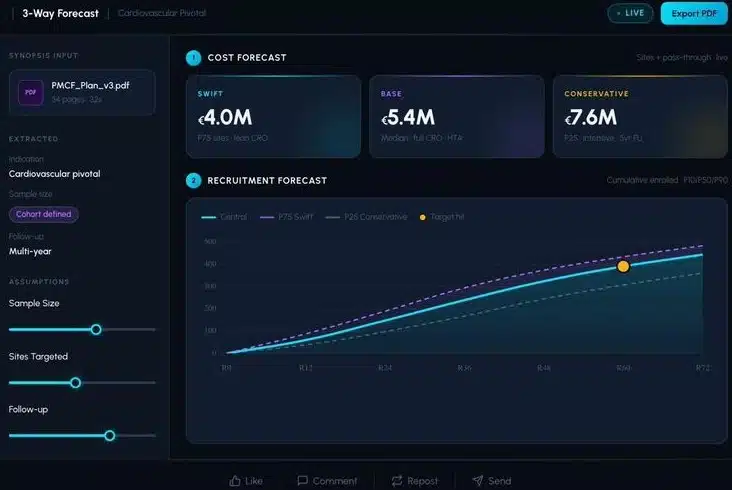
Milo TF three-way clinical trial cost forecast dashboard showing swift, base and conservative scenarios with a recruitment forecast graph for a cardiovascular pivotal study
Swift · P75 sites, lean CRO
€4.0M
Lowest cost, highest delivery risk
Base · median, full CRO + HTA
€5.4M
The number you build the program around
Conservative · P25, 5yr follow-up
€7.6M
The number that protects the program

Illustrative output. Your real cost and recruitment curves are built live against your protocol across the three workshops.

How it works

Three workshops on Milo TF. You watch the budget being built.

Not a quote you wait three weeks for, a working session. You change the inputs and the cost, sites and recruitment forecasts reflow in front of you.

1Scope & model live

Enter the scope, modelled in real time.

One hour · live on screen

We take your synopsis or PMCF plan and build the forecast with you, live. You see cost, sites and recruitment reflow as we set the design.

  • Indication, design and visit schedule entered together
  • Country mix set: France, Germany and the UK
  • Live modeling of all three scenarios on screen
  • Report delivered after the workshop
2Tune the parameters

Adjust the 45+ parameters.

After your internal review

You take the report back to your team. Once reviewed internally, we reconvene and tune the model against your reality, more than 45 parameters from per-visit imaging to monitoring intensity.

  • Your internal review drives the agenda
  • 45+ parameters adjusted to your assumptions
  • Country comparison re-run side by side
  • Scenario spread re-anchored with the experts
3Final round

Close what is still missing.

Final session

We resolve the last open questions, lock the assumptions and hand you a defendable, itemised budget across all countries and all three scenarios.

  • Open assumptions resolved with the experts
  • Final country-by-country budget locked
  • CRO and site fees fully itemised
  • Board-ready three-scenario output
The depth behind the number

More than 45 parameters, all yours to adjust.

A real forecast is not one slider. Across the three workshops you tune every assumption that moves the budget. A representative selection:

Design & protocol

12+ params
  • Sample size and randomization ratio
  • Number and schedule of visits
  • Follow-up duration
  • MRI / IRM scans per patient
  • X-ray and other imaging per visit
  • Lab and biomarker burden
  • Adjudication / core-lab requirement

Sites & geography

16+ params
  • Country mix: France, Germany, UK
  • Number of sites per country
  • Per-patient site grant by country
  • Research nurse rate per hour
  • Clinician / PI rate per hour
  • Pharmacy and start-up fees
  • Ethics / IRB fees and timelines

CRO, recruitment & risk

17+ params
  • CRO line items per role, per hour
  • Monitoring intensity and frequency
  • P25 / P50 / P75 enrollment rates
  • Screen-fail and drop-out rates
  • Pass-through: courier, customs, kit
  • HTA dossier and payer engagement
  • Contingency and inflation assumptions
The old way vs the Eclevar way

Weeks of back-and-forth, or a defendable number in 48 hours.

A traditional CRO quote is a long wait that still leaves you guessing. Eclevar runs it live, with two senior experts in the room, and hands you an itemised, three-scenario budget within 48 hours.

Traditional CRO quote

A rough estimate, a long wait.

4–8weeks per scenario, and still no real number
×

Send an RFP, then wait.

Days to weeks before the first draft quote even comes back.

×

Site fees not included.

Quoted as "to be negotiated directly with sites", you get a rule of thumb, roughly 0.8x the CRO budget.

×

Hourly rates hidden.

A project total, not what a senior CRA, biostatistician or regulatory lead actually costs.

×

Every "what if" is another round.

Change the sample size or add Germany, wait another 4 to 8 weeks for a new scenario.

×

Recruitment from PI memory.

No historical anchoring, no P25/P75, no conservative case for the board.

×

Hidden costs surface late.

Courier, customs, IRB, kit shipment appear mid-execution, risk you discover after you have committed.

vs
Eclevar + Milo TF

Real data. Real time. Two experts.

48hto an itemised, three-scenario budget

One hour, modelled live.

Workshop 1: your scope entered on screen, all three scenarios reflow as you watch.

Site fees built in.

Country-specific grants from a live hospital-tariff database: nurse, clinician, MRI, X-ray, per patient and per visit.

Every hourly rate exposed.

CRO line items priced per role, per hour. You see exactly what you pay for.

45+ parameters, tuned with you.

Workshops 2 and 3 adjust every assumption, no waiting weeks for a re-quote.

Recruitment anchored to real data.

P25/P50/P75 site rates from seven years of delivery, with the conservative case taken seriously.

Two senior experts in the room.

A clinical-trial veteran and a former TUV SUD reviewer catch the risk and the hidden cost before you commit.

Who is in the room

Software does the math. Two seniors judge the number.

Milo TF gives you a budget. These two tell you whether it is defendable. No account managers, no junior staff: the people who decide whether your design passes a Notified Body and whether your sites actually recruit are with you in every workshop.
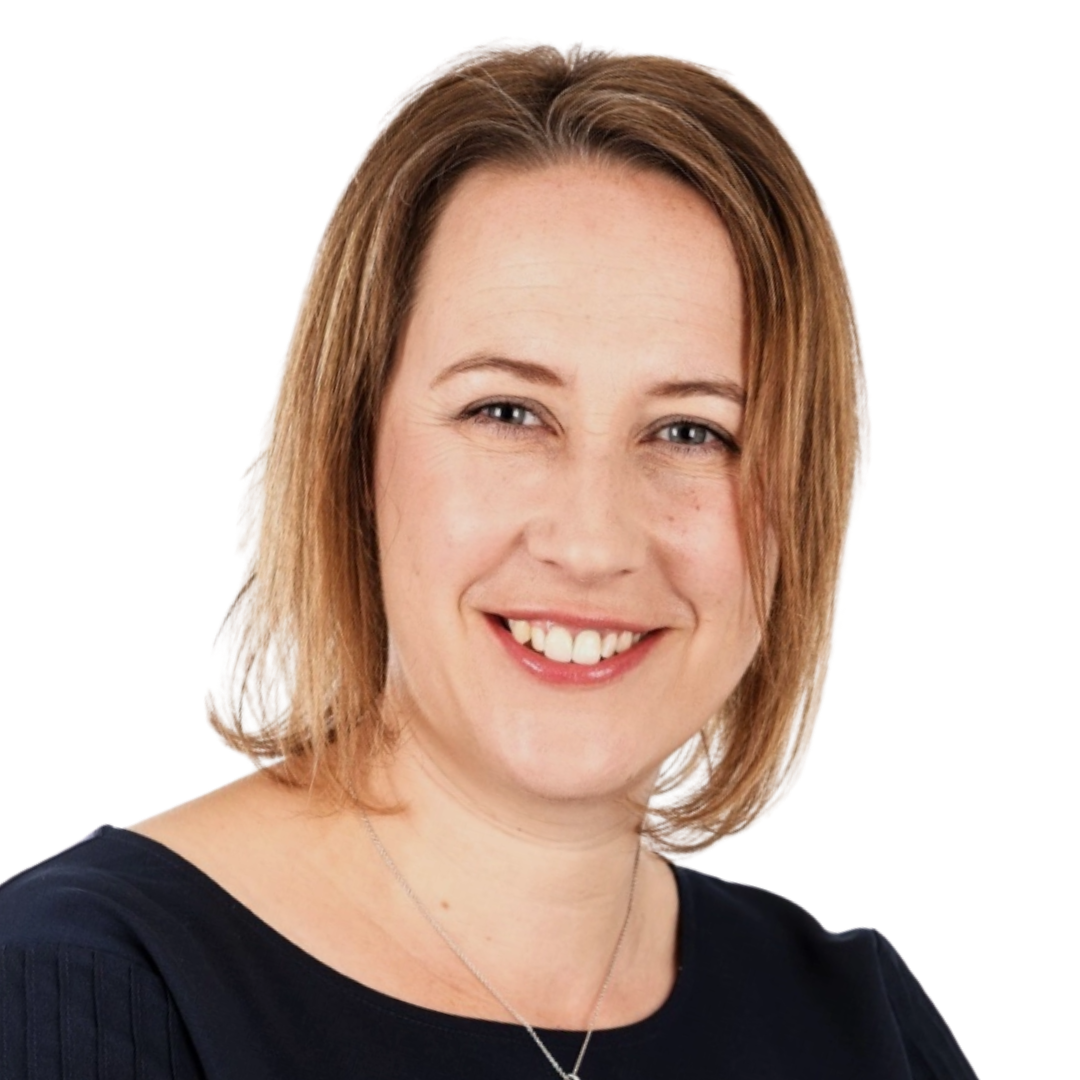
Nancy, Head of Clinical Operations at Eclevar Medtech
Operational feasibility

Nancy

Head of Clinical Operations, Eclevar Medtech. Cardiovascular & PAD lead, ISO 14155:2026 oversight.
Clinical OpsSite qualificationRecruitment realism

A veteran of clinical trial delivery across France, Germany, the UK and Eastern Europe. Nancy knows which sites underdeliver in winter, which ethics committees add eight weeks to start-up, and which PIs are systematically overconfident about recruitment. She is the reason the conservative scenario is taken seriously.

What Nancy judges, live, on your forecast
  • Site network realism, capacity and conflicting trials
  • Recruitment plausibility, historical rate vs PI estimate
  • Start-up timeline, by country, by site type
  • Drop-out and contingency, where the risk concentrates
Mark, former Head of Clinical Review at TUV SUD, strategic adviser at Eclevar Medtech
Design + regulatory strategy

Mark

Former Head of Clinical Review, TUV SUD. Class III device specialist, now strategic adviser at Eclevar Medtech.
Ex-Notified BodyClass III MDRStrategy & design

Mark spent years deciding whether clinical evidence was good enough for a CE mark. In the workshop he reads your design the way a Notified Body reviewer will, flagging the gaps that turn into expensive amendments later and the over-engineering you are paying for but do not need.

What Mark judges, live, on your forecast
  • Design defensibility, against MDR and the Notified Body lens
  • Endpoint and follow-up, what is truly required
  • Imaging and adjudication, cost vs evidentiary value
  • Amendment risk, what will cost you later if skipped now
News & events

Meet the team and the Notified Body DNA in person.

Eclevar takes the same cardiovascular and MDR expertise that scopes your budget onto the stage at Europe's leading device congresses. Come and pressure-test your trial design with us.

Eclevar Medtech at EuroPCR, Paris, 19 to 22 May 2026: bring the DNA of Notified Bodies to your cardiovascular trials
EuroPCR 202619 to 22 May · Paris

Bring the DNA of Notified Bodies to your cardiovascular trials.

Meet Chems Hachani (CEO), Dr Mark Da Costa (COO, former Notified Body expert), Nancy Boodhun (Director of Operations) and S. Meier Piantanida (Chief Data Officer) at the world's leading interventional cardiovascular course.
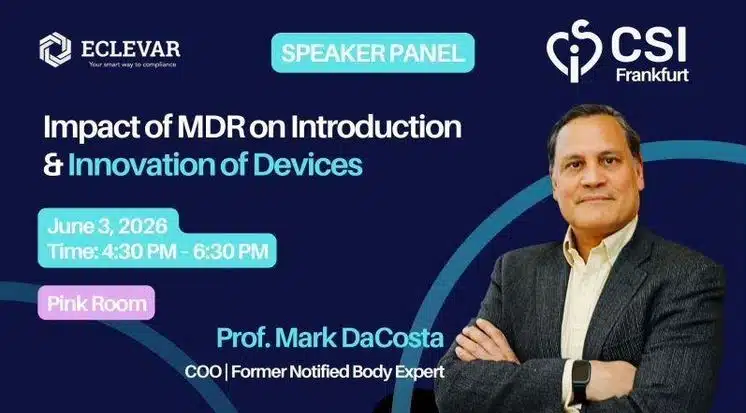
Eclevar Medtech speaker panel at CSI Frankfurt, 3 June 2026: impact of MDR on the introduction and innovation of devices, with Dr Mark Da Costa
CSI Frankfurt3 June 2026 · Pink Room

Speaker panel: impact of MDR on the introduction and innovation of devices.

Dr Mark Da Costa (COO, former Notified Body expert) joins the panel from 16:30 to 18:30 to discuss how EU MDR is reshaping the path for new structural-heart and cardiovascular devices.

Funding & backing

Award-winning, EU co-funded, and venture-backed.

Beyond the Platinum Award and European Union co-funding, Eclevar and the Milo platform are backed by private investors and venture capital, including Laurent venture capital. The same investment that scales the platform keeps your trial priced against live, real-world European data.

Get your three-scenario budget
Book it, or talk to a human first

Pay and lock your workshops, or call Karina.

Ready to go? Pay securely and we schedule workshop one straight away, first budget back within 48 hours. Want to ask questions first? Book a no-obligation call with Karina, our Head of Partnerships. No payment required to talk.

Complete package
£980three workshops, all in · one payment
  • Workshop 1, one hour, scope modelled live on Milo TF
  • Report within 48 hours of the first session
  • Workshops 2 & 3, tune the 45+ parameters, then finalise
  • Three scenarios across France, Germany and the UK
  • Full country cost breakdown unlocked, CRO + site fees itemised
  • Two senior experts in the room throughout
Pay £980 securely & book

Secure payment via Stripe. Card details are entered on Stripe's encrypted checkout, never on this page.

Karina, Head of Partnerships at Eclevar Medtech
Head of Partnerships

Talk to Karina

Not sure which countries to model, or whether your protocol is ready to cost? Book a no-obligation call. Karina will walk you through how the three workshops work, what to bring to workshop one, and answer anything before you commit. No payment needed to talk.

Book a call with Karina
Questions manufacturers ask

Clinical trial cost in Europe, answered.

The questions sponsors and medical device manufacturers ask most often when scoping CRO and site costs across France, Germany and the UK.

How do you calculate the cost of a clinical trial in Europe?+
The cost is built bottom up from the things that actually drive a budget: per-patient site grants paid to hospitals, the CRO scope priced per role and per hour, and pass-through costs. Milo TF assembles each site grant from real per-hour staff rates, clinician time, MRI and X-ray tariffs and visit schedules, country by country, then adds the full CRO scope. You receive three costed scenarios, swift, base and conservative, for your specific protocol.
How much does a clinical trial cost in Europe?+
There is no single figure. Cost depends on study design, number of patients and sites, the countries you run in, the imaging and visit burden, and monitoring intensity. The largest drivers are per-patient site grants, the CRO scope and pass-through costs. A Milo TF workshop produces three costed scenarios for your protocol so you see a realistic range rather than one guess.
What drives the cost of a clinical trial site in France, Germany and the UK?+
Site costs are built from the real cost of the people and equipment that run each visit: research-nurse and clinician hours, MRI and X-ray per scan, screening visits, pharmacy set-up and ethics or IRB fees. These vary by country, German imaging and staff rates often sit above France while UK costs are in pounds, which is why each country is priced separately and compared side by side.
What is the difference between a CRO budget and site costs?+
The CRO budget covers the people who manage the trial: project management, CRAs, biostatistics, data management, medical writing and regulatory. Site costs are the grants paid to hospitals per patient and per visit. Traditional quotes often include only the CRO scope and leave site fees "to be negotiated", which is how sponsors end up several times over budget. We price both, itemised.
How long does it take to get a CRO cost estimate?+
A traditional RFP cycle can take four to eight weeks per scenario, with repeated back-and-forth and still no site fees. With Milo TF your scope is modelled live in a one-hour workshop and your first three-scenario budget is delivered within 48 hours, then refined across two further workshops.
How accurate are the cost estimates?+
Each forecast is anchored to seven years of European clinical-trial delivery and a live database of hospital tariffs and CRO hourly rates, then judged in the room by two senior experts, a clinical-trial operations veteran and a former TUV SUD head of clinical review. Recruitment is modelled on historical P25 / P50 / P75 site rates, not investigator optimism.
Which countries and therapeutic areas do you cover?+
Costing covers France, Germany and the United Kingdom, with cardiovascular as a lead franchise alongside orthopedics, dental, neuro and wound care. Other countries and indications can be modelled on request.

Stop guessing what your trial costs. Cost it on real data.

Book workshop one and we build your first three-scenario, country-by-country budget live on Milo TF, then deliver the report within 48 hours. Or send your synopsis ahead and we arrive with the model already roughed in.

£980 for three workshops · first budget within 48 hours · France, Germany and the UK

Reforming Clinical Evaluation of Medical Devices in Europe