

Cardiovascular & Structural Heart · EU MDR 2017/745

Cardiovascular and structural heart medical device CRO, across Europe

Class III cardiovascular and structural heart devices, run through European sites with VARC-3 endpoints, imaging core lab, independent adjudication, PMCF and CER.

TAVITMVR / TTVRVARC-3Core lab & adjudicationEU MDR 2017/745
Cardiovascular clinical investigation under ISO 14155
Integrated evidence program
1
Clinical strategy
2
Protocol
3
Endpoints
4
Sites
5
Imaging · CEC
6
Data · Statistics
7
CSR
8
CER · PMCF · PSUR
Every block is built by one team, so a design decision is already understood by those who will defend it at submission.
Expertise & recognition

A recognized European cardiovascular team

EUCROF Platinum Award 2026
EUCROF Platinum Award 2026xShare Open Call for Clinical Research, co-funded by the European Union
Prof. Mark DaCosta

Prof. Mark DaCosta

Chief Operating Officer & Head of Cardiovascular

TÜV SÜD
25+yrs

in cardiac surgery & cardiovascular device evaluation

  • Cardiac surgeon & former TÜV SÜD Lead Cardiovascular Reviewer
  • Reviewed clinical evidence for 400+ cardiovascular devices
  • Leads Eclevar's TAVI, structural heart & high-risk cardiovascular device programs

LinkedIn
Susanne Höfer

Susanne Höfer

Head of Cardiovascular Clinical Operations · DACH

Previously
Edwards Lifesciences Stryker ReCor
19+yrs

in international clinical research (cardiovascular & interventional)

  • Led international programs covering ~200 sites & ~3,000 patients
  • Investigator engagement, KOL collaboration & site training
  • Oversees cardiovascular study delivery across the DACH region
LinkedIn
S. Meier Piantanida

Sébastien Meier Piantanida

Chief Data Officer · Biometrics & Data Systems

30yrs

in clinical data management, EDC & biometrics systems

  • Leads EDC, clinical data management & biometrics across the study lifecycle
  • Expertise in CDISC, CDASH, SDTM & ADaM
  • Oversees validated data flows between sites, the Core Lab & statistical teams
LinkedIn
Mathilde Renier

Mathilde Renier

Senior Clinical Data Manager · Cardiovascular

10+yrs

in cardiovascular clinical data management

  • Manages eCRF & database build, validation, cleaning & lock
  • Coordinates imaging & endpoint data from the Core Lab to analysis
  • Supports VARC-3-aligned data collection, review & traceability
LinkedIn
Charline Petitdemange

Charline Petitdemange

Lead Clinical Project Manager · Cardiovascular programs (France & UK)

10+yrs

in clinical research & medical device studies

  • Leads cardiovascular investigations & PMCF studies from start-up to close-out
  • Manages site coordination, monitoring, timelines & cross-functional teams
  • Former CPM at the Center de Recherche Cardio-Vasculaire des Alpes
LinkedIn
Trusted by

Leading medical device teams

TERUMOMerilNIHON KOHDENVYGONColoplastSHOFUASAHI INTECCRegenLabTERUMOMerilNIHON KOHDENVYGONColoplastSHOFUASAHI INTECCRegenLab
On the ground with our clients

Real cardiovascular partners

Our clinical team on site with the manufacturers who trust Eclevar to run their cardiovascular and structural heart evidence.

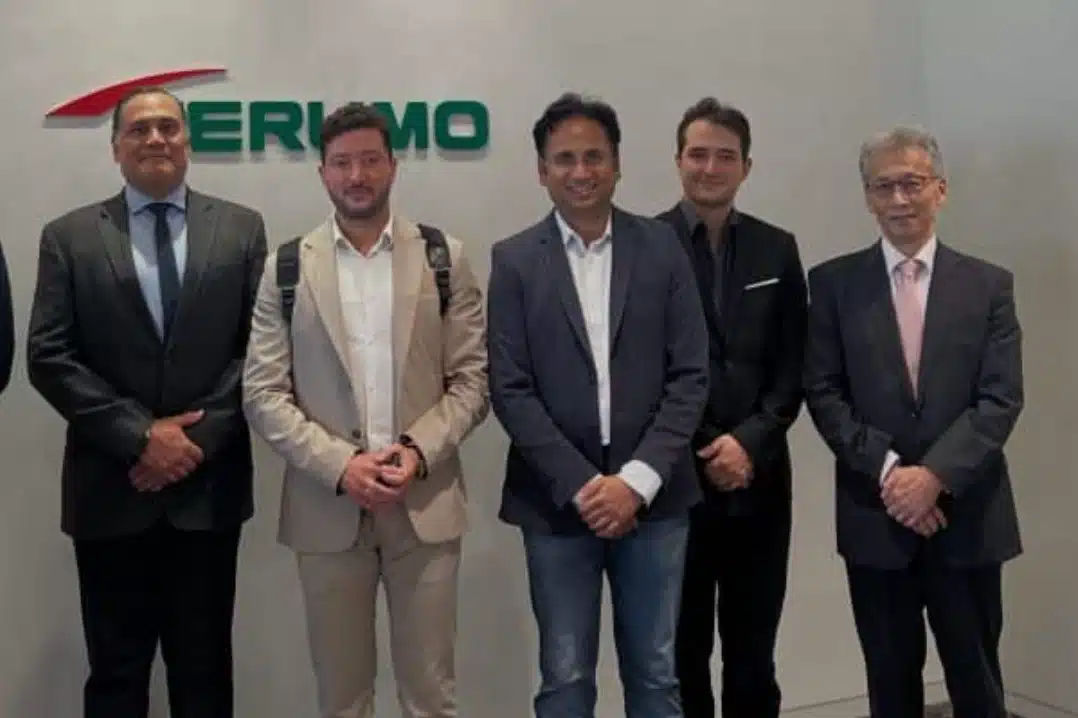
Eclevar MedTech team with Terumo on EU MDR vascular strategy
With Terumo · EU MDR vascular device strategy
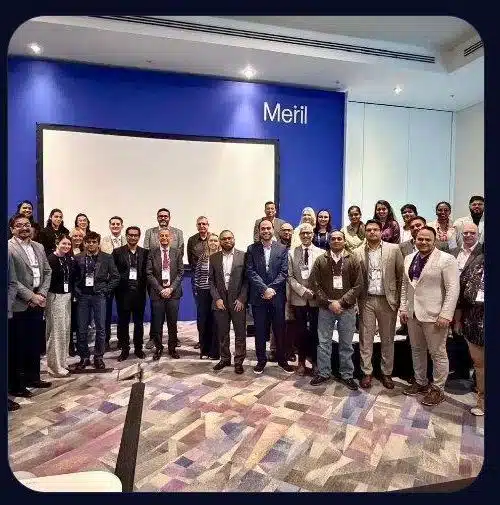
Eclevar MedTech team with Meril Life Sciences
With Meril Life Sciences · structural heart program
Delivery model

The Eclevar cardiovascular delivery model, four pillars

PillarDelivery
Clinical strategy and study designEvidence gap assessment, clinical development pathway, protocol and CIP, endpoints, statistical design.
Sites and clinical operationsSite and investigator feasibility, start up, monitoring, safety management across European cardiovascular centers.
Imaging, adjudication and dataCore lab model, CEC and adjudication charters, EDC, data management, imaging reconciliation.
Regulatory evidence and post market integrationSubmissions, CER, PMCF, PSUR alignment, Notified Body deficiency response.
Why Eclevar

Why cardiovascular manufacturers choose Eclevar

Cardiovascular programs fail on the seams between work packages: a protocol that the biostatistician never stress-tested, endpoints the core lab cannot adjudicate, a CER disconnected from the PMCF plan. Eclevar removes the seams: clinical strategy, study design, data management, biostatistics and submission evidence are built by one team, informed by former Notified Body cardiovascular review experience, bringing reviewer-side insight into evidence planning and submission readiness.

  • Cardiac surgeon-led clinical strategy. Dr Mark DaCosta, former TÜV SÜD cardiovascular reviewer and cardiac surgeon, brings reviewer-side insight to study design.
  • Class III and implantable experience across structural heart, coronary and peripheral vascular.
  • In-house medical writing, biostatistics and clinical data management, the core evidence functions, led and integrated by Eclevar.
  • Established investigator and site relationships across European tertiary cardiovascular centers.
Who this is for

Designed for sponsors who

  • are preparing a first in human or pivotal cardiovascular investigation in Europe
  • hold a CE marked implant that needs PMCF, durability or registry evidence
  • face a Notified Body request, a CECP consultation or an evidence gap
  • are entering Europe from Japan, the US or another market
  • need imaging, core lab and adjudication designed into the protocol, not retrofitted
  • want one integrated evidence program rather than disconnected work packages
Starting situations

Where you are, and where to start

Where you areStart here
You have a device but no European evidence strategyCardiovascular Evidence and Study Strategy Assessment
You have a protocol that has not been stress testedStudy design and biostatistics review
You need centers that can recruit and contractSite and investigator feasibility
Your endpoints require independent adjudicationCore lab and CEC design
Your Notified Body requested more evidenceDeficiency response and evidence remediation
You need long term durability evidenceCardiovascular PMCF program
The entry offer

Cardiovascular Evidence and Study Strategy Assessment

The offer that carries the pillar. We assess the evidence your device family needs, the pathway it should follow and the countries, sites, imaging and statistical model that can deliver it, before the first work package is committed. The recommendation is independent and can challenge the current plan.

What the sponsor sends

  • device family, intended purpose, development stage, current protocol or synopsis, CER and PMCF plan
  • claims, target countries, endpoints, current evidence gaps

A mutual CDA can be executed before document exchange, and materials are handled through Eclevar's controlled document sharing process.

What the sponsor receives

  • Evidence strategy. Evidence gap map, recommended clinical pathway, endpoint and follow up strategy
  • Execution model. Country and site model, imaging, core lab and adjudication recommendation, statistical considerations
  • Integration. CER and PMCF integration plan
  • Commercial. Work packages, timeline, budget

Request a cardiovascular evidence assessment

Device families

Cardiovascular device families

Each family carries its own population, endpoints and registry landscape. This section situates them; the owning page carries the full design.

Structural heart

TAVI, mitral, tricuspid, LAAO, occluders. Elderly and frail populations, CT sizing, echo core labs, adjudicated endpoints and multi-year follow-up. Start with the structural heart evidence overview, then the dedicated TAVI page.

Structural Heart Clinical Evidence

Coronary and interventional

Stents, drug-coated balloons, guidewires, microcatheters, vascular closure. High-volume procedures with strong comparator expectations and dense procedural data. Evidence hinges on operator effects, lesion complexity and event adjudication.

Coronary Device Clinical Evidence

Peripheral and aortic vascular

Peripheral intervention, EVAR and TEVAR, embolic protection, grafts. Anatomically diverse populations and long durability horizons; imaging surveillance and reintervention data dominate the plan. Scoped through the strategy assessment; a dedicated page is in preparation.

Cardiovascular software and connected devices (imaging analysis, AI-assisted interpretation, physiological monitoring) follow a different regulatory logic under Rule 11 and are covered by our SaMD and Digital Health cluster, not treated as a cardiovascular family here, to keep evidence requirements and search intent distinct.

Three cardiovascular families, one deliberate boundary Cardiovascular devices branch into three families: structural heart, coronary and interventional, and peripheral and aortic vascular. Digital cardiovascular devices sit outside the boundary and follow SaMD and Digital Health Rule 11 logic. DEVICE FAMILIES Three cardiovascular families, one deliberate boundary Each family carries its own population, endpoints and registry landscape, digital devices follow a different regulatory logic. Cardiovascular devices Structural heart TAVI · mitral · tricuspid · LAAO · occluders Coronary and interventional stents · drug coated balloons · guidewires · microcatheters · vascular closure Peripheral and aortic vascular peripheral intervention · EVAR and TEVAR · embolic protection · grafts Digital cardiovascular imaging analysis, AI interpretation, monitoring ? SaMD and Digital Health cluster, Rule 11 The boundary is deliberate, it keeps evidence requirements and search intent distinct per family. Eclevar MedTech · Cardiovascular · Structural Heart
Development pathway

Clinical development pathway

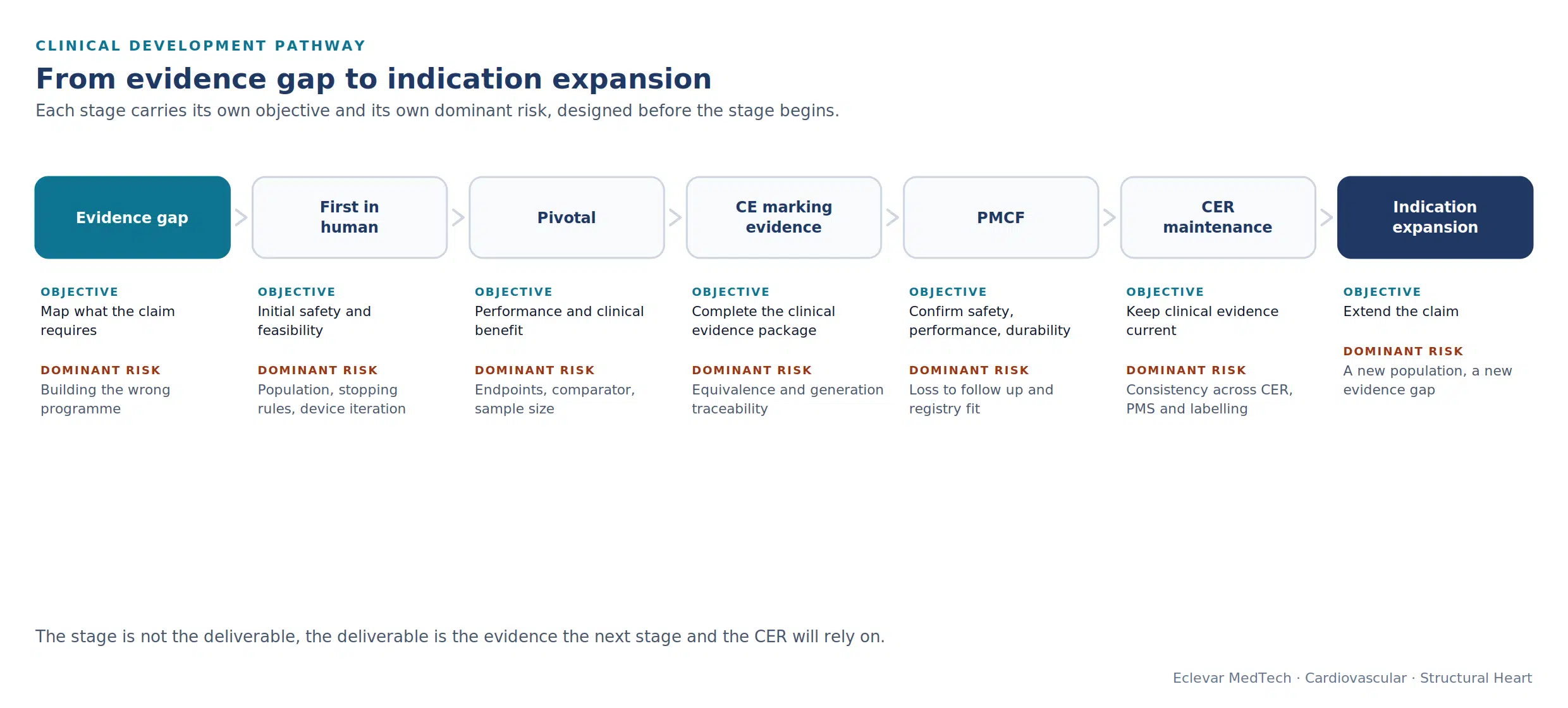
Eclevar supports the complete cardiovascular evidence lifecycle, from evidence-gap assessment through CE-marking evidence, PMCF and indication expansion. Each stage carries its own objective, dominant risk and owning service page.

StageObjectiveDominant risk
First-in-humanInitial safety and feasibilityPopulation, stopping rules, device iteration
PivotalPerformance and clinical benefitEndpoints, comparator, sample size
PMCFConfirm safety, performance, durabilityLong-term follow-up, loss to follow-up, registry fit
CER maintenanceKeep clinical evidence currentConsistency across CER, PMS and labeling

Owning pages: First-in-Human · Pivotal · PMCF · CER.

Clinical development pathway from evidence gap to indication expansion.
Evidence challenges

Common cardiovascular evidence challenges

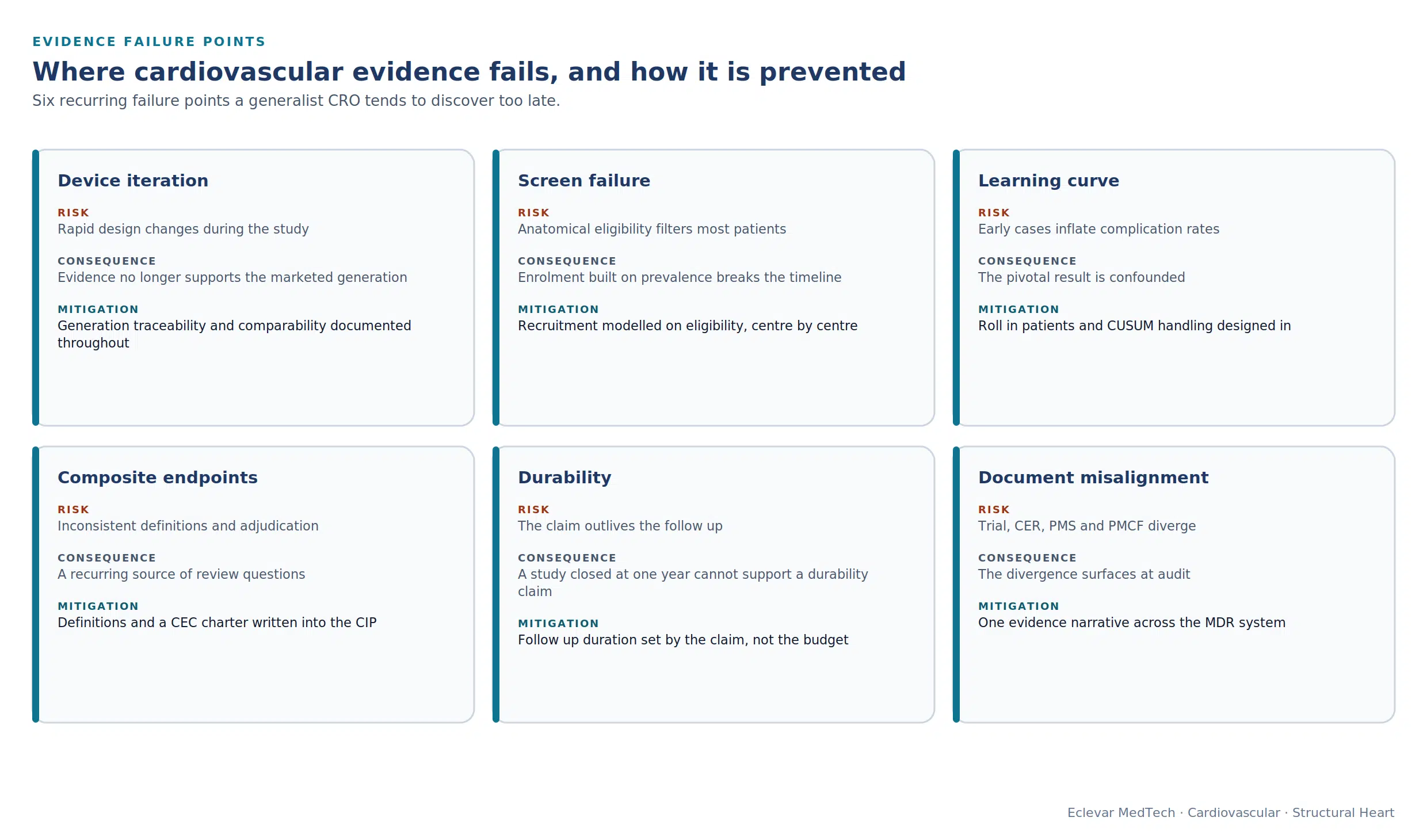
This is where a cardiovascular specialist earns its place. Each challenge below carries a concrete consequence a generalist CRO tends to discover too late.

ChallengeConcrete consequence
Rapid device iterationsWeakens the link between the investigated generation and the CE-marked device; design changes, comparability and residual uncertainty must be documented throughout.
Small eligible populations and screen failuresAnatomical eligibility drives high screen-failure; enrollment assumptions built on prevalence, not eligibility, break the timeline.
Operator and center effects, learning curvesEarly cases inflate complication rates; roll-in patients and, where appropriate, CUSUM handling must be designed in, or the pivotal result is confounded.
Composite endpoints and event adjudicationPoorly defined or inconsistently adjudicated composite endpoints are a recurring source of review questions; definitions and a CEC charter belong in the CIP.
Long-term durabilityValve and implant claims require multi-year follow-up; a study closed at one year cannot support a durability claim the label makes.
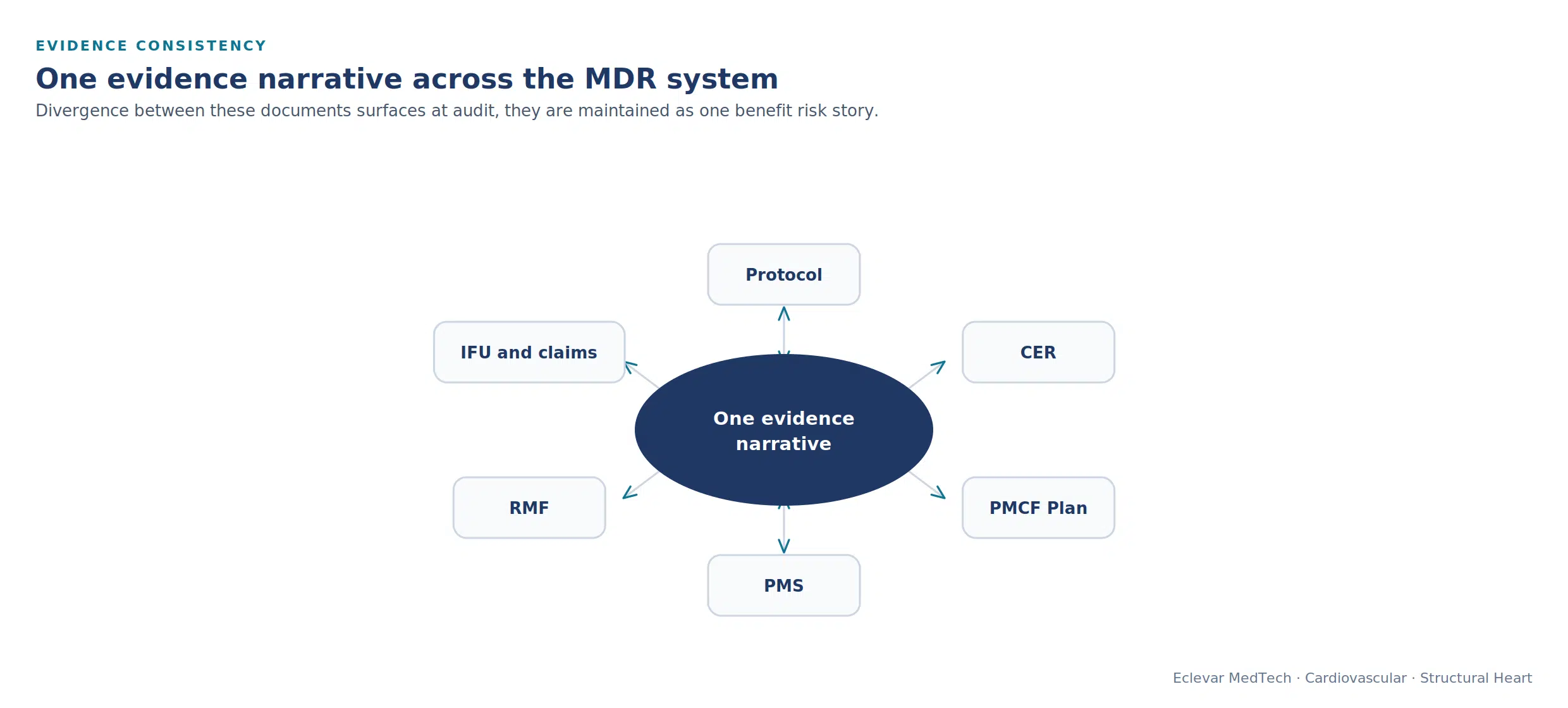
Study, CER, PMS and PMCF alignmentDivergence between the trial, the CER and the PMCF plan surfaces at audit; they must be one evidence narrative, not four documents.

The reviewer's-eye view of these deficiencies is set out in MDR Compliance for Class III Cardiac Implants.

Six cardiovascular evidence failure points.
Populations and sites

Patient populations and site requirements

Cardiovascular sites are not interchangeable. Recruitment concentrates in high-volume tertiary centers with mature heart-team decision-making and on-site CT, echo and cath-lab capability. Feasibility is less can we find sites than can we win priority at the right ones: investigator relationships and per-center commitments decide timelines, and competing valve trials at any high-volume center must be mapped per site, not per country.

  • Site expertise and procedure volume, heart-team model, imaging capability (CT, echo, cath), follow-up capacity.
  • Screening burden and realistic screen-failure assumptions modelled by indication and anatomy, not by prevalence.
  • Referred versus local populations, recruitment competition from concurrent commercial and study procedures.
  • Operational readiness, site activation capacity, proctoring readiness for some devices, imaging-transfer readiness.
Independent core lab and endpoint adjudication
Independent core lab & adjudicationEvery cardiovascular imaging endpoint is read and adjudicated the same way, across European sites.
Endpoints

Endpoints and follow-up

Endpoints depend on the device family; composites must be justified; follow-up duration follows the risk and the claim; and major clinical events often require independent adjudication, particularly in pivotal and high-risk implant studies. Cardiovascular endpoints span mortality, stroke, myocardial infarction, rehospitalisation, device and procedural success, hemodynamic performance, reintervention, functional status and long-term durability. How these are defined and adjudicated, and how VARC-3 structures them from first-in-human to pivotal, is set out in the endpoint reference guide.

Owner: Structural Heart Trials: VARC-3 Endpoints from FIH to Pivotal.

Imaging and core lab

Imaging, core lab and adjudication

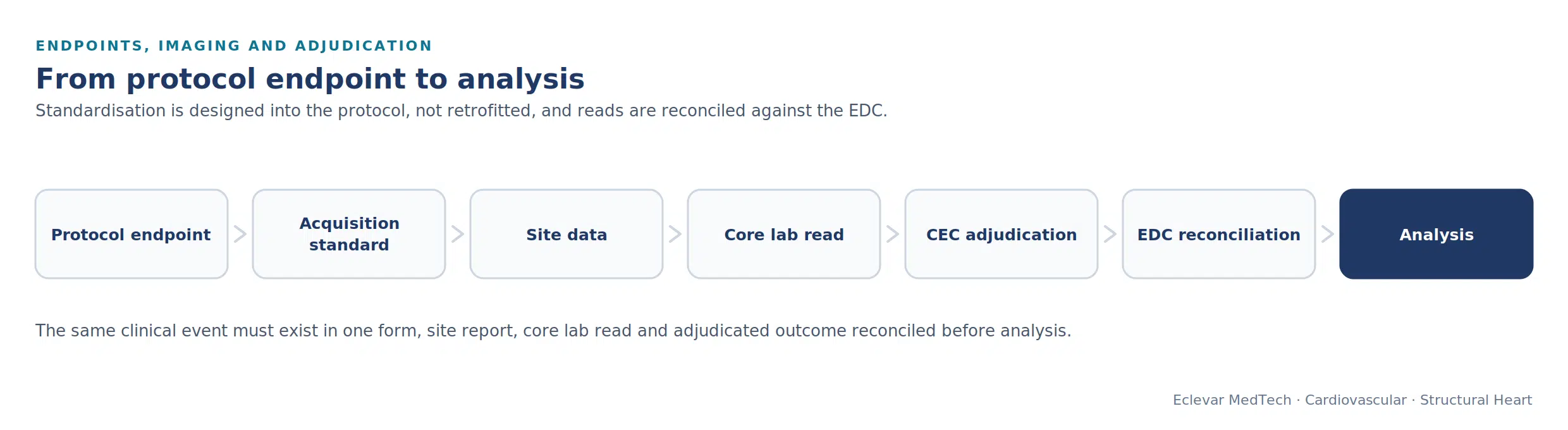
Imaging is often the primary evidence of device performance, so standardization must be designed into the protocol, not retrofitted. Echo, CT, angiography and hemodynamic assessment need defined acquisition, a core-lab charter, qualified readers and imaging-transfer logistics solved before activation, with reads reconciled against the EDC. A core lab or CEC may become necessary when key endpoints depend on blinded, independent assessment.

Owner: Cardiovascular Endpoint Adjudication and Core Lab Services.

From protocol endpoint to analysis: the imaging and adjudication workflow.
Imaging & data

One imaging and data pipeline, adjudication-ready

From site echo and CT to core lab reads, DICOM pseudonymisation and endpoint adjudication, we keep a single controlled pipeline, so the same clinical event never exists in three inconsistent forms.

Clinical data management and biostatistics
Data and biostatistics

Data management and biostatistics

The statistical strategy is built with the protocol, the imaging plan, the adjudication plan, the follow-up model and the regulatory claims, never bolted on afterwards.

Data management

  • Dense procedural CRFs, imaging reconciliation, CEC and adjudication datasets, device accountability, safety reconciliation, longitudinal follow-up.

Biostatistics

  • Performance goals, composite endpoints, time-to-event, competing risks, missing imaging data, registry benchmarking, external controls.

Owners: Clinical Data Management · Biostatistics · Sample Size · Imaging and Core Lab Data.

Regulatory and Notified Body

Regulatory and Notified Body expectations

Class III cardiac implants are subject to heightened MDR scrutiny and may fall within the Clinical Evaluation Consultation Procedure (CECP) under Article 54. Literature alone is often insufficient to support the full clinical evidence package for novel or high-risk cardiac implants; equivalence is hard to demonstrate for iterating devices; durability and long-term follow-up are scrutinised; and the CER, risk management file, PMS, PMCF and labeling must tell a consistent benefit-risk story. Device-generation traceability, proving which generation the evidence supports, is a recurring pressure point.

One evidence narrative across the MDR system.
PMCF

PMCF and long-term evidence

Cardiovascular devices need post-market evidence that most other device types do not: multi-year durability, imaging surveillance, reintervention rates and device-deficiency trends in real-world populations. The strategy distinguishes prospective PMCF studies, registry-based PMCF and RWE, and for aortic valve devices, national registries can carry part of the burden. The dedicated page carries the design; registry proper nouns live in the registry directory.

Owner: Post Market Clinical Follow Up. The dedicated cardiovascular PMCF and registry page is in preparation.

Class III cardiovascular clinical evidence under EU MDR
Class III cardiovascular evidenceFrom TAVI and transcatheter valves to durable long-term follow-up under EU MDR 2017/745.
Country execution

European cardiovascular study execution

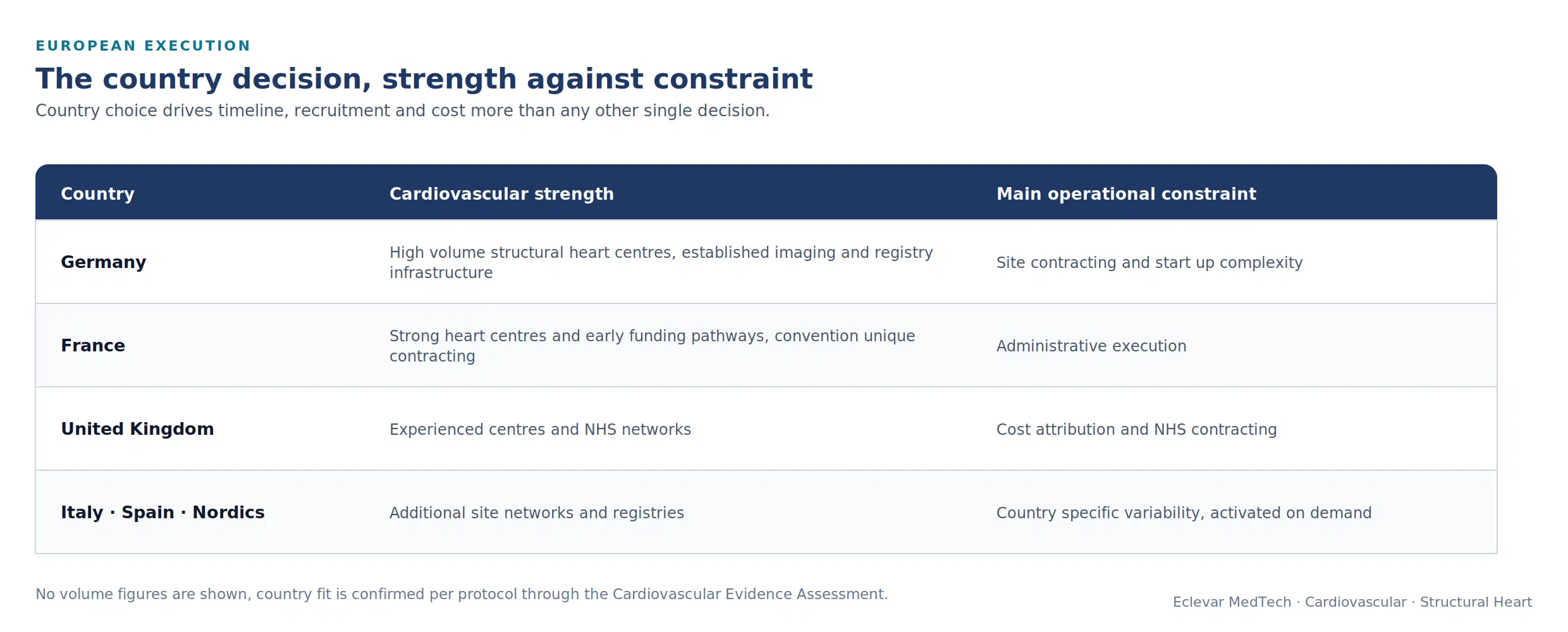
Country choice drives timeline, recruitment and cost more than any other single decision. This pillar frames the trade-off and links out; it does not detail any national submission pathway.

CountryCardiovascular profile and main operational challengeHub
GermanyStrong network of high volume structural heart centers, established imaging and national registry infrastructure; site contracting and start up are complex.Germany hub, live
FranceStrong heart centers plus early funding pathways; convention unique standardises contracting.France hub, in preparation
United KingdomExperienced centres and NHS networks; cost attribution and NHS contracting add complexity.UK hub, in preparation
Italy, Spain, NordicsAdditional site networks and registries; backlog hubs, promoted on demand.on demand

Structural Heart Clinical Trials in Germany (flagship intersection) · Where Should I Run My Study?.

European country decision matrix.
One evidence program

The Eclevar cardiovascular delivery model

Clinical strategy, protocol and CIP, regulatory submissions, site feasibility, KOL and investigator network, monitoring, safety management, core lab and adjudication, data management, biostatistics, CER and PMCF are managed as one evidence program rather than disconnected work packages. The advantage is not breadth for its own sake, it is that a decision made in study design is already understood by the statisticians, the data managers and the writers who will defend it at submission.

European clinical operations

Cardiovascular sites, run end to end

Heart Team coordination, high-volume structural heart centers, proctoring logistics and monitoring, with VARC-3 endpoints and reimbursement-grade evidence built in from the protocol onwards.

Cardiovascular clinical operations across European sites
Expertise

Cardiovascular expertise

Named, verifiable expertise. Every row carries an exact, substantiable proof.

NameRoleExact proof
Prof. Mark DaCostaCOO and CMO, CardiovascularCardiac surgeon and former senior cardiovascular reviewer at TÜV SÜD (confirmed, published on eclevarmedtech.com)
Pierre-Marie BoutanquoiHead of Medical WritingCER and Notified Body deficiency-response experience
Sébastien Meier PiantanidaChief Data Officer, data and biostatisticsLeads data management, biostatistics and the Milo clinical data platform (published on eclevarmedtech.com)
Charline PetitdemangeLead Clinical Project ManagerSite qualification, monitoring and TMF for European investigations under ISO 14155:2020 (published on eclevarmedtech.com)
Prof. Georg NickenigScientific advisory board[confirm public-reference rights, SME]
Selected experience

Selected cardiovascular experience

Format: device, evidence challenge, Eclevar intervention, result. These engagements are named because they are already published on the Eclevar client success stories page.

Structural heart, TAVI (Meril Life Sciences)

TAVI device portfolio, Class III. Challenge: reimbursement grade clinical evidence satisfying UK NICE requirements and post-Brexit MDR equivalent expectations. Eclevar: design and delivery of a multicentre reimbursement clinical study across leading UK cardiology centers. Result: a running multicentre study built on Eclevar's cardiovascular clinical expertise and site network.

Portfolio PMCF program (Meril Life Sciences)

Class III cardiovascular and orthopedic portfolio. Challenge: sustain post market clinical evidence across multiple product lines. Eclevar: PMCF survey strategy across the portfolio, run in parallel with the TAVI study. Result: a portfolio-wide PMCF survey program.

Guidewire and coronary portfolio (Asahi Intecc)

Coronary guidewire portfolio. Challenge: pass Notified Body review of the clinical evidence. Eclevar: clinical evidence preparation and review readiness. Result: Notified Body review completed with zero major nonconformity reports, a verified outcome published by Eclevar.

Class III vascular portfolio (Terumo)

Global vascular portfolio, Class III. Challenge: bridge Japanese regulatory logic to European Notified Body clinical evidence expectations. Eclevar: clinical evaluation strategy, PMCF architecture and structured deficiency response methodology. Result: an EU MDR market access evidence framework across the portfolio.

Request a Cardiovascular Evidence and Study Strategy Assessment

Get a structured read on evidence strategy, endpoints, sites and timeline for your device, grounded in what European reviewers and expert panels actually expect.

Request a cardiovascular evidence assessment

Reforming Clinical Evaluation of Medical Devices in Europe