Cardiovascular & Structural Heart · EU MDR 2017/745

Cardiovascular PMCF and registry studies, under EU MDR

Class III cardiovascular and structural heart devices, run through European sites with VARC-3 endpoints, imaging core lab, independent adjudication, PMCF and CER.

TAVITMVR / TTVRVARC-3Core lab & adjudicationEU MDR 2017/745
Cardiovascular clinical investigation under ISO 14155
From uncertainty to CER-ready evidence
1
Residual uncertainty
  • · CER gaps
  • · Residual risks
  • · Notified Body commitments
2
Cardiovascular PMCF program
  • · Study
  • · Registry
  • · Imaging
  • · Follow-up
3
Regulatory evidence
  • · PMCF Evaluation Report
  • · CER update
  • · PSUR
  • · RMF / benefit-risk
One integrated program of study, registry, imaging and follow-up, feeding CER, PSUR and benefit-risk.
Expertise & recognition

A recognized European cardiovascular team

EUCROF Platinum Award 2026
EUCROF Platinum Award 2026xShare Open Call for Clinical Research, co-funded by the European Union
Prof. Mark DaCosta

Prof. Mark DaCosta

Chief Operating Officer & Head of Cardiovascular

TÜV SÜD
25+yrs

in cardiac surgery & cardiovascular device evaluation

  • Cardiac surgeon & former TÜV SÜD Lead Cardiovascular Reviewer
  • Reviewed clinical evidence for 400+ cardiovascular devices
  • Leads Eclevar's TAVI, structural heart & high-risk cardiovascular device programs
LinkedIn
Susanne Höfer

Susanne Höfer

Head of Cardiovascular Clinical Operations · DACH

Previously
Edwards Lifesciences Stryker ReCor
19+yrs

in international clinical research (cardiovascular & interventional)

  • Led international programs covering ~200 sites & ~3,000 patients
  • Investigator engagement, KOL collaboration & site training
  • Oversees cardiovascular study delivery across the DACH region
LinkedIn
S. Meier Piantanida

Sébastien Meier Piantanida

Chief Data Officer · Biometrics & Data Systems

30yrs

in clinical data management, EDC & biometrics systems

  • Leads EDC, clinical data management & biometrics across the study lifecycle
  • Expertise in CDISC, CDASH, SDTM & ADaM
  • Oversees validated data flows between sites, the Core Lab & statistical teams
LinkedIn
Mathilde Renier

Mathilde Renier

Senior Clinical Data Manager · Cardiovascular

10+yrs

in cardiovascular clinical data management

  • Manages eCRF & database build, validation, cleaning & lock
  • Coordinates imaging & endpoint data from the Core Lab to analysis
  • Supports VARC-3-aligned data collection, review & traceability
LinkedIn
Charline Petitdemange

Charline Petitdemange

Lead Clinical Project Manager · Cardiovascular programs (France & UK)

10+yrs

in clinical research & medical device studies

  • Leads cardiovascular investigations & PMCF studies from start-up to close-out
  • Manages site coordination, monitoring, timelines & cross-functional teams
  • Former CPM at the Center de Recherche Cardio-Vasculaire des Alpes
LinkedIn
Trusted by

Leading medical device teams

TERUMOMerilNIHON KOHDENVYGONColoplastSHOFUASAHI INTECCRegenLabTERUMOMerilNIHON KOHDENVYGONColoplastSHOFUASAHI INTECCRegenLab
On the ground with our clients

Real cardiovascular partners

Our clinical team on site with the manufacturers who trust Eclevar to run their cardiovascular and structural heart evidence.

Eclevar MedTech team with Terumo on EU MDR vascular strategy
With Terumo · EU MDR vascular device strategy
Eclevar MedTech team with Meril Life Sciences
With Meril Life Sciences · structural heart program
The service

Cardiovascular PMCF services

Strategy

  • PMCF gap assessment
  • PMCF strategy
  • PMCF Plan

Identify the unresolved clinical questions and define the evidence model required to close them.

Study design

  • Protocol and CIP
  • Statistical rationale
  • Registry assessment

Design the study, endpoints and data source that can actually close the gap.

Study delivery

  • Feasibility
  • Start-up
  • Clinical operations

Activate sites and retain interpretable follow-up over the full study duration.

Evidence integration

  • Data management
  • Biostatistics
  • CER and PSUR integration

Turn clean longitudinal data into CER-ready regulatory evidence.

Delivery model

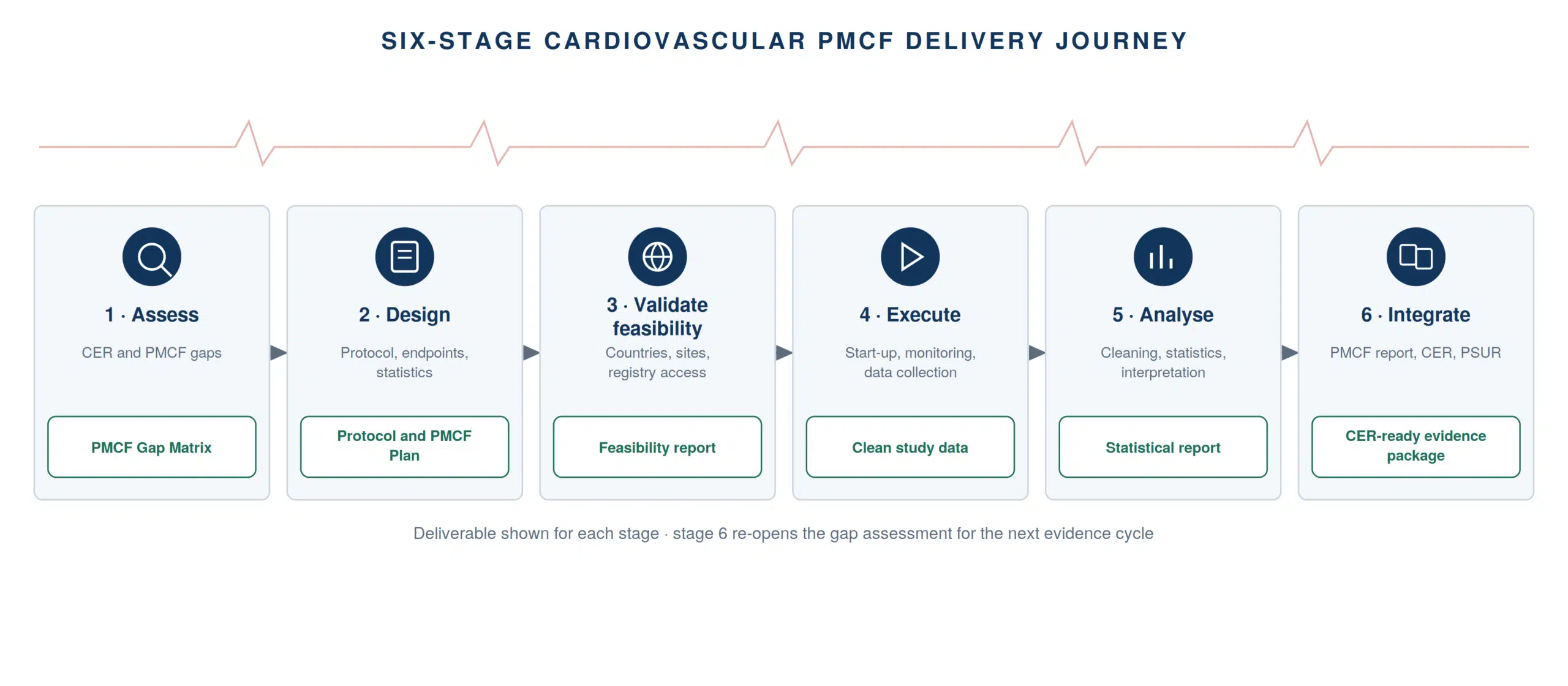
Eclevar end-to-end delivery model

The six-stage PMCF delivery journey, a verb, an icon and a named deliverable per stage, along a discreet ECG line.
Why programs fail

Why cardiovascular PMCF programs fail

Cardiovascular PMCF fails when it is treated as a regulatory formality rather than a targeted evidence program. Five failure points break the evidence chain.

Failure pointConsequence
Unclear PMCF questionThe study cannot close the evidence gap
Registry not fit for purposeThe data cannot support the intended conclusion
Weak device traceabilityDevice generations become mixed
Follow-up too shortDurability remains unresolved
No CER integrationThe study produces data, not regulatory evidence
Eclevar connects the evidence question, study design, execution and regulatory integration from the start.
Evidence questions

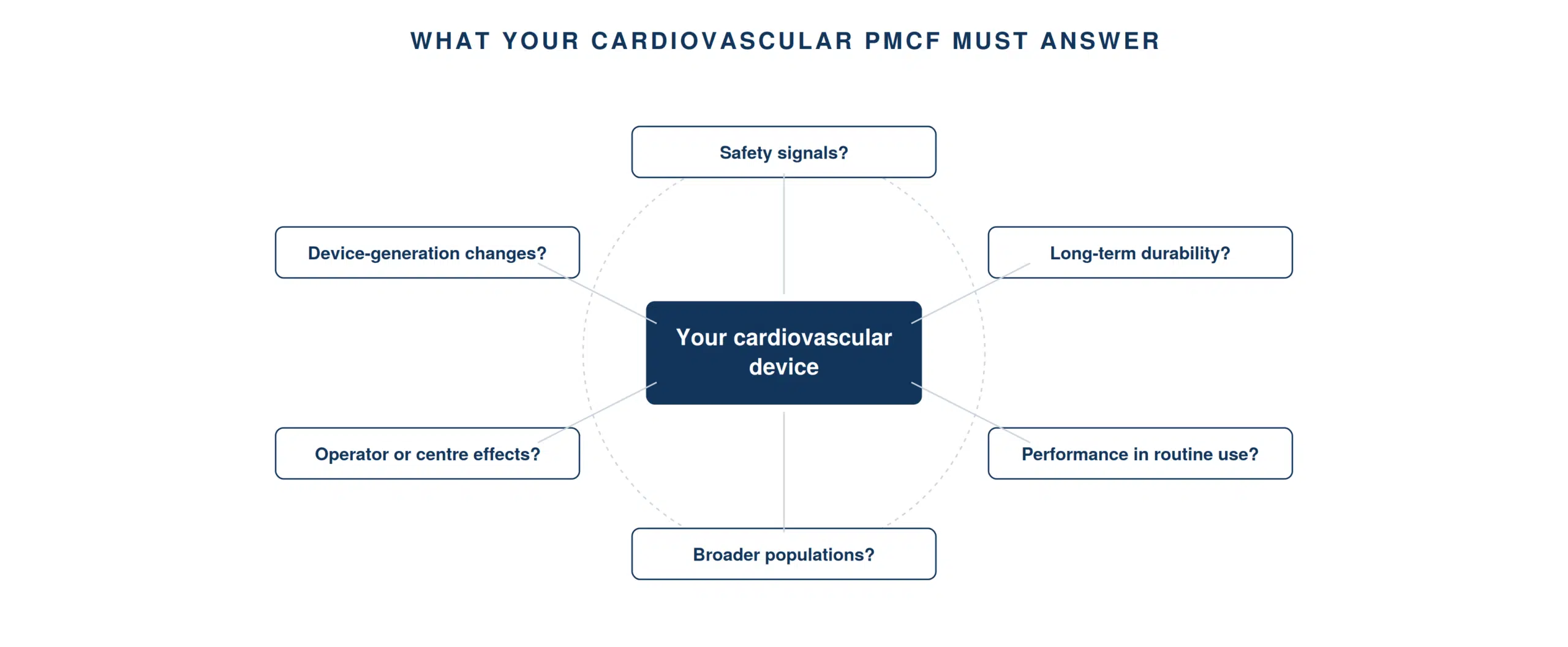
What your PMCF must answer

Six explicit evidence questions around the device.
A PMCF program must answer explicit evidence questions, not merely confirm safety and performance.
Gap matrix

The Eclevar cardiovascular PMCF gap matrix

The Eclevar cardiovascular PMCF gap matrix: gap, regulatory relevance, data source and output.

The assessment maps intended purpose, claims, studied population, residual risks and Notified Body commitments into a single deliverable, the Eclevar cardiovascular PMCF gap matrix. Three representative gaps:

Evidence gapWhy it mattersBest data sourceOutput
DurabilityLong-term benefit-riskProspective or registryCER, PSUR
Rare safety signalSafetyPooled registry or PMCFPSUR
New device generationTraceabilityProspective cohortCER

Other gaps assessed include broader-risk populations, imaging deficiencies, operator variability, missing variants and label-expansion questions.

Not sure which PMCF model your device needs? Request a PMCF gap assessment

Independent core lab and endpoint adjudication
Independent core lab & adjudicationEvery cardiovascular imaging endpoint is read and adjudicated the same way, across European sites.
PMCF models

PMCF models we design and deliver

The model follows the gap, never the reverse. Each model is delivered end to end: strategy, protocol, sites or network, data, statistics and CER integration.

Prospective PMCF

Best used when: Structured, adjudicated evidence is required

Strength: Control and endpoint robustness

Limitation: Cost and duration

Observational cohort

Best used when: Routine use and broader populations matter

Strength: Real-world relevance

Limitation: Less control over practice variation

Registry-based PMCF

Best used when: Longitudinal real-world data already exist

Strength: Scale and long-term follow-up

Limitation: Only usable when device, endpoints and data quality are fit for purpose

Retrospective review

Best used when: Historical signal or feasibility must be assessed

Strength: Speed and low burden

Limitation: Data quality and completeness limits

PMCF survey

Best used when: Use-pattern and experience data are the gap

Strength: Reach across users

Limitation: Rarely sufficient alone

Hybrid program

Best used when: Several gaps cannot be resolved by one study

Strength: One integrated evidence plan

Limitation: Requires strong data-source coordination

A hybrid program is often the most appropriate route when several evidence gaps coexist and no single data source can close them.


Device families

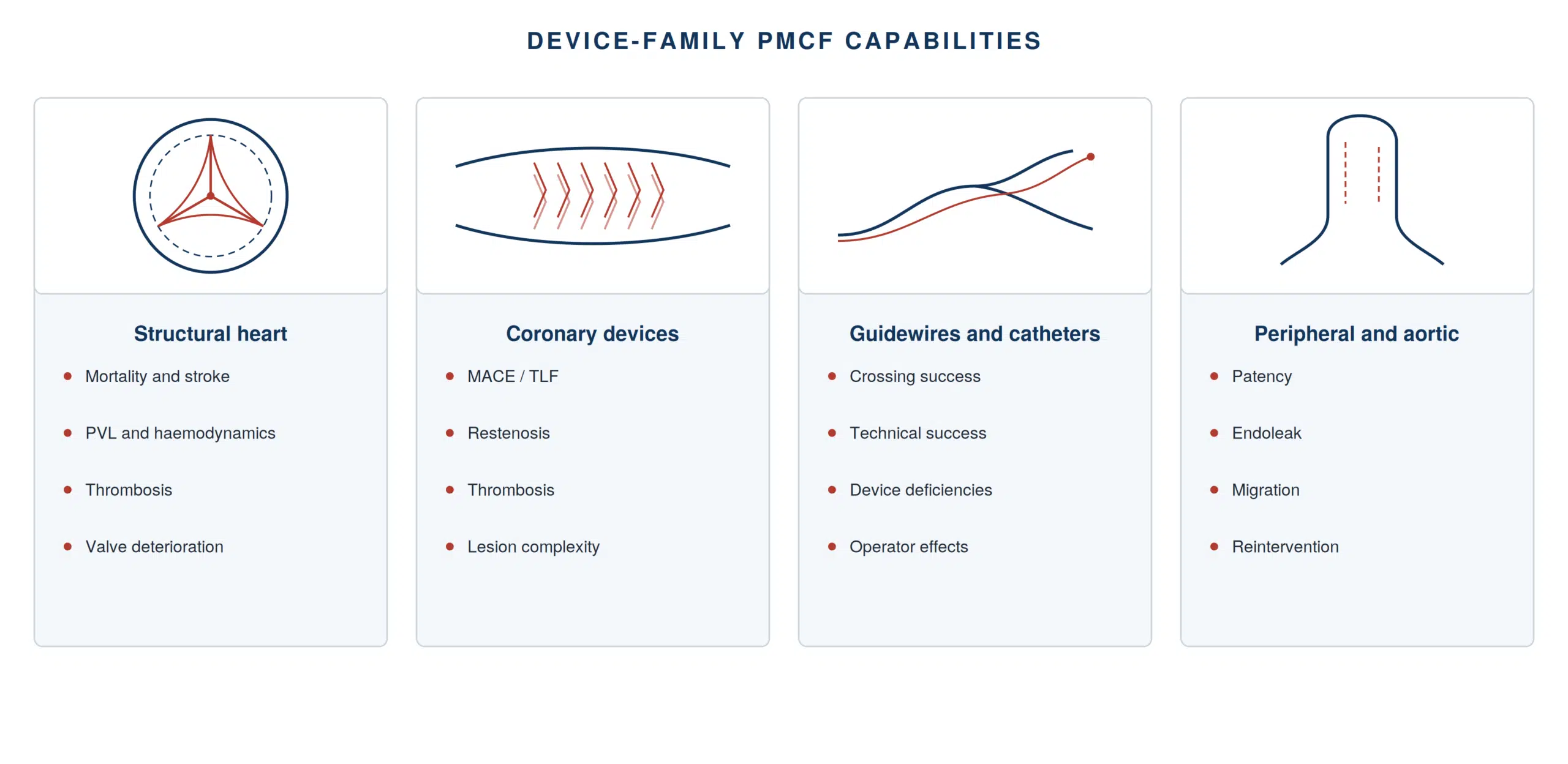
Device-family PMCF capabilities

Four device families: transcatheter valve, coronary stent, guidewire in the vascular tree, and the aorta and peripheral arteries.
Registry fit-for-purpose

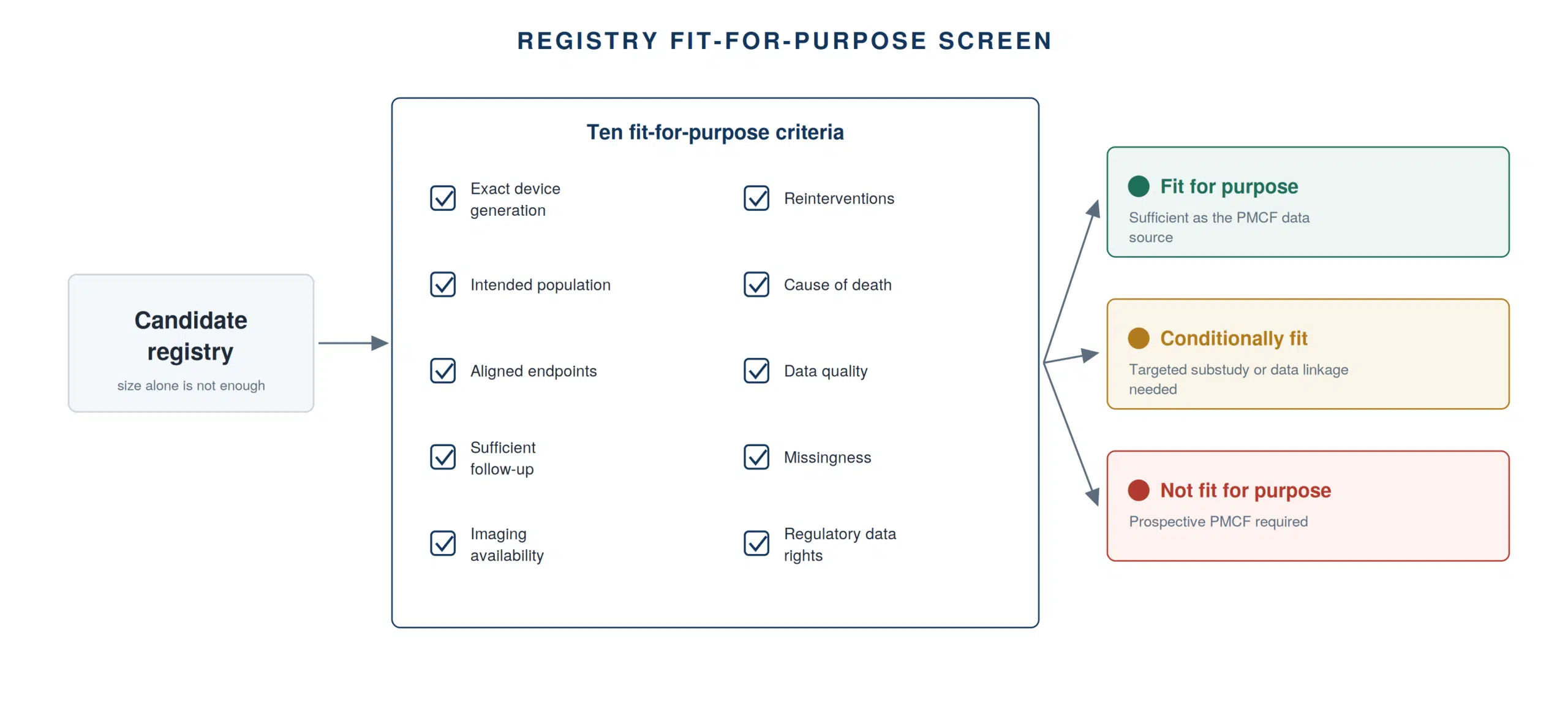
A large registry is not automatically a useful PMCF registry

Ten registry fit-for-purpose criteria and three outcomes: fit, fit with remediation, not fit.

The four most discriminating criteria in practice:

CriterionAcceptableGapAction
Device generationExact UDI or modelFamily onlyAdd sponsor dataset
EndpointsAligned definitionsPartially alignedMapping or adjudication
Follow-upMulti-yearShortExtension
Data qualityAuditedUncertainValidation

The decision is not registry versus study. It is which combination provides sufficient control, scale and longitudinal depth for the unresolved evidence question.

Already have access to a registry? Request a registry fit-for-purpose review

Feasibility

Country, site and KOL feasibility

Country selection turns on cardiovascular center density, device adoption, registry access, imaging readiness, long-term follow-up reliability, contracting timelines and cost per patient.

European Cardiovascular Feasibility Network EUROPEAN CARDIOVASCULAR FEASIBILITY NETWORK NOUKDEFRITES UKNHS data continuity, specialist centresWatch: cost attribution and site process FranceStrong clinical networksWatch: hospital contracting, start-up NordicsStrong longitudinal registriesWatch: access and governance vary bycountry GermanyHigh-volume cardiovascular centersWatch: contracting and data complexity Italy / SpainExperienced operators, competitiverecruitmentWatch: regional and foundation contracting

Registry access and data governance vary by Nordic country and are assessed individually during feasibility.

Need realistic sites, timelines and costs? Request a European feasibility assessment

Imaging & data

One imaging and data pipeline, adjudication-ready

From site echo and CT to core lab reads, DICOM pseudonymisation and endpoint adjudication, we keep a single controlled pipeline, so the same clinical event never exists in three inconsistent forms.

Clinical data management and biostatistics
Clinical operations

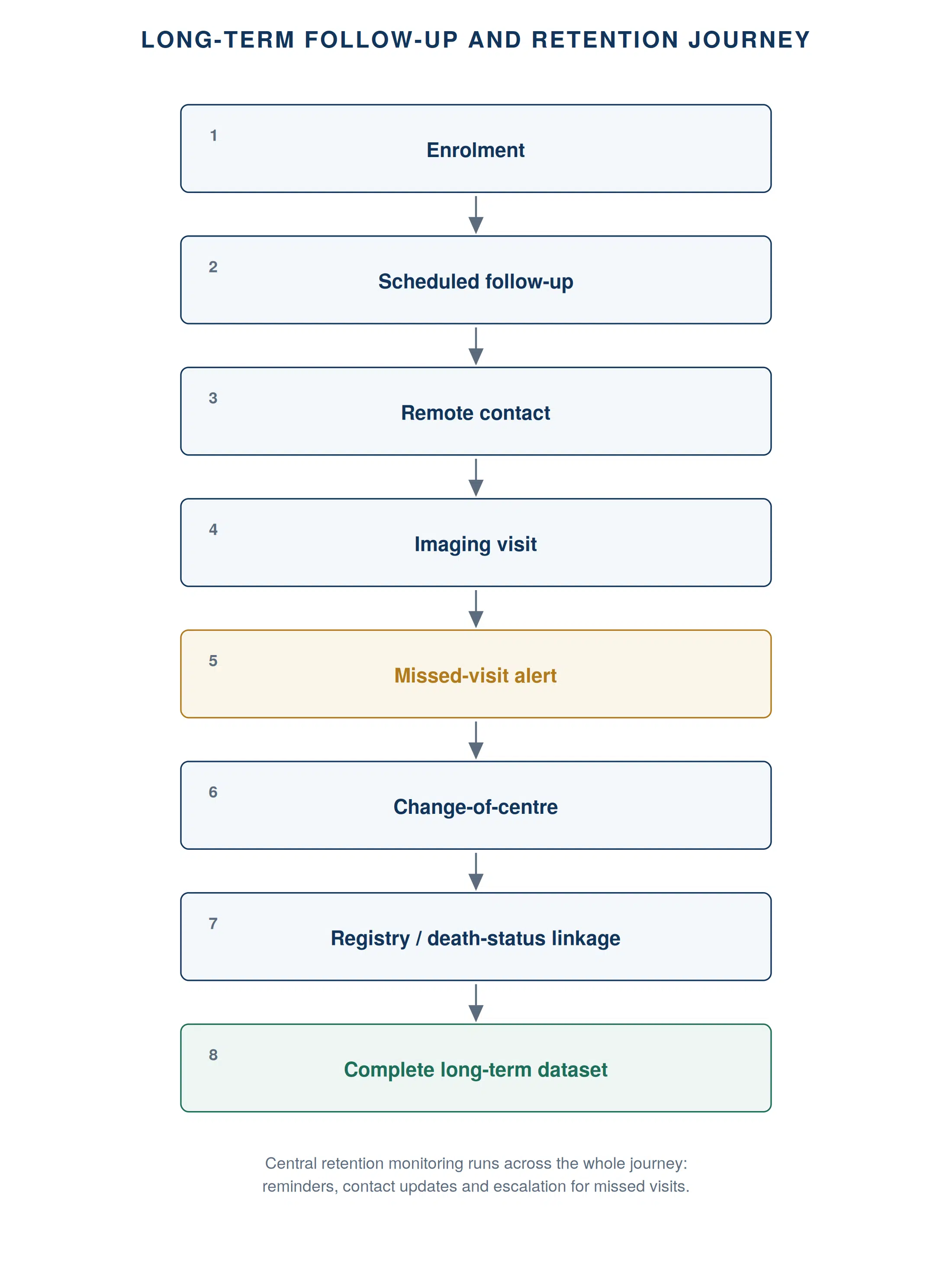
Clinical operations and long-term retention

End-to-end operational delivery: submissions and notifications where required, contracting and budgets, site activation, monitoring, patient retention and safety management.

The long-term patient follow-up journey, a single continuous flow from enrolment to a complete long-term dataset.
In cardiovascular PMCF, the main operational risk is often not enrollment, but retaining interpretable follow-up over several years.

Safety and device-deficiency integration. PMCF captures SAEs, device deficiencies, reinterventions, urgent safety measures and PSUR trends, but PMCF does not replace vigilance. The two systems must reconcile, device deficiencies must be traceable, and trends must feed the PSUR and benefit-risk. German-specific safety reporting stays on the dedicated German PMCF compliance page.

Imaging and core lab

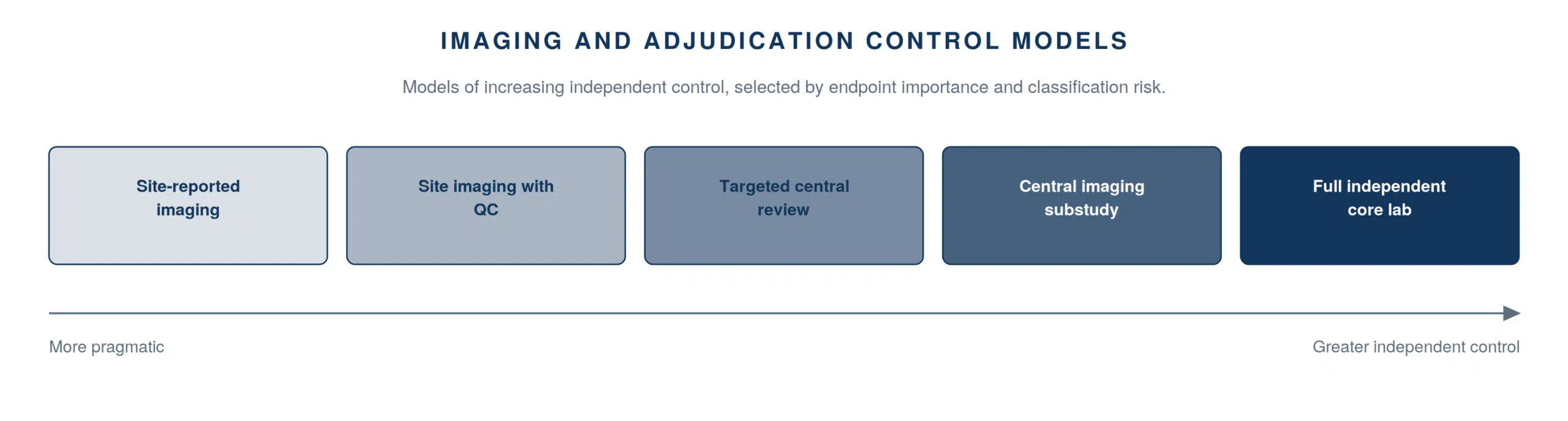
Imaging, core lab and adjudication

Five imaging control models, from the most pragmatic to the strongest central control, selected by endpoint importance and classification risk.
PMCF does not automatically require pivotal-study adjudication intensity, but independence must remain proportionate to endpoint importance and classification risk.

Execution service: Cardiovascular Endpoint Adjudication and Core Lab Services. Endpoint taxonomy: VARC-3 endpoints for aortic valve trials.

Data and technology

Data management and technology

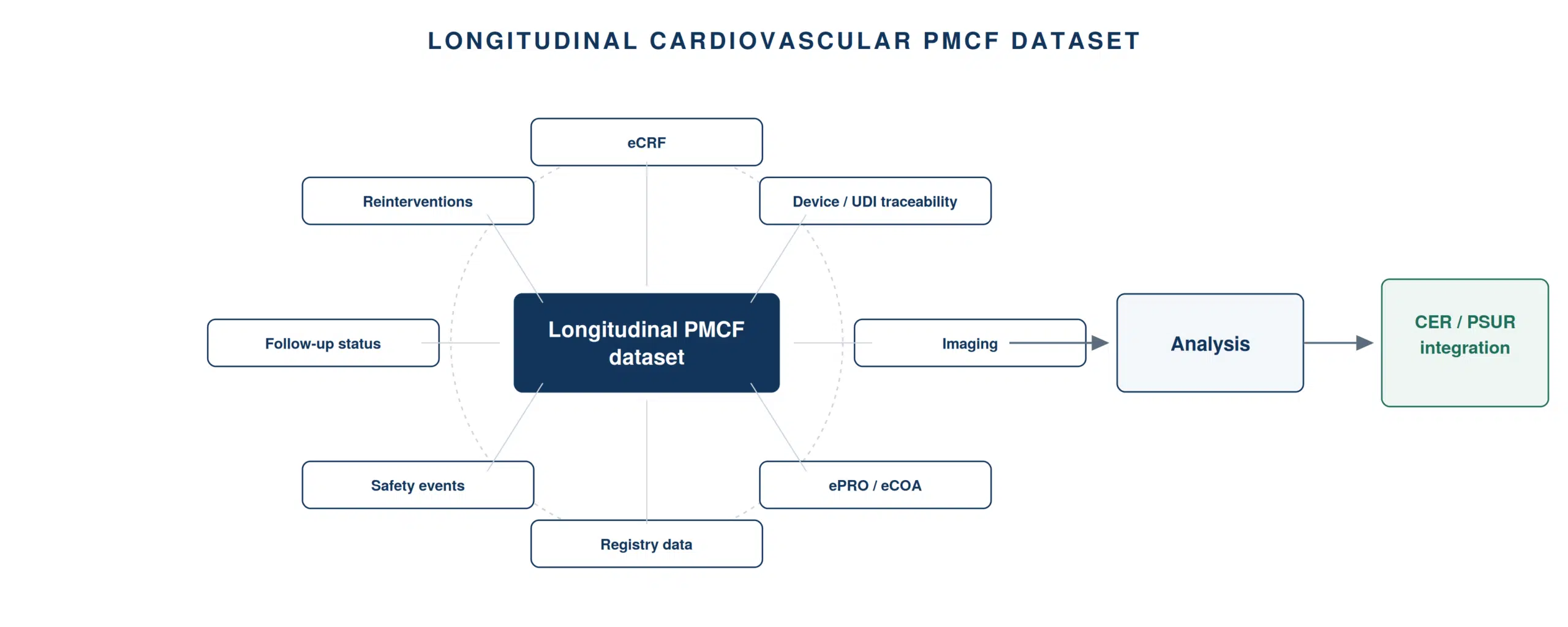
The longitudinal PMCF dataset ecosystem, flowing to analysis and CER and PSUR integration.

What makes cardiovascular PMCF data hard: several years of data, change of center, device-version change, historical plus prospective sources, reinterventions outside the center, cause of death, missing imaging and registry linkage.

Delivered on the MILO EDC and ePRO platform where applicable.

Biostatistics

Biostatistics

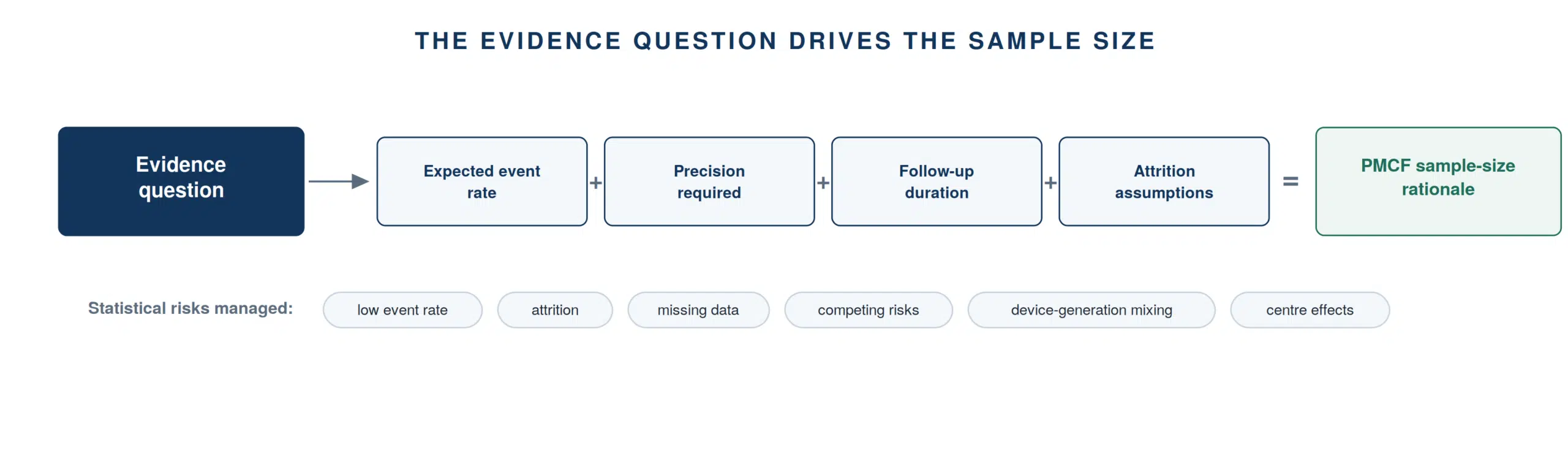
The evidence question drives the sample size, with six statistical risks under management.
PMCF sample size should follow the evidence question and expected event frequency, not a generic minimum number of patients.
Class III cardiovascular clinical evidence under EU MDR
Class III cardiovascular evidenceFrom TAVI and transcatheter valves to durable long-term follow-up under EU MDR 2017/745.
Deliverables

What the sponsor receives

Strategy package

  • PMCF gap assessment
  • PMCF strategy memorandum
  • PMCF Plan
  • Feasibility and registry fit report
  • Budget and timeline

Study document package

  • CIP or protocol and synopsis
  • Statistical analysis plan
  • Data management plan and eCRF specifications
  • Monitoring, safety and adjudication charters

Operational evidence package

  • Activated sites
  • Patient and follow-up tracking
  • Clean, reconciled, locked database
  • Core-lab and CEC outputs
  • Interim evidence reviews

Regulatory integration package

  • Clinical Study Report
  • PMCF Evaluation Report
  • CER update package
  • PSUR and benefit-risk tables
Evidence integration

CER, PSUR and benefit-risk integration

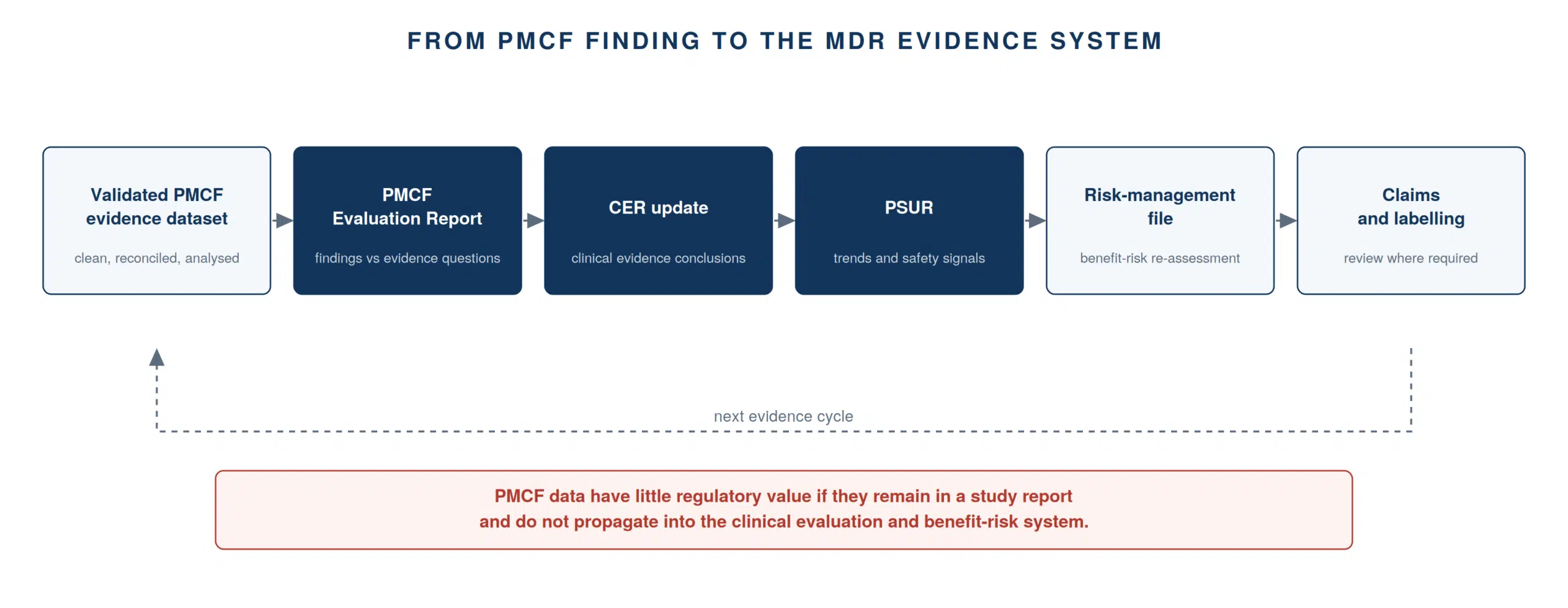
PMCF findings propagate through the whole MDR evidence system, then re-open the next evidence cycle.
PMCF findingCERPSURRMFNext evidence action
Stable performanceConfirmTrendMaintainContinue
Unexpected eventReassessSignalUpdateInvestigation
Durability declineReviseEscalateNew riskFocused PMCF

A broader-population benefit is handled separately: it can support a formal indication-extension strategy, subject to the applicable regulatory route and evidence requirements.

Facing a Notified Body PMCF deficiency? Submit the deficiency for review

Staffing

How the program is staffed

Eclevar orchestrates the full program and states honestly which functions it leads directly and which specialist functions it coordinates where required.

Eclevar directly leads

  • Clinical and regulatory strategy
  • PMCF gap assessment
  • Protocol and PMCF Plan
  • Project management
  • Data management and biostatistics
  • CER and PSUR integration

Specialist functions coordinated where required

  • Independent imaging readers
  • Core laboratories
  • CEC members
  • Specialist laboratories
  • Registry owners
  • Country-specific services

This split is stated so sponsors know exactly which functions Eclevar controls directly.

Timeline and cost

Timeline and cost drivers

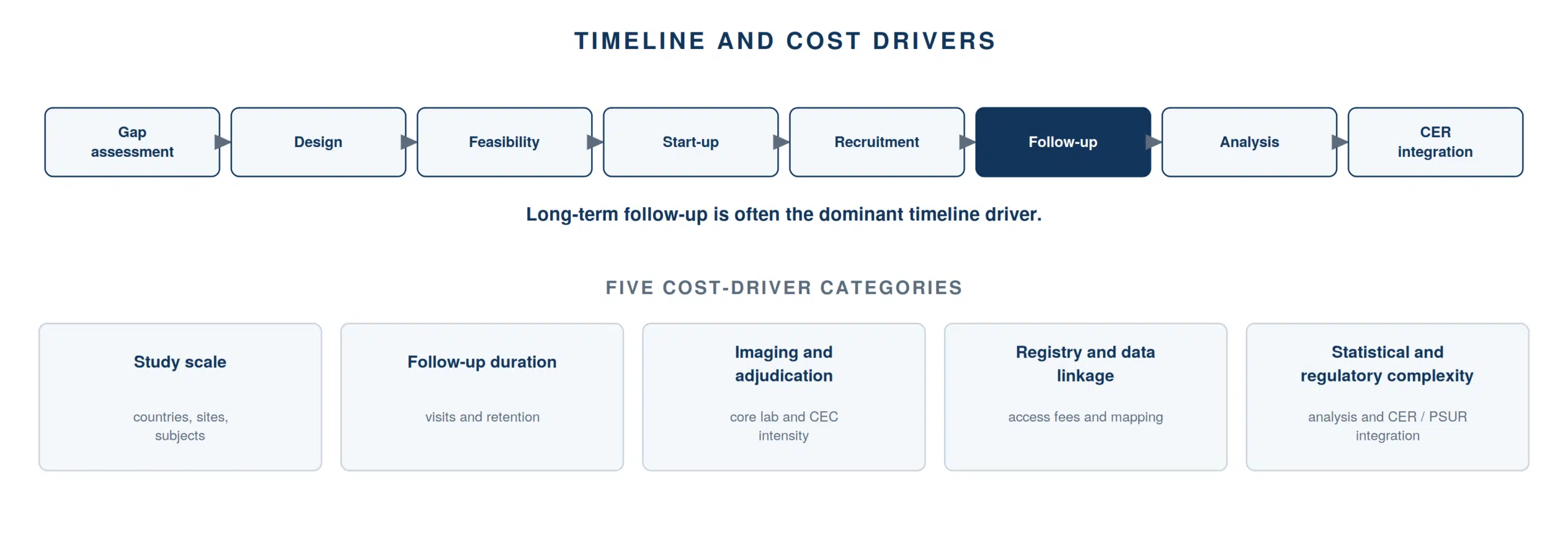
The programme timeline, with long-term follow-up as the dominant driver, and the five cost-driver categories.

Commercial models: strategy and setup fee, per-site setup, per-patient and per-visit costs, registry access or data fee, imaging, core-lab and adjudication packages, annual evidence update.

No universal patient number or recruitment rate is published: the gap and the data source drive the scope.
European clinical operations

Cardiovascular sites, run end to end

Heart Team coordination, high-volume structural heart centers, proctoring logistics and monitoring, with VARC-3 endpoints and reimbursement-grade evidence built in from the protocol onwards.

Cardiovascular clinical operations across European sites
Why Eclevar

Why sponsors choose Eclevar

Clinical authority

Cardiac surgeon-led strategy (Dr Mark DaCosta, cardiac surgeon and former TÜV SÜD cardiovascular reviewer) and former Notified Body review experience.

Operational capability

European sites, KOL feasibility and long-term follow-up delivery, with integrated data management.

Regulatory continuity

PMCF Plan to study execution, PMCF Evaluation Report, CER update, PSUR and benefit-risk integration.

Integrated technology

EDC, ePRO, registry mapping and imaging integration with longitudinal patient tracking.

Selected experience

Selected experience

Coronary guidewire

Challenge: Limited post-market safety and use-pattern evidence

Model: Multi-country PMCF survey and prospective collection

Delivered: Study design, HCP network, EDC, analysis and CER-ready outputs

Structural heart

Challenge: Durability and late-event uncertainty

Model: Prospective long-term follow-up with imaging

Delivered: Protocol, imaging strategy, adjudication and longitudinal analysis

Registry-based cardiac PMCF

Challenge: Existing registry insufficient for regulatory use

Model: Fit-for-purpose assessment plus targeted substudy

Delivered: Data mapping, gap closure and regulatory dataset

All cases anonymised.

Ways to engage

Ways to engage Eclevar

PMCF Gap Assessment

For sponsors uncertain about the required evidence model. Output: gap matrix and recommended model.

PMCF Design Package

For sponsors needing the protocol, PMCF Plan and SAP. Output: design and feasibility package.

Full-Service PMCF

For end-to-end study execution and evidence integration, start-up through the final evidence package. Primary offer

Registry Rescue

For existing registries that do not fully close the evidence gap. Output: fit assessment and gap-closure program.

Frequently asked

Questions sponsors ask first

What type of PMCF study does a cardiovascular device need?
The design depends on the unresolved evidence question. Options include prospective PMCF investigations, observational cohorts, registries, retrospective studies, surveys or a hybrid program.
Can a registry replace a prospective PMCF study?
Only when the registry is fit for purpose and captures the relevant device generation, population, endpoints, follow-up and data quality. A targeted substudy may still be required.
How long should cardiovascular PMCF follow-up last?
Follow-up should reflect implant permanence, expected failure modes, durability claims, residual risks and the timing of clinically relevant events.
How are PMCF findings used in the MDR evidence system?
They should update the PMCF Evaluation Report, CER, PSUR, risk-management file, benefit-risk conclusion and, where necessary, claims or labeling.

Define the right cardiovascular PMCF model before committing to sites, patients and long-term follow-up

Receive a mapped evidence-gap assessment covering data source, endpoints, follow-up and CER and PSUR integration.

Request a cardiovascular PMCF assessment

Reforming Clinical Evaluation of Medical Devices in Europe