IVD · Oncology · CRO
IVDs in oncology, and the evidence behind them.
In vitro diagnostics sit at the heart of modern cancer care, but under the IVDR they must prove their performance. Here is the role of the diagnostic, and of the CRO that evidences it.

European Champion
Platinum Award 2026
Eclevar MedTech & Milo Health · xShare × EUCROF Open Call
Led by authority
Oncology diagnostics, evidenced properly.
An oncology IVD is only as strong as its performance data. Our teams build that evidence to the standard the IVDR demands.

Dr Mark Da Costa
Cardiac surgeon and former lead Notified Body reviewer at TÜV SÜD. 400+ devices CE-certified.
in LinkedIn
Sébastien Meier
Endpoints, statistics and RWE; architect of the MILO EDC, 21 CFR Part 11 and real-time dashboards.
Awards, funding, accountability
Europe’s best-rated medical device CRO.
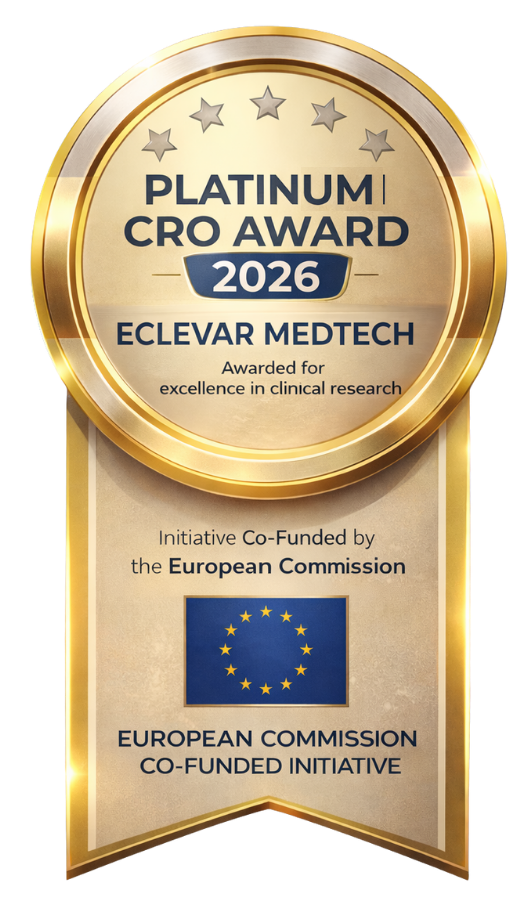
Platinum Award 2026
Top tier at the xShare × EUCROF Open Call, awarded to Eclevar MedTech and its Milo Health platform, presented at EUCROF 2026 in Amsterdam.
The announcement →Co-funded by the European Union
Selected through the xShare Open Call for clinical research innovation, Horizon Europe.
xShare results →Independently reported
Distinction confirmed by an independent third party, the CVBF, also an awardee of the xShare × EUCROF Open Call.
CVBF coverage →The field
Why diagnostics drive cancer care.
IVDs detect and measure biomarkers that guide diagnosis, prognosis and treatment in oncology. Under the IVDR, each of those claims must be supported by robust performance evidence.
01
What IVDs do in oncology
In vitro diagnostics examine samples such as blood, saliva or tissue to detect and measure markers linked to cancer. In oncology they support risk assessment, early detection, staging, prognosis and monitoring of response after therapy, informing decisions at every step of the patient journey.
02
Why the stakes are high
Because a diagnostic result can direct or withhold treatment, oncology IVDs carry real clinical risk.
What a result decides
- Whether a cancer is detected early enough to treat
- How a tumour is staged and the prognosis assessed
- Whether a patient is eligible for a targeted therapy (companion diagnostics)
- Whether treatment is working, through monitoring and recurrence detection
03
What the IVDR requires
Under the IVD clinical evidence under IVDR, an oncology diagnostic must demonstrate scientific validity, analytical performance and clinical performance, drawn together in a Performance Evaluation Report. Companion diagnostics face additional scrutiny because they gate access to a specific therapy. The risk-based classification means most oncology IVDs now require Notified Body involvement.
04
The role of the CRO
A CRO designs and runs the studies that generate this evidence: performance studies against defined acceptance criteria, access to well-characterised oncology sample cohorts, biostatistics, and the Performance Evaluation Report itself, plus post-market performance follow-up. We turn a promising oncology assay into a diagnostic that clears review.
Oncology IVD at a glance
Diagnostics that hold up.
Talk to a specialist
Building an oncology diagnostic?
Book a free scoping call. We design the performance studies and Performance Evaluation Report your oncology IVD needs under the IVDR.
Book a free scoping callAn oncology diagnostic is only as good as its evidence.
An expert read maps the performance studies your IVD needs, secures the right sample cohorts, and builds a Performance Evaluation Report that clears IVDR review.
Book a free scoping callQuestions we hear first