
EFS-to-Pivotal Clinical Development | Medical Devices

From Early Feasibility Study to Pivotal Medical Device Evidence

A positive early signal is not yet a pivotal evidence plan. ECLEVAR turns EFS results, device changes, safety signals, operator learning, and residual uncertainty into a recommendation on the next study and a plan you can execute in the United States, Europe, or both.

  • Medical device specialists
  • Clinician-led interpretation
  • Integrated data and biostatistics
  • US and Europe evidence planning

The EFS can have been conducted by ECLEVAR, another CRO, an academic center, or your own team. We review the clinical, technical, operational, and regulatory package as it stands.

After the early feasibility study

From early signal to pivotal readiness

The question is not whether the results were encouraging. It is whether the remaining uncertainty is small enough to justify confirmatory cost, scale, and regulatory exposure.

Figure 1 · Pivotal readiness and the decision gate

Pivotal readiness assessed against a decision gate Seven readiness dimensions are drawn as horizontal ranges standing for the illustrative residual uncertainty attached to each pivotal assumption, each with a marker at an illustrative position. A gold decision gate crosses the plot and the area beyond it is shaded as the resolved side. Four dimensions, device maturity, population definition, data completeness and site scalability, sit entirely beyond the gate and are drawn in navy with solid markers. Three dimensions, procedure consistency, endpoint measurability and operator learning curve, still cross or fall short of the gate and are drawn in coral with hollow markers. Four possible next clinical steps are listed below. The first two, additional EFS learning and a traditional feasibility study, represent a need for further learning before any confirmatory commitment. The final two, a US pivotal study and an EU MDR clinical investigation, represent later evidence-generating pathways. The figure is an illustrative decision framework: it carries no units, no scores and no study results, and the positions shown were not calculated from any sponsor program. In this vertical layout each dimension is a label with its own measurement strip underneath, and the decision gate is drawn as repeated aligned gate segments, one per strip, rather than as one continuous vertical line. Commit to a pivotal studywhen the criticalassumptions are sufficientlyresolved. DECISION GATE Device maturity Procedure consistency Population definition Endpoint measurability Operator learning curve Data completeness Site scalability More uncertainty Less uncertainty Range: illustrative residualuncertainty. Marker: illustrativeposition. Illustrative decision frameworkonly. No units, scores or studyresults. POSSIBLE NEXT CLINICAL STEP Additional EFS learning Key assumptions remain unresolved Traditional feasibility study Near-final design; pivotal readinessstill developing US pivotal study Definitive safety and effectivenessevidence EU MDR clinical investigation Clinical safety, performance andbenefit
Pivotal readiness assessed against a decision gate Seven readiness dimensions are drawn as horizontal ranges standing for the illustrative residual uncertainty attached to each pivotal assumption, each with a marker at an illustrative position. A gold decision gate crosses the plot and the area beyond it is shaded as the resolved side. Four dimensions, device maturity, population definition, data completeness and site scalability, sit entirely beyond the gate and are drawn in navy with solid markers. Three dimensions, procedure consistency, endpoint measurability and operator learning curve, still cross or fall short of the gate and are drawn in coral with hollow markers. Four possible next clinical steps are listed below. The first two, additional EFS learning and a traditional feasibility study, represent a need for further learning before any confirmatory commitment. The final two, a US pivotal study and an EU MDR clinical investigation, represent later evidence-generating pathways. The figure is an illustrative decision framework: it carries no units, no scores and no study results, and the positions shown were not calculated from any sponsor program. In this vertical layout each dimension is a label with its own measurement strip underneath, and the decision gate is drawn as repeated aligned gate segments, one per strip, rather than as one continuous vertical line. Commit to a pivotal study when the criticalassumptions are sufficiently resolved. DECISION GATE Device maturity Procedure consistency Population definition Endpoint measurability Operator learning curve Data completeness Site scalability More uncertainty Less uncertainty Range: illustrative residual uncertainty. Marker:illustrative position. Illustrative decision framework only. No units, scoresor study results. POSSIBLE NEXT CLINICAL STEP Additional EFS learning Key assumptions remain unresolved Traditional feasibility study Near-final design; pivotal readiness still developing US pivotal study Definitive safety and effectiveness evidence EU MDR clinical investigation Clinical safety, performance and benefit
Pivotal readiness assessed against a decision gate Seven readiness dimensions are drawn as horizontal ranges standing for the illustrative residual uncertainty attached to each pivotal assumption, each with a marker at an illustrative position. A gold decision gate crosses the plot and the area beyond it is shaded as the resolved side. Four dimensions, device maturity, population definition, data completeness and site scalability, sit entirely beyond the gate and are drawn in navy with solid markers. Three dimensions, procedure consistency, endpoint measurability and operator learning curve, still cross or fall short of the gate and are drawn in coral with hollow markers. Four possible next clinical steps are listed below. The first two, additional EFS learning and a traditional feasibility study, represent a need for further learning before any confirmatory commitment. The final two, a US pivotal study and an EU MDR clinical investigation, represent later evidence-generating pathways. The figure is an illustrative decision framework: it carries no units, no scores and no study results, and the positions shown were not calculated from any sponsor program. The layout is a single labeled plot with the seven dimensions stacked in one column and the four possible next clinical steps arranged in two rows of two beneath it. Commit to a pivotal study when the criticalassumptions are sufficiently resolved. DECISION GATE Device maturity Procedure consistency Population definition Endpoint measurability Operator learning curve Data completeness Site scalability More residual uncertainty Less residual uncertainty Range: illustrative residual uncertainty. Marker: illustrative position. Illustrative decision framework only. No units, scores or study results. POSSIBLE NEXT CLINICAL STEP Additional EFS learning Key assumptions remain unresolved Traditional feasibility study Near-final design; pivotal readinessstill developing US pivotal study Definitive safety and effectivenessevidence EU MDR clinical investigation Clinical safety, performance andbenefit
Pivotal readiness assessed against a decision gate Seven readiness dimensions are drawn as horizontal ranges standing for the illustrative residual uncertainty attached to each pivotal assumption, each with a marker at an illustrative position. A gold decision gate crosses the plot and the area beyond it is shaded as the resolved side. Four dimensions, device maturity, population definition, data completeness and site scalability, sit entirely beyond the gate and are drawn in navy with solid markers. Three dimensions, procedure consistency, endpoint measurability and operator learning curve, still cross or fall short of the gate and are drawn in coral with hollow markers. Four possible next clinical steps are listed below. The first two, additional EFS learning and a traditional feasibility study, represent a need for further learning before any confirmatory commitment. The final two, a US pivotal study and an EU MDR clinical investigation, represent later evidence-generating pathways. The figure is an illustrative decision framework: it carries no units, no scores and no study results, and the positions shown were not calculated from any sponsor program. The layout is a single labeled plot with the seven dimensions stacked in one column. Commit to a pivotal study when the critical assumptions aresufficiently resolved. DECISION GATE Device maturity Procedure consistency Population definition Endpoint measurability Operator learning curve Data completeness Site scalability More residual uncertainty Less residual uncertainty Range: illustrative residual uncertainty. Marker: illustrative position. Illustrative decision framework only. No units, scores or study results. POSSIBLE NEXT CLINICAL STEP Additional EFS learning Key assumptions remainunresolved Traditional feasibilitystudy Near-final design; pivotalreadiness still developing US pivotal study Definitive safety andeffectiveness evidence EU MDR clinicalinvestigation Clinical safety, performanceand benefit
An early feasibility study does not automatically lead to a pivotal study. The gate can also return the program to further early learning.
01

What the EFS resolved

Proof of principle, initial clinical safety information, device functionality, and early insight into patient selection, separated from what they cannot yet establish.

02

What remains uncertain

Missing follow-up, unstable estimates, inconsistent outcome definitions, and assumptions no small dataset can carry. Named explicitly, because these are what the next study has to close.

03

Device configuration stability

Whether the configuration is frozen or close to it, which subjects were exposed to which version, and what any remaining change would do to a confirmatory design.

04

Endpoints and population

Whether the intended population is defined tightly enough to reproduce across centers, and whether the endpoints are clinically meaningful and collectible at scale.

05

Operator learning

Whether the observed signal reflects the device or still reflects experience with it. Center and operator effects are examined before any estimate is carried into a sample-size calculation.

06

Read as one assessment

Endpoints cannot be fixed before the population is defined, and the site model cannot be sized before the endpoints settle. If that earlier decision is still open, see our early feasibility study services.

The decision gate

Choose the next study before scaling

Five routes are usually on the table. A recommendation not to move to the pivotal study yet is a useful result: it protects the budget and the regulatory position that a premature confirmatory study would spend.

US pivotal study

Indication
Device and study assumptions are mature enough for confirmatory evaluation
Unresolved question
Safety and effectiveness evidence for the intended FDA pathway
Planning implication
FDA interaction, pivotal design, IDE planning, scalable US operations

European confirmatory clinical investigation

Indication
European conformity-assessment evidence is the priority
Unresolved question
Safety and clinical performance under the EU MDR evidence strategy
Planning implication
EU MDR Article 62 and Annex XV, ISO 14155:2026, competent authority and ethics pathway

Coordinated US and Europe program

Indication
Both markets are strategic and meaningful alignment is possible
Unresolved question
Which elements can be shared and which stay jurisdiction-specific
Planning implication
Core protocol strategy with documented regional adaptations

Additional feasibility or bridging study

Indication
The design is progressing but pivotal assumptions remain immature
Unresolved question
Reproducibility across operators and operational feasibility at scale
Planning implication
Larger exploratory study on a more stable device, with tighter methods

Device or protocol refinement before further enrollment

Indication
A device or procedure change is still pending
Unresolved question
Whether earlier findings still apply to the configuration you intend to study
Planning implication
Change control, protocol amendment, IDE supplement where applicable

The appropriate route is device-specific and should be confirmed with the relevant regulatory authorities and qualified regulatory specialists. This is a planning aid, not a regulatory algorithm. Once the US route is selected, see our FDA IDE clinical study support.

Entry engagement

EFS-to-Pivotal Strategy Workshop

A structured working session with your clinical, regulatory, and development leads, run whether or not ECLEVAR conducted the EFS. The engagement is designed to produce the decision-ready outputs a sponsor needs before committing to the next clinical study.

What we ask for

  • Protocol and amendments
  • Device version history
  • Safety and monitoring findings
  • Deviations
  • Endpoint completion
  • Listings and available analyses
  • Investigator and operator feedback
  • Intended claims and target markets

What you leave with

  • Findings and residual uncertainty map
  • Recommended next-study pathway
  • Device-readiness and change-control assessment
  • Candidate population and endpoint framework
  • US and European regulatory question plan
  • Execution roadmap with data and statistical priorities
The ECLEVAR method

How ECLEVAR builds the transition plan

Four phases. Each one closes a decision before the next begins, so you can stop, redirect, or commit at a defined point rather than at the end.

01

Diagnose the EFS evidence

Principal activity
Review of protocol and amendments, device versions, monitoring findings, deviations, safety data, endpoint completion, listings, and investigator feedback
Decision produced
What the EFS established, and what it did not
Deliverable
Findings and residual uncertainty map

02

Define the decision gate and next-study route

Principal activity
Assessment of device and procedure maturity against the intended claims and target markets
Decision produced
Which of the five routes the evidence supports, and why
Deliverable
Next-study recommendation with its rationale

03

Build the evidence architecture

Principal activity
Population and endpoint framework, estimand and sample-size assumptions, and the regulatory question plan for each market
Decision produced
What is shared across markets and what stays jurisdiction-specific
Deliverable
Clinical, statistical, and regulatory evidence architecture

04

Prepare the execution handover

Principal activity
Controlled document transfer, site and enrollment feasibility, governance, risk register, and timeline and budget assumptions
Decision produced
Whether to commit, run one more learning step, or pause
Deliverable
Execution roadmap and handover pack
Market strategy

One scientific core, separate US and European decisions

A single scientific core can serve both markets. The regulatory decisions behind them stay separate, and evidence generated for one is not automatically accepted for the other. Where an EFS estimate is too unstable to carry a sample-size calculation, we say so and set out what would make it usable.

What we examine in the EFS dataset

  • Missingness, endpoint completion, and follow-up
  • Variability, confidence intervals, and preliminary effect sizes
  • Center, operator, and learning-curve effects
  • Outcome-definition consistency and adjudication needs
  • Device-version differences and protocol deviations

Why this is done jointly

Statistical instability, clinical plausibility, and operational burden are usually the same problem seen from three angles. Reviewed separately, they produce a design that is defensible on paper and undeliverable in practice, so the therapeutic physician, the biostatistician, clinical operations, and data management work the dataset together.

Intended claims
US pivotal studySafety and effectiveness for the intended FDA submission
European confirmatory investigationSafety and clinical performance under the EU MDR
Coordinated programOne claim set, two evidence objectives written down separately
Population and endpoints
US pivotal studySized for the confirmatory question and the US site network
European confirmatory investigationSized for the conformity-assessment question and the country mix
Coordinated programHarmonized definitions where scientifically and regulatorily appropriate
Device configuration
US pivotal studyChange control traced through the IDE framework where applicable
European confirmatory investigationChange control traced through the clinical investigation documentation
Coordinated programOne controlled version history, referenced by both submissions
Statistical framework
US pivotal studyEstimand, comparator, and analysis sets aligned to the FDA question
European confirmatory investigationAnalysis aligned to the clinical evidence strategy under the EU MDR
Coordinated programShared statistical principles, separately justified conclusions
Regulatory interaction and submission
US pivotal studyQ-Submission and IDE pathway as applicable
European confirmatory investigationCompetent authority and ethics pathway, by country
Coordinated programSequenced or parallel interactions, with no automatic mutual acceptance

In Europe, authorization and ethics review are handled under the EU MDR and applicable national procedures; the competent authorities and submission processes depend on the countries involved. A European confirmatory clinical investigation is not an automatic regulatory equivalent of a US pivotal study.

Figure 2 · US and European Union evidence architecture

One scientific foundation, separate regulatory decisions One shared scientific foundation is shown as four stratified courses: intended use and population, endpoint definitions, statistical principles, and data standards with the benefit-risk rationale. Two structurally different regulatory structures are shown. The United States structure is a solid navy block covering FDA interaction, IDE and pivotal planning, and safety and effectiveness, capped by the FDA premarket decision. The European Union structure is an outlined block covering EU MDR clinical evidence, Article 62 and Annex XV, and clinical safety, performance and benefit, capped by the EU MDR conformity assessment. A dashed coral rule labeled separate regulatory decisions divides the two. Evidence generated for one market may inform the other, but it is assessed under each market's own requirements, and there is no automatic mutual acceptance. In this vertical layout the shared scientific foundation is presented first, at the top of the sequence, followed by the United States structure, then the separation, then the European Union structure. The foundation is read before the two structures rather than drawn beneath them. One scientific foundation,separate regulatorydecisions. SHARED SCIENTIFIC FOUNDATION Intended use andpopulation Endpoint definitions Statistical principles Data standards andbenefit-risk rationale UNITED STATES FDA interaction IDE and pivotal planning Safety and effectiveness FDA premarket decision Separate regulatory decisions EUROPEAN UNION EU MDR clinical evidence Article 62 and Annex XV Clinical safety, performanceand benefit EU MDR conformity assessment Evidence generated for one marketmay inform the other, but it isassessed under each market's ownrequirements. There is no automaticmutual acceptance.
One scientific foundation, separate regulatory decisions One shared scientific foundation is shown as four stratified courses: intended use and population, endpoint definitions, statistical principles, and data standards with the benefit-risk rationale. Two structurally different regulatory structures are shown. The United States structure is a solid navy block covering FDA interaction, IDE and pivotal planning, and safety and effectiveness, capped by the FDA premarket decision. The European Union structure is an outlined block covering EU MDR clinical evidence, Article 62 and Annex XV, and clinical safety, performance and benefit, capped by the EU MDR conformity assessment. A dashed coral rule labeled separate regulatory decisions divides the two. Evidence generated for one market may inform the other, but it is assessed under each market's own requirements, and there is no automatic mutual acceptance. In this vertical layout the shared scientific foundation is presented first, at the top of the sequence, followed by the United States structure, then the separation, then the European Union structure. The foundation is read before the two structures rather than drawn beneath them. One scientific foundation, separateregulatory decisions. SHARED SCIENTIFIC FOUNDATION Intended use and population Endpoint definitions Statistical principles Data standards and benefit-risk rationale UNITED STATES FDA interaction IDE and pivotal planning Safety and effectiveness FDA premarket decision Separate regulatory decisions EUROPEAN UNION EU MDR clinical evidence Article 62 and Annex XV Clinical safety, performance and benefit EU MDR conformity assessment Evidence generated for one market may inform the other,but it is assessed under each market's own requirements.There is no automatic mutual acceptance.
One scientific foundation, separate regulatory decisions One shared scientific foundation is shown as four stratified courses: intended use and population, endpoint definitions, statistical principles, and data standards with the benefit-risk rationale. Two structurally different regulatory structures are shown. The United States structure is a solid navy block covering FDA interaction, IDE and pivotal planning, and safety and effectiveness, capped by the FDA premarket decision. The European Union structure is an outlined block covering EU MDR clinical evidence, Article 62 and Annex XV, and clinical safety, performance and benefit, capped by the EU MDR conformity assessment. A dashed coral rule labeled separate regulatory decisions divides the two. Evidence generated for one market may inform the other, but it is assessed under each market's own requirements, and there is no automatic mutual acceptance. In this layout the two structures are placed side by side and visibly stand on the foundation, which spans the full width beneath them. One scientific foundation, separate regulatory decisions. Separate regulatory decisions FDA premarket decisionUNITED STATESFDA interactionIDE and pivotal planningSafety and effectiveness EU MDR conformity assessmentEUROPEAN UNIONEU MDR clinical evidenceArticle 62 and Annex XVClinical safety, performanceand benefit SHARED SCIENTIFIC FOUNDATION Intended use and population Endpoint definitions Statistical principles Data standards and benefit-risk rationale Evidence generated for one market may inform the other, but it is assessed undereach market's own requirements. There is no automatic mutual acceptance.
One scientific foundation, separate regulatory decisions One shared scientific foundation is shown as four stratified courses: intended use and population, endpoint definitions, statistical principles, and data standards with the benefit-risk rationale. Two structurally different regulatory structures are shown. The United States structure is a solid navy block covering FDA interaction, IDE and pivotal planning, and safety and effectiveness, capped by the FDA premarket decision. The European Union structure is an outlined block covering EU MDR clinical evidence, Article 62 and Annex XV, and clinical safety, performance and benefit, capped by the EU MDR conformity assessment. A dashed coral rule labeled separate regulatory decisions divides the two. Evidence generated for one market may inform the other, but it is assessed under each market's own requirements, and there is no automatic mutual acceptance. In this layout the two structures are placed side by side and visibly stand on the foundation, which spans the full width beneath them. One scientific foundation, separate regulatory decisions. Separate regulatory decisions FDA premarket decisionUNITED STATESFDA interactionIDE and pivotal planningSafety and effectiveness EU MDR conformity assessmentEUROPEAN UNIONEU MDR clinical evidenceArticle 62 and Annex XVClinical safety, performance and benefit SHARED SCIENTIFIC FOUNDATION Intended use and population Endpoint definitions Statistical principles Data standards and benefit-risk rationale Evidence generated for one market may inform the other, but it is assessed under each market's own requirements. There is noautomatic mutual acceptance.
Structural illustration only. It does not represent an approval, a marking, or an endorsement by any authority or notified body.
Accountability

ECLEVAR leadership

The team assigned to a transition depends on the device, the therapeutic area, the markets, and the contracted scope. These are the people who carry the decision.

Dr Mark Da Costa

Chief Operating Officer and Head of Cardiovascular, Senior Consultant Cardiac Surgeon

Mark combines 25 years of Consultant Cardiac Surgery experience with first-hand senior leadership Notified Body clinical review experience. He tests pivotal readiness against intended claims, endpoints, patient population, operator learning and device maturity.

Decision stage: device and procedure maturity, cardiovascular and structural heart evidence strategy.

Dr. Nikhil Khadabadi

Chief Medical Officer, Orthopedics and Spine, Senior Consultant Surgeon

NHS orthopedic surgeon with Class III implantable device assessment experience and Principal Investigator experience in robotic surgery research. He brings the surgical and implant perspective to population definition and procedure standardization.

Decision stage: population, procedure reproducibility, and separating device performance from operator experience.

Sebastien Meier Piantanida

Chief Data Officer

Owns data strategy and biometrics across the transition, including EDC and eCOA governance and pivotal dataset readiness. He establishes whether the EFS dataset can carry the assumptions a confirmatory design would rest on.

Decision stage: data completeness, statistical assumptions, and endpoint collectability.

Dawn Heimer

Strategic Clinical Advisor, United States

Dawn advises medical-device sponsors on FDA clinical engagement and the transition from early feasibility learning to the next clinical-development stage. Her experience includes planning and executing approximately 15 FDA Pre-Submission and Q-Submission interactions and managing an Early Feasibility Study over the past three years. She contributes to ECLEVAR programs when included in the contracted advisory scope.

Decision stage: FDA engagement strategy, interpretation of FDA feedback, and EFS-to-pivotal transition planning.

Named contributors, responsibilities, and regulatory interfaces are confirmed in the contracted scope. The sponsor retains US regulatory leadership through its designated FDA regulatory lead or a separately retained qualified FDA specialist.

Former notified body positions are stated for biographical context only. ECLEVAR MedTech is independent and is not affiliated with or endorsed by any notified body.

Questions sponsors ask

EFS-to-pivotal transition: frequently asked questions

What is an EFS-to-pivotal transition?
It is the work between the end of an early feasibility study and the commitment to the next clinical study. It establishes what the EFS resolved, what remains uncertain, whether the device configuration and endpoints can support confirmatory evidence, and which route the evidence actually supports. The output is a documented recommendation and an executable plan, not a restatement of the EFS results.
Can ECLEVAR assess an EFS conducted by another CRO?
Yes. This can be a valid starting point. We review the protocol and amendments, device version history, monitoring findings, deviations, safety data, endpoint completion, and available listings and analyses, together with investigator feedback. The output is a findings and residual uncertainty map your team can challenge before any recommendation on the next study is made.
Can a US EFS support planning for a European clinical investigation?
It can inform the planning substantially, including device maturity, procedure standardization, endpoint behavior, and patient selection. It does not mean the data will be accepted for a European conformity assessment. European clinical evidence requirements are assessed under the EU MDR on their own terms, and the acceptability of any dataset is a separate question from its usefulness for design.
When is another feasibility study more appropriate than a pivotal study?
When the device or procedure is still changing, when outcomes still track operator experience, when the intended population has not stabilized, or when the available estimates are too unstable to size a confirmatory study. In those cases a bridging or additional feasibility study usually costs less than a pivotal study that has to be amended, extended, or repeated.
Can one clinical program support both US and European evidence strategies?
Sometimes a single scientific core can serve both, with regional modules for documentation, submissions, and site requirements. It is never automatic. The two regulatory decisions are made under different frameworks, and acceptance of information in one jurisdiction does not by itself establish sufficiency for the other. Alignment should be planned deliberately and confirmed with each authority.
Can ECLEVAR execute the next clinical study?
Yes, where the scope fits our capabilities. European clinical investigation delivery is our core execution capability, covering feasibility, site selection, start-up, monitoring, data management, biostatistics, and medical writing. Execution scope is agreed separately from the transition work, and the transition engagement is not conditional on awarding us the study.

Official content

Our content, signed by Eclevar

Whitepapers, client voices and publications produced by our own teams and by our partners: BSI, TÜV SÜD and RegenLab.
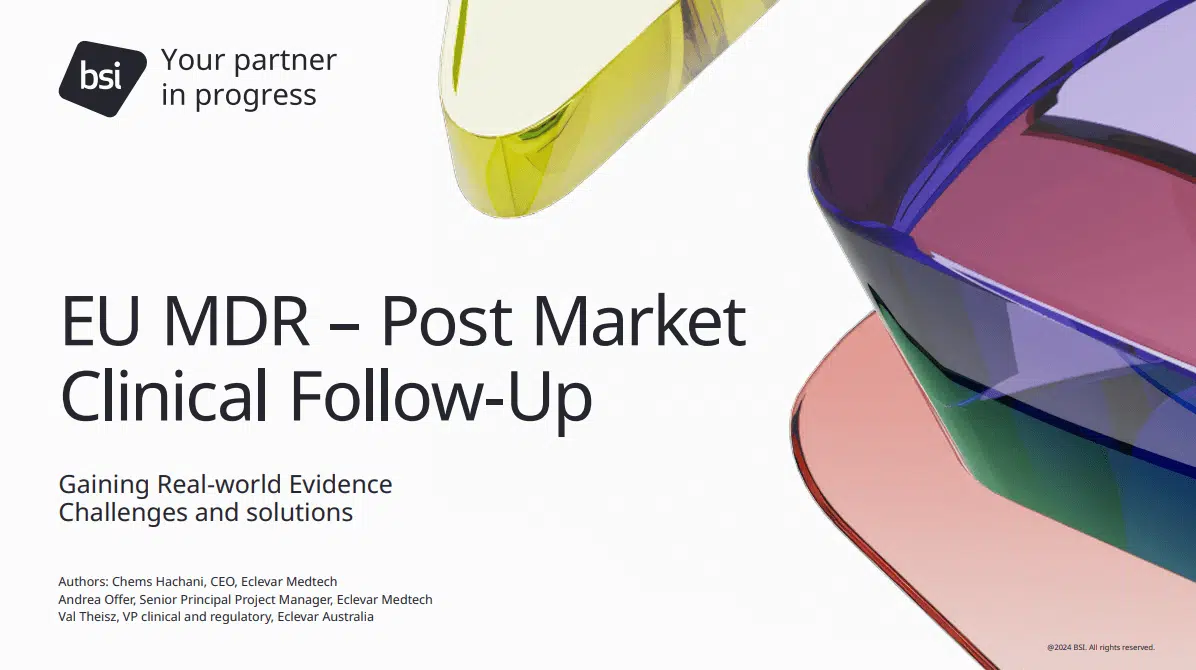
Cover of the whitepaper written by BSI and Eclevar on the EU MDR

Whitepaper · BSI x Eclevar

A whitepaper by BSI and Eclevar on the EU MDR

Written with the notified body BSI: a practical look at what clinical evidence has to show under EU MDR 2017/745, and at the quality bar the data have to clear. It is the same bar a European dataset meets before it is put in front of any reviewer.

Read the whitepaper

PMCF studies · Regenerative medicine · 5 EU countries

A client voice on Eclevar's ability to run complex studies

Eclevar runs RegenLab's PMCF program on chronic wound products. It is a randomized study of 160 subjects across 14 centers in 5 EU countries, covering both diabetic foot ulcer and venous leg ulcer. The partnership combines Eclevar's ISO 14155 expertise with the Milo Studio platform, from study design through to the final study report.

« Eclevar, with its tailored approach and the advanced Milo Studio platform, represents a significant strategic advantage. »Antoine Turzi, CEO, RegenLab

  • 160Subjects · 14 centers
  • 5EU countries

Watch the testimonial

RegenLab video testimonial on the PMCF program run by Eclevar

Coming soon. Breakthrough Device Technology under the EU MDR, a whitepaper written with TÜV SÜD, co-authored by Dr Nikhil Khadabadi.

Decide the next study on evidence, not momentum

Bring your early feasibility package. Leave with a documented view of what it resolved, what it did not, and which route the evidence supports.

Regulatory references

  • FDA, Early Feasibility Studies (EFS) Program: fda.gov
  • FDA guidance, Investigational Device Exemptions (IDEs) for Early Feasibility Medical Device Clinical Studies, Including Certain First in Human (FIH) Studies: fda.gov
  • FDA guidance, Requests for Feedback and Meetings for Medical Device Submissions: The Q-Submission Program: fda.gov
  • Regulation (EU) 2017/745 on medical devices, in particular Article 62 and Annex XV: eur-lex.europa.eu
  • ISO 14155, clinical investigation of medical devices for human subjects, 2026 edition: iso.org

This page is general information about clinical development planning and is not regulatory or legal advice.

Reforming Clinical Evaluation of Medical Devices in Europe