
FDA 510(k) premarket notification, done right.
For the US market we run the 510(k) pathway end to end: predicate selection, substantial-equivalence argumentation, performance and clinical data, and an FDA-ready submission, with EU MDR evidence re-used wherever it counts.
 Platinum Award 2026
Eclevar MedTech and Milo took the Platinum Award at xShare & EUCROF.
Top prize in the xShare x European CRO Federation "EHDS & Clinical Research" Open Call, awarded to Eclevar MedTech and its Milo Health platform, presented at the EUCROF 2026 conference in Amsterdam.
Horizon Europe · Grant Agreement No. 101136734 · Amsterdam, 2 Feb 2026
Trusted by MedTech manufacturers.
Leading device manufacturers choose Eclevar for clinical evidence and real world evidence. Read all client success stories.





A 510(k) that survives FDA review.
Dr Mark Da Costa, COO and former Notified Body reviewer, leads a team that knows regulatory submissions from the reviewer's side of the table. We structure the 510(k) so that the predicate comparison and the data package hold up under FDA scrutiny, and reuse EU MDR evidence to cut duplication.
Substantial equivalence, argued properly.
A 510(k) demonstrates that a device is substantially equivalent to a legally marketed predicate. A weak or mismatched predicate comparison is the single most common cause of FDA Additional Information (AI) requests and lost months.
We select the right predicate, build a clean equivalence argument on intended use and technological characteristics, and add bench, biocompatibility or clinical data only where a genuine technological difference must be addressed.
What makes a 510(k) defensible.
Every element is built to withstand FDA review from the first submission.
Predicate & comparison
A suitable predicate and a clean substantial-equivalence comparison.
Performance & clinical data
Bench, biocompatibility (ISO 10993) and, where needed, clinical data.
Submission dossier
A structured 510(k) built to current FDA eSTAR requirements.
We do not outsource monitoring
Eclevar deploys in-house Clinical Research Associates in the United Kingdom, Germany, France and Sweden, ensuring smooth study initiation, ethics-committee submissions (for example CPP in France) and high-quality clinical data collection.
From strategy to FDA clearance.
Regulatory strategy
Predicate selection and pathway (Traditional, Special, Abbreviated).
Evidence generation
Performance and clinical data where the equivalence needs it.
Dossier & submission
Compilation and management of the 510(k) submission and AI responses.
Substantial equivalence
A clean demonstration of equivalence to the predicate.
Predicate choice
A suitable, defensible predicate device.
Close data gaps
Add performance or clinical data for technological differences.
FDA compliance
A submission built to current FDA guidance and eSTAR.
Fewer AI requests
Reduced Additional Information requests and faster review.
US market access
The route to marketing your device in the United States.
A five-step 510(k) methodology.
Data quality means completeness, consistency and accuracy across all investigational sites.
Feasibility assessment
Assessing data-source quality, completeness and consistency.
Protocol development
A robust protocol aligned with ISO 14155:2026 and GCP.
Conduct
Site activation, in-house CRAs, high-quality data collection.
Data analysis
Rigorous statistical analysis of safety and performance.
Documentation
Comprehensive reports for Notified Body and authorities.
Programs we have delivered.
Multicentre study on a Class III vascular patch
Multicentre study with retrospective and prospective record data from French university hospitals (CHU Valenciennes, Nantes, Brest), covering carotid and femoral locations up to 3 years post-op and meeting EU MDR requirements for CE certification.
Registry-based RWE-PMCF for wound care
RegenLab needed PMCF data to renew its CE marking without disrupting clinical workflows. Eclevar designed a targeted RWE-PMCF registry study on the MILO EDC platform capturing wound-healing trajectories and adverse-event tracking.
From EU MDR to FDA: compliant on both sides.
EU MDR 2017/745
- Clinical evidence under Chapter VI (Articles 62-82)
- PMCF plan mandatory for Class IIb and III
- Clinical Evaluation Report and ISO 14155:2026
- Notified Body review and competent authority reporting
France
- EU MDR plus national requirements
- Ethics committee (CPP) approval
- Data collection across the French hospital network
- Annual safety reports, French documentation
Germany
- EU MDR plus national requirements
- Protocols filed with BfArM
- Ethics committee approval mandatory
- Quarterly safety reports, German documentation
United Kingdom
- UK MDR, aligned with the EU MDR
- Plan for Class IIb and III
- Research Ethics Committee (REC) approval
- NHS hospital data, annual reports to the MHRA
Our content, signed Eclevar.
Whitepapers, client testimonials and publications produced by our teams and partners (BSI, TÜV SÜD, RegenLab).
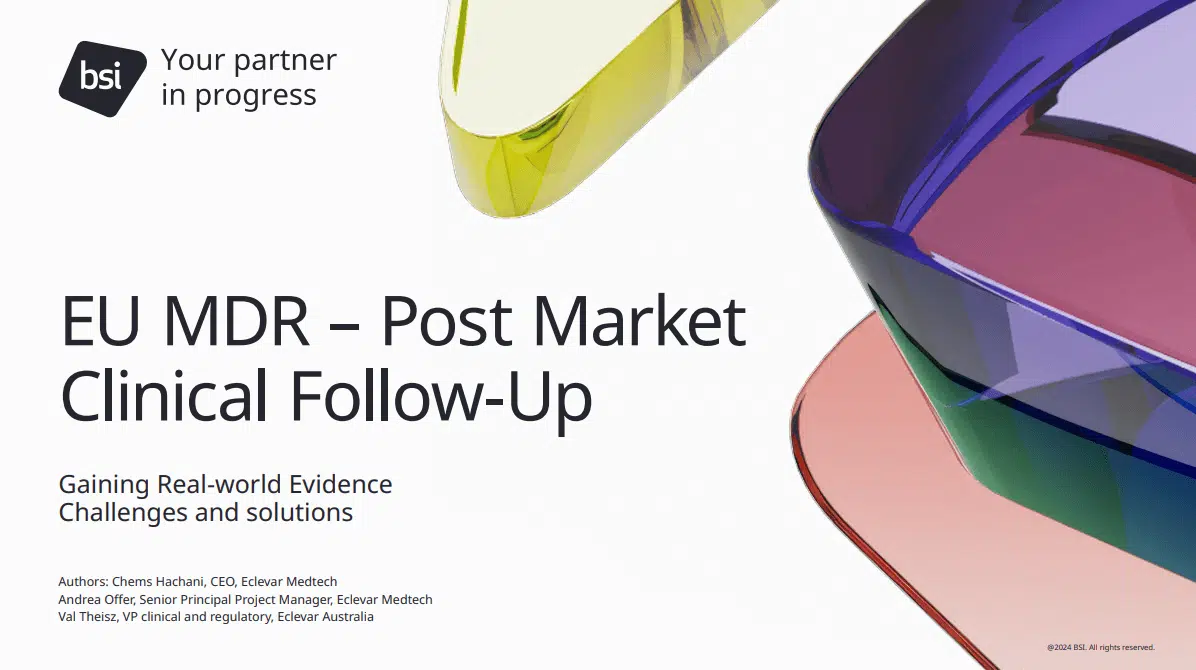
A BSI and Eclevar whitepaper on the EU MDR.
Written with Notified Body BSI: a practical reading of the clinical evidence expectations under EU MDR 2017/745, relevant to any clinical program.
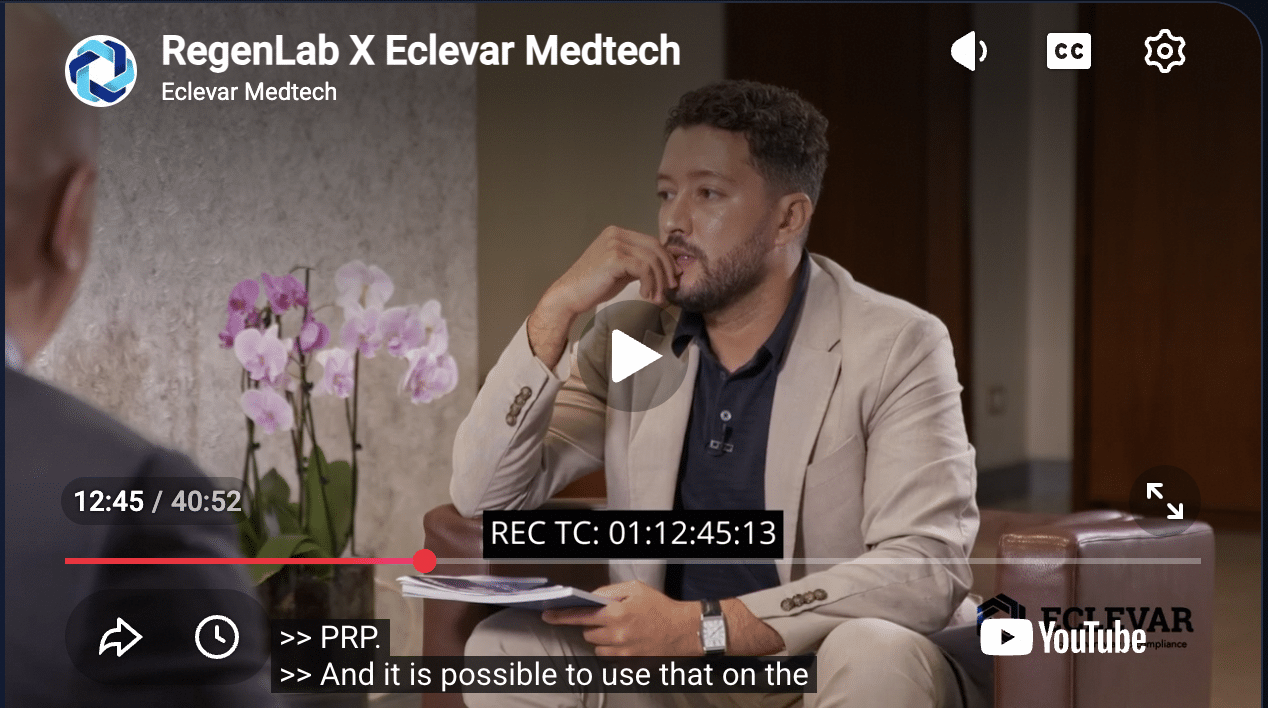
A client's live testimonial on Eclevar's capability to run complex trials.
Eclevar manages RegenLab's PMCF program on chronic wound devices: a randomized study of 160 patients across 14 sites in 5 EU countries, covering both diabetic foot ulcer (DFU) and venous leg ulcer (VLU) indications. The partnership combines Eclevar's ISO 14155 clinical expertise with the Milo Studio platform to deliver post-market clinical follow-up evidence that supports both Notified Body scrutiny and reimbursement endpoints.
« Eclevar, with its tailor-made approach and advanced Milo Studio platform, represents a major strategic asset. »
510(k) premarket notification, answered.
What is a 510(k) premarket notification?
A submission to the FDA that demonstrates a device is substantially equivalent to a legally marketed predicate device.
When is a 510(k) the right pathway?
For most Class II devices in the US where a suitable predicate exists; higher-risk or novel devices may require De Novo or PMA.
Are clinical data required for a 510(k)?
Not always, but frequently, to address technological differences from the predicate.
How do EU MDR and 510(k) relate?
Existing EU MDR evidence (clinical evaluation, biocompatibility, performance testing) can often be reused for the FDA submission; we align the strategy to both markets.
What is the most common reason for FDA questions?
A weak or unsuitable predicate comparison and insufficient data on technological differences.
Enter the US market with a solid 510(k).
Talk to our team about predicate selection, data strategy and the fastest compliant route to FDA clearance.
Book a free call