Registries rarely fail on the protocol. They fail because centers that looked strong on paper never enrolled, or because the one variable everyone assumed was recorded turned out to be blank in half the files. Feasibility answers whether the patients, the data and the sites can actually be reached, at the volume and the quality your evidence question requires.

The people who build your evidence have sat on the other side of the table.
 Charline PetitdemangeProject Delivery Lead, France and United KingdomStudy start-up and close-out
 Susanne HoferHead of Clinical Operations, DACH regionClass I to III devices
 Dr Mark Da CostaChief Operating Officer and Head of CardiovascularFormer TÜV SÜD Team Leader





Registries rarely fail on the protocol. They fail because centers that looked strong on paper never enrolled, or because the one variable everyone assumed was recorded turned out to be blank in half the files. Feasibility answers whether the patients, the data and the sites can actually be reached, at the volume and the quality your evidence question requires.
Leading manufacturers rely on Eclevar for registry-based PMCF and real-world evidence. Read all the client success stories.
Reviewers rarely challenge a feasibility directly. They challenge what it produced: why these centers, on what evidence, and what happened to the ones that were rejected. A selection that cannot be explained afterward weakens the whole registry, whoever performed it.
That is why we keep a written record per site, including the refusals. It costs nothing during selection and it is the difference between answering a question in an afternoon and reconstructing a decision three years later.
Feasibility for a clinical investigation asks whether investigators will follow a protocol. Feasibility for a registry under the EU MDR asks something different: whether routine care already produces the data you need, and whether a site will keep entering that data for years without the rhythm of protocol visits to carry it.
Three questions have to be answered before a registry is worth starting. Is the population reachable, meaning the real annual number of patients treated with your device for your indication at each candidate site, not the department total. Is the data there, meaning the variables your endpoints depend on, where they live, at what completeness, and who owns them. And will the sites hold, meaning willingness, staffing, and the honest answer to whether someone will still be entering data in year three.
One boundary, so this page stays useful. It covers feasibility and site selection for registries. It does not cover protocol and endpoint design, and it does not explain how a registry is run once open. Feasibility for interventional studies is a different exercise, covered on feasibility and site selection for clinical trials.
A feasibility that answers three of the four is not a feasibility. It is a shortlist with a risk hidden in it.

Annual volume by indication and by device reference, per site, with a source for the number. A department total tells you almost nothing about your device. Volume also has to be evaluated over time: we have seen a study recruit nobody because the eligible patients simply did not attend that clinic, which a single-year snapshot would never have shown.
The endpoint variables, one by one. Are they captured, in which system, by whom, and can the device be identified at patient level. Device traceability is the single most common blocker, and the one nobody checks early enough. Where the data will live afterward is covered on EDC and data management.
Who enters the data, whether the department has carried a long study before, staff turnover, and whether patients actually come back to that center for follow-up or are referred elsewhere. The endpoint and event rate decide how many sites are needed, which is designed with our biostatistics team.
The ethics and data protection route in each country, the contracting route with each institution, and a realistic path to first patient in. This is the part of the schedule a sponsor does not control, which is exactly why it belongs in feasibility rather than in start-up.
Everyone can list criteria. What costs money is the thing the questionnaire did not ask, and that only surfaces six months later. These are our own cases, anonymized.
One site, a recruitment target of twenty, and zero patients recruited before it was closed. The team was one nurse with no clinical trial experience, one coordinator and one investigator. When a single person was on holiday, no study activity could happen at all. The questionnaire had asked whether staffing was adequate. It had not asked how many of those people would be delegated to this study.
In the same project the investigator worked across two sites and was rarely present at the one where the study ran. We now ask directly whether the investigator will be based at the site where the work will take place, which matters most in primary care and general practice settings.
A study in a specific patient population recruited nobody, because eligible participants did not attend that clinic. The protocol was not suited to the population that center actually sees. Patient numbers have to be assessed over time and against the real case mix, not against a headline annual figure.

In the UK there is no public registry showing whether a site met its recruitment target. What can be requested is indirect: laboratory reports, or pharmacy and supply figures for the device. It is not standard practice, and it is worth asking for when the number looks optimistic.
For studies in England, past study set-up times at a site are visible and useful. A center that has consistently missed the ninety day set-up target is a center we would exclude, whatever its stated volume, because the delay will repeat.
Whether a center and its staff have genuinely participated in comparable trials before is often impossible to confirm from public registries or publications. We say so rather than assume it, and we weight the qualification call accordingly.
A single study nurse on the project. Study nurses with no prior clinical trial experience. An investigator who delegates the feasibility call to someone else and will not spend time discussing the study. Beyond that, a site running mainly on temporary personnel or interns, or with high turnover, affects quality, patient engagement and recruitment. One or two staff members is not enough to manage a registry properly. We ask how many trials are ongoing, the exact number of study staff, whether they are involved in other studies, and how many trials each person carries. Total workload, not headcount, is what tells you whether the protocol will be met.
This is where selection decisions are actually paid for, and it is why the contact model belongs in the selection phase rather than in start-up.
It varies between a study coordinator and a nurse, and it is almost never the investigator. Investigators and sub-investigators are frontline physicians with clinical responsibilities and limited time for day-to-day study work. The coordinator, the technicians and the CRAs carry the protocol, the patient management and the reminders. That is why the study coordinator deserves significant weight during site selection.
Sites are markedly more responsive when more than one person is listed as main contact. We ask for those details in the feasibility questionnaire and then work through a group address, which covers holidays and sickness instead of stalling on them. If a site is already hard to reach during start-up, that is a reason to reconsider inclusion, not a detail to work around later.
Most communication runs through the electronic data capture platform, and its frequency follows the queries rather than a calendar. Scheduled weekly or monthly calls are of little benefit: site staff are unlikely to find the time, and the burden is real. Phone and email escalate when a team is unresponsive, weekly if needed. Investigator-level contact is reserved for genuine non-response, a major error, or a monitoring visit.
On-site visits require significant organization and the constant availability of the study coordinator, who is then unable to do anything else for the day. They also assume the site has somewhere to put a CRA for half a day or more, which is not always true. Telephone monitoring is frequently more efficient for the same result, and the balance between the two belongs in the plan rather than in habit. How that is decided and justified is set out on on-site and remote monitoring, and the activation sequence on initiation of clinical studies.

There is an access request, usually a scientific committee, and rules on what may be published. That process has its own calendar and it is not negotiable by the sponsor. It belongs in the timeline from the first version, alongside the rest of the schedule on registry cost and timeline.
Feasibility is a data question. Does the dataset identify your device at patient level, are the endpoints already collected and defined the way you need them, and will the custodian grant access on terms you can accept. You do not visit sites. You read a data dictionary and you negotiate. Often the route to real-world evidence at lower cost.
Feasibility is a site question. Volumes, willingness, data entry capacity, and the ability to hold for the duration of the follow-up.
An existing registry for the denominator and the benchmark, your own sites for the variables it does not carry. Feasibility then has to prove both, and prove that the endpoint definitions can be reconciled between the two.
The cost of each of these is set out with the budget lines on what a study will actually cost.
We write the residual clinical uncertainty as one sentence before calling a single site. That sentence gives the endpoints, and the endpoints give the variables we then go and look for.
We check whether the variables exist before we ask anyone whether they are interested. It reorders the whole exercise, and it is what stops month eight discoveries.
A written record per site, so the selection can be defended later and so a site that was refused can be revisited if the design changes.
The regulatory and data protection route confirmed with the institutions themselves, not read off a summary table.
The named risks and the reasoning behind each one. If our answer is that the registry will not answer the question, that is the deliverable, and it is the cheapest one we can give you.
Feasibility opens the sequence covered on PMCF registry CRO and the wider medical device CRO offer, and it decides what data quality and monitoring will have to hold together afterward.
Whitepapers, client voices and publications produced by our teams and our partners (BSI, TÜV SÜD, RegenLab).
Yes, on the point that matters. A trial feasibility tests whether sites will follow a protocol for a defined period. A registry feasibility tests whether routine care already produces the data, and whether the site will keep entering it over years without protocol visits to structure the work. The site questionnaire looks similar. The scoring is not.
You need a different one. There are no site visits, but there is a harder data question: is your device identifiable at patient level in that dataset, are your endpoints collected and defined the way you need them, and will the custodian grant access on acceptable terms. Skipping this is how projects discover in month eight that the variable is not there.
The number comes from the endpoint and the expected event rate, not from a habit. A survivorship question needs breadth and years. A safety signal on a rare event needs a denominator that only a large population produces. Fixing the site number before fixing the endpoint is the most common planning error we see.
Then that site can contribute to a procedure-level analysis and not to a device-level one. Sometimes that is acceptable, for example when the site provides the benchmark rather than your device data. Often it is not. Either way it is a decision to make during selection, not a discovery to make during analysis.
Partly. Public procedure volumes, published registry reports and national statistics get you to a shortlist. They will not tell you who enters the data, whether the department is about to be reorganized, or whether the implant log is usable. The last part requires talking to people.
Either, provided it is documented. What matters is that the site selection can be explained afterward: why these centers, on what evidence, and what was done about the ones that were rejected. A selection that cannot be explained is a weakness in the file, whoever performed it. Talk to our registry team.
Yes, on the point that matters. A trial feasibility tests whether sites will follow a protocol for a defined period. A registry feasibility tests whether routine care already produces the data, and whether the site will keep entering it over years without protocol visits to structure the work. The site questionnaire looks similar. The scoring is not.
You need a different one. There are no site visits, but there is a harder data question: is your device identifiable at patient level in that dataset, are your endpoints collected and defined the way you need them, and will the custodian grant access on acceptable terms. Skipping this is how projects discover in month eight that the variable is not there.
The number comes from the endpoint and the expected event rate, not from a habit. A survivorship question needs breadth and years. A safety signal on a rare event needs a denominator that only a large population produces. Fixing the site number before fixing the endpoint is the most common planning error we see.
Then that site can contribute to a procedure-level analysis and not to a device-level one. Sometimes that is acceptable, for example when the site provides the benchmark rather than your device data. Often it is not. Either way it is a decision to make during selection, not a discovery to make during analysis.
Partly. Public procedure volumes, published registry reports and national statistics get you to a shortlist. They will not tell you who enters the data, whether the department is about to be reorganized, or whether the implant log is usable. The last part requires talking to people.
Either, provided it is documented. What matters is that the site selection can be explained afterward: why these centers, on what evidence, and what was done about the ones that were rejected. A selection that cannot be explained is a weakness in the file, whoever performed it. Talk to our registry team.
Whitepapers and publications produced by our teams with our notified body partners.
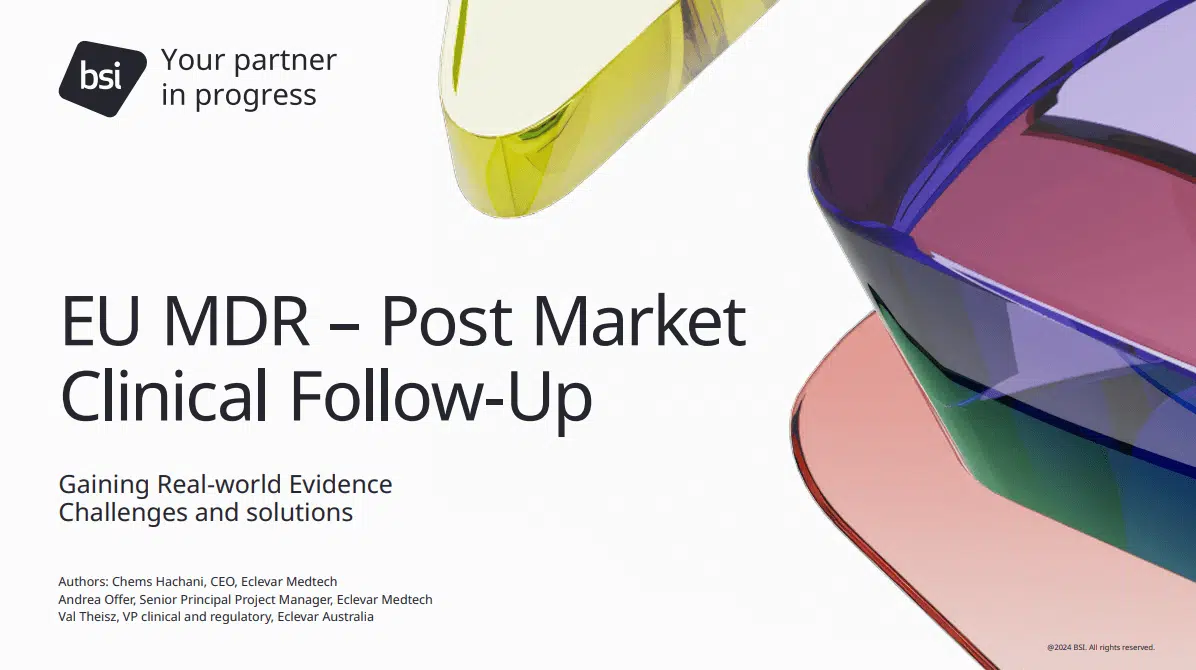
Written with Notified Body BSI: a practical reading of the clinical evidence expectations under EU MDR 2017/745, the same evidence your file has to support.
The services and topics connected to this page.
Send us the device, the claim and the deadline. You get a written answer within 24 hours.
Your documents are reviewed confidentially. An NDA can be signed before we receive any technical or clinical information.