RPM · Connected · Data
Remote patient monitoring, rigorous, not just convenient.
RPM promises continuous, real-world data and lighter site burden. The trade-off is data governance and compliance. Here is how to get the benefit without the risk.

European Champion
Platinum Award 2026
Eclevar MedTech & Milo Health · xShare × EUCROF Open Call
Led by authority
Continuous data, controlled properly.
RPM generates a flood of data. The value is in governing it, which is where our data team lives.

Sébastien Meier
Endpoints, statistics and RWE; architect of the MILO EDC, 21 CFR Part 11 and real-time dashboards.

Charline Petitdemange
ISO 14155 study conduct, EUDAMED registration and multi-country site monitoring across Europe.
Awards, funding, accountability
Europe’s best-rated medical device CRO.
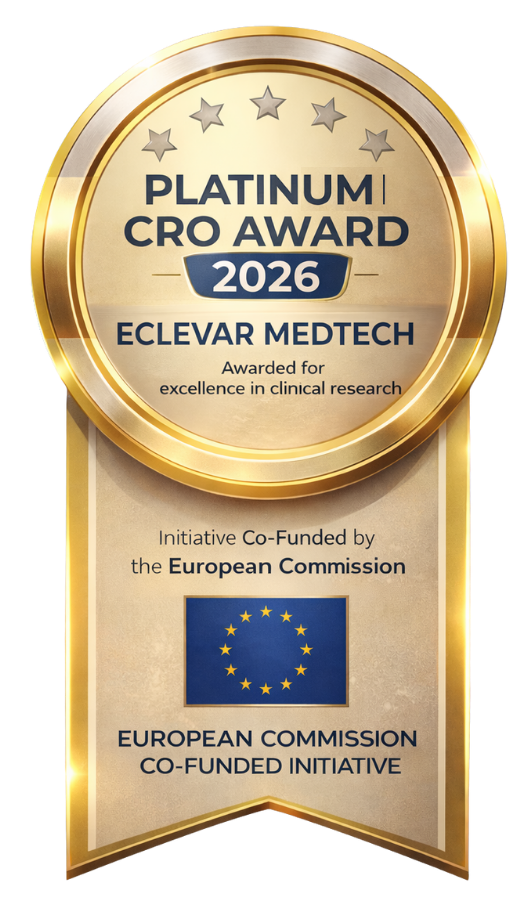
Platinum Award 2026
Top tier at the xShare × EUCROF Open Call, awarded to Eclevar MedTech and its Milo Health platform, presented at EUCROF 2026 in Amsterdam.
The announcement →Co-funded by the European Union
Selected through the xShare Open Call for clinical research innovation, Horizon Europe.
xShare results →Independently reported
Distinction confirmed by an independent third party, the CVBF, also an awardee of the xShare × EUCROF Open Call.
CVBF coverage →The approach
The promise and the trade-off.
Remote patient monitoring uses connected devices and apps to capture data between or instead of visits. Done well it improves retention and richness; done badly it creates ungovernable data.
01
What RPM brings
RPM captures continuous, real-world physiological and behavioural data from the patient’s own environment, reducing site visits and revealing patterns a periodic visit would miss. For long follow-up and PMCF it can transform retention.
02
The trade-offs
The cost is complexity.
What you take on
- Device validation and data provenance for every connected source
- Missing-data handling when patients or devices disconnect
- Data volume that needs a plan, not just a database
- Patient burden and adherence with wearables
03
Compliance
RPM data is still trial data: it must meet ISO 14155 for GCP, and GDPR for continuous health-data collection, with clear consent for the monitoring, pseudonymisation and compliant hosting. The connected devices themselves need documented validation.
04
Doing it well
The winning approach is selective: use RPM for the endpoints where continuous data adds real value, keep controlled measurement for the primary endpoint, and run it on a validated platform. We match the monitoring to the science, not the hype.
RPM at a glance
Rich data, governed.
Talk to a specialist
Could RPM strengthen your study, or complicate it?
Book a free scoping call. We tell you where remote monitoring adds real value and how to keep it compliant and governable.
Book a free scoping callContinuous data is only an asset if you can govern it.
An expert read tells you where RPM adds value, what validation and GDPR steps it needs, and how to keep the primary endpoint controlled.
Book a free scoping callQuestions we hear first