Device-specific clinical operations
The program is built around a device investigation: intended purpose, claims, risk management and the clinical evaluation it has to feed. It is not a pharmaceutical protocol with the drug references removed.
One medical device specialist team runs your French investigation end to end: feasibility, the ANSM and CPP route, site activation, monitoring, data management and the Clinical Investigation Report. Where French reimbursement is part of the commercial strategy, we review study design early against the evidence questions that may later matter to HAS and CNEDiMTS.
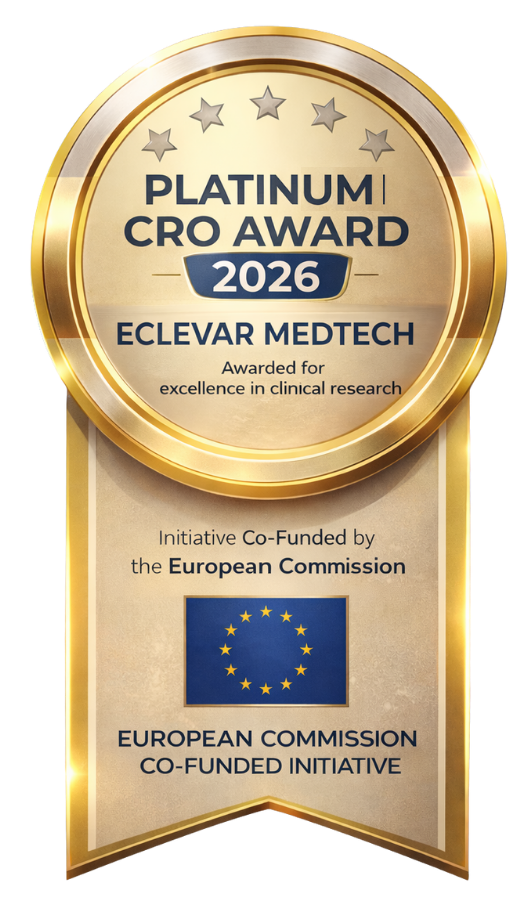
Eclevar was awarded Platinum in the xShare and EUCROF EHDS clinical research open call. The announcement is published by the awarding program itself, not by us.
Not a pharmaceutical CRO with a medical device team attached. Eclevar remains accountable for program governance across feasibility, submissions, sites, monitoring, data and reporting, with the delivery model defined for the contracted scope.
Planning France as part of a multicountry European program? Explore Eclevar's broader medical device CRO capabilities across Europe.
Sponsors comparing one medical device CRO France option against another are usually comparing the same promise. What follows is what we would want checked if we were on your side of the table, whether you are appointing an EU MDR CRO France side only or adding French sites to a European program.
The program is built around a device investigation: intended purpose, claims, risk management and the clinical evaluation it has to feed. It is not a pharmaceutical protocol with the drug references removed.
Eclevar coordinates the operational route for a French investigation, including the applicable ANSM and CPP processes. The exact pathway depends on how the research is classified, and we confirm that classification before anything is drafted.
Objectives, endpoints, claims, risk management and reporting stay aligned with the Clinical Evaluation Report the investigation exists to support, so the dataset lands where the technical documentation needs it.
Where a French commercial launch is intended, the comparator, endpoints and follow-up duration are reviewed against what CNEDiMTS looks for, while the protocol can still be changed without an amendment.
Feasibility, submissions, sites, monitoring, safety, biostatistics, medical writing and the Clinical Investigation Report run under one program governance. Fewer handoffs, and clinical, data and reporting decisions stay connected instead of being renegotiated between separate suppliers.
Our strongest franchises are cardiology and structural heart, orthopedics and spine, neuromodulation and advanced wound care, each with named clinical leadership rather than a generic therapy list.
Seven stages, one team, one reporting line. Stage 3 is summarized here and expanded in our step-by-step guide to submitting a device investigation in France. It is the sequence a medical device clinical trial CRO France sponsors appoint has to own from end to end.

Intended purpose, claims to be supported, the gap in the clinical evaluation, endpoints, comparator, population and study design. This stage decides whether France is one country in a European program or the program itself.
Investigator identification, site qualification, recruitment assumptions tested against French standard of care, equipment and staffing at each site, and whether the contracting route is realistic. See clinical feasibility and site selection.
The study is classified first, because the category sets the route, the documentation and who reviews it. The dossier is then built against that route, including the parts required in French. Where the route calls for both an ANSM submission and a CPP submission, they are prepared in parallel rather than in sequence.
Site agreements, essential documents, investigator and site staff training, initiation visits and activation, sequenced so the first sites open while the rest are still contracting. See study start-up.
Project management, on-site and remote monitoring of the French sites, safety handling, vendor coordination and a written escalation path for the issues that actually stop a study. Monitoring is delivered under Eclevar governance, with the resourcing model confirmed for the contracted scope.
Database build, clinical data management, biostatistics, data cleaning and database lock, on the Milo Studio environment for prospective data capture.
Clinical Investigation Report and summary, publication support where the program calls for it, integration into the CER and the PMCF plan, and the dataset organized so a later market-access dossier does not start from raw exports.
What a sponsor needs in order to plan. The document-level walkthrough lives in the dedicated guide, and this section sends you there rather than repeating it.
The applicable French review route depends on the MDR investigation category, the device class, the CE-marking status, the intended use and the purpose of the study. Some categories call for authorization by the ANSM together with a favorable opinion from a Comité de Protection des Personnes; others follow different review or notification arrangements. Eclevar confirms the applicable pathway before the dossier is built.
The category the investigation falls into, under EU MDR and the French national requirements that sit alongside it, determines which submissions apply and what documentation is required. Settling it in writing first is what keeps a French start-up on a clean path.
Once the route is confirmed, Eclevar builds and coordinates the required submissions, including the parts expected in French. Sponsors from outside France routinely commission the French-language documentation late, which is where the schedule goes.
See our step-by-step guide to medical device clinical investigation submissions in France for the dossier itself, the documents expected in French and the early scientific-advice route for implantable devices.
Investigations are planned against the applicable regulatory framework and the applicable clinical investigation standards, ISO 14155 included. The current international edition and the European harmonization position are covered on our ISO 14155:2026 CRO page.
The same protocol, the same dataset and the same report are read by a Notified Body, by the French authorities during execution, and later by whoever assesses the device for reimbursement. Designing for the first two and discovering the third afterward is the most expensive sequence available.
EU MDR
Notified Body view
French execution
ANSM and CPP view
Market access
HAS and CNEDiMTS view
Related questions, not identical ones. No outcome, timeline or reimbursement result is implied.
A study designed around CE-marking questions can be complete, clean and still fail to answer what the French reimbursement file asks. Two assessments, two bodies, two standards, one device.
This is the part a CRO can actually change, and only while the protocol is still open.
How the assessment itself works, including Service Attendu, Amélioration du Service Attendu and LPPR listing, is covered in full on the CNEDiMTS guide linked below.
Not every gap can be closed inside the pivotal study, and not every device needs it to be. Where the question is durability, real-world use, a broader population or a comparison that was not practical before market entry, a PMCF investigation or a registry and real-world evidence approach is often the honest answer.
What matters is that the post-market program is designed as part of the evidence architecture rather than commissioned later as a repair. The same data can serve the PMCF obligations under EU MDR and a subsequent French file, but only if it was structured to do both.
A CE mark lets the device be placed on the French market. It does not decide whether the device gets paid for, and the evidence that answers the second question is far harder to generate after the study has closed.
We can read a protocol before it is locked and name the places where the French pathway may later ask a question the design does not answer. If critical evidence requirements are identified only after study completion, additional analysis, post-market evidence generation or a further study may be required. See how CNEDiMTS evaluates medical device evidence in France, or read our reimbursement strategy and HTA work.
Six situations we are brought into, and what we do in each.
We support feasibility, the regulatory route, site strategy and full execution, and we tell you early if France is the wrong first country for this device.
Scope the programWe review operational feasibility, endpoint alignment and the France-specific requirements, and return a marked-up list of what will cause questions.
Request a protocol reviewWe add and manage French sites inside a wider European program, keeping one protocol, one database and one reporting line.
Add French sitesWe design PMCF, prospective or registry approaches against the specific gap, rather than repeating the pivotal study.
Close the gapWe assess whether the planned clinical evidence addresses the questions the French pathway will raise, and what it would take to change that while the protocol is still open.
Review the evidence planFor a first-in-human or early feasibility study, we size the first cohort so it informs the pivotal design instead of duplicating it.
Discuss a first study| Strategy | Start-up | Execution | Evidence |
|---|---|---|---|
| Clinical and regulatory strategy | ANSM and CPP dossier | Project management | Clinical data management |
| Protocol and synopsis design | Site feasibility | Monitoring, on site and remote | Biostatistics |
| Endpoint and comparator strategy | Site selection | Safety handling | Medical writing |
| Evidence gap review | Site agreements and start-up | Vendor management | Clinical Investigation Report |
| Reimbursement-aware design | Initiation visits and activation | Recruitment oversight | CER and PMCF integration |
Quality and regulatory support runs across all four streams, including ISO 13485 quality management and EU MDR technical review.
Status wording is taken from the program register. Outcomes stated are operational and factual. No clinical result, endpoint finding or regulatory decision is claimed.

Post-market clinical follow-up on implantable ports in a parenteral nutrition and intestinal failure population, where the relevant clinical experience sits inside French hospital practice and is not reachable from a literature review alone.
Eclevar structured the program architecture and supports delivery: multicenter observational design, 300 participants, five French sites, with the French dossier, site contracting and monitoring run under Eclevar governance.
A single French multicenter program running under one protocol and one database, with Eclevar accountable for the regulatory and ethics submissions.
If your device family needs French real-world evidence, this is the shape of the program that produces it, and the operational reason to use a team that is inside the French system.
Ongoing program. Client name and program description used with permission. No result, enrollment completion or regulatory decision is claimed or implied.

Post-market clinical follow-up covering diabetic foot ulcer and venous leg ulcer indications, with data that has to hold up in one clinical evaluation rather than as two separate narratives.
Eclevar designed and is managing the program: a randomized investigation, 160 participants, 14 sites across five European countries including France, with prospective capture on the Milo Studio environment and monitoring under ISO 14155.
One randomized multicountry program covering both indications, with France as one of the participating countries and a single data pipeline behind it.
France rarely stands alone. This is what it looks like when the French sites are one arm of a European program rather than a separate study bolted on afterward.
Ongoing program. Client name and program description used with permission. No result, endpoint outcome, enrollment completion or regulatory decision is claimed or implied.

A comparative question about a compact female intermittent catheter that a single-arm design could not answer, in a population where recruitment is dispersed across a small number of specialist services.
Eclevar designed and is managing the investigation: a randomized crossover design, 72 participants, ten sites across Denmark, the United Kingdom and France, registered on ClinicalTrials.gov under NCT05814211, alongside continuing clinical evidence advisory work.
A registered comparative investigation running in three countries, with the comparative structure built in from the design stage rather than retrofitted.
Comparative evidence is what the French reimbursement pathway usually asks for. It is far easier to design a comparison at the start than to argue for one after database lock.
Ongoing program. Client name and program description used with permission. Study registration is public. No result, endpoint outcome, enrollment completion or regulatory decision is claimed or implied.
Your first conversation is with the clinical and regulatory people who would work on the program, not with a separate sales function.

Chief Operating Officer and Head of Cardiovascular, Senior Consultant Surgeon
Twenty-five years in cardiac surgery, and a former senior clinical reviewer at a Notified Body, where more than 400 devices were assessed. Reads a protocol the way an assessor opens a technical file.

Chief Medical Officer, Orthopedics and Spine
Orthopedic surgeon and former clinical reviewer at a Notified Body. Class IIb and III implant evidence, registry-based post-market follow-up, and clinical evaluation methodology for orthopedic and spine programs.

Head of Medical Writing
Owns the documents the file is judged on: clinical investigation plan, Clinical Investigation Report and summary, and the clinical evaluation documentation the investigation has to feed.

Chief Data Officer
Designs the database and the statistical methodology, including how the dataset has to be structured if a market-access dossier is going to draw on it later.

Project Delivery Lead, France and United Kingdom
Runs French investigations day to day: site qualification, activation sequencing, monitoring oversight and the French-language documentation that reaches participants and ethics committees.

Head of Quality and Compliance
Owns the quality system behind delivery: controlled documents, deviation and corrective action handling, vendor qualification and trial master file completeness.
Notified Body experience is professional background, not a medical qualification, and the two are stated separately above. Former positions are given for biographical context only. Eclevar is independent, and is not affiliated with or endorsed by any Notified Body. Meet the full leadership team.
A France clinical feasibility assessment is a contained piece of work that answers the country question before you commit a protocol, a budget or a submission to it. Six things it looks at.
Eligible French sites named individually, with the basis for including each one and the services the study actually needs.
Assumptions tested with investigators rather than assumed from an epidemiology figure, and the reasons a site would decline.
What French practice actually does today for this indication, which is what a comparator argument has to be built against.
The applicable French route for this specific study type, confirmed rather than assumed, and what it requires in French.
Whether the planned design answers the EU MDR question, and whether it also answers what a later French market-access file would ask.
Study complexity, the risks we would expect to manage, and a sequencing view with its assumptions written down. Where relevant, a recommendation of France against an alternative European country.
Scope, duration and fee are agreed per device and per indication. We do not publish a fixed timeline, because the honest answer depends on the study type and the sites involved.
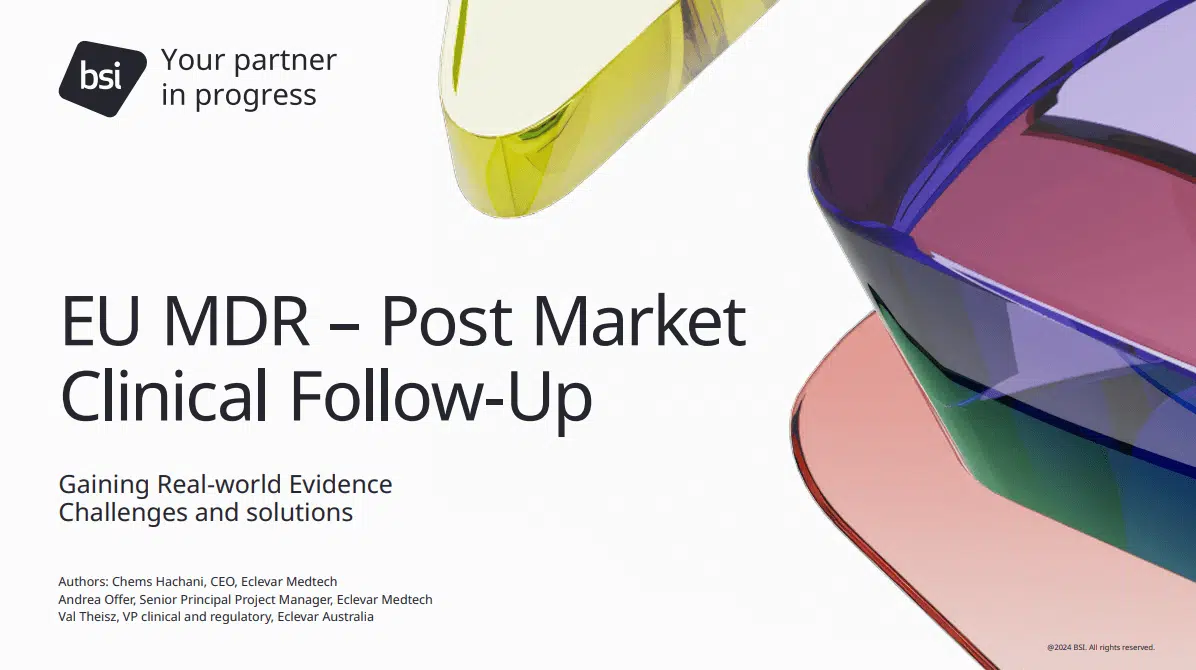
Written with Notified Body BSI: a practical reading of the clinical evidence expectations under EU MDR 2017/745. It is the same reading a French investigation has to satisfy, whichever submission route applies to it.
Start with the classification of the study and the evidence question, not with the dossier. The category the investigation falls into determines the route, the documentation and who has to review it, and it depends on the MDR investigation category, the device class, the CE-marking status, the intended use and the purpose of the study. In practice the sequence is: confirm the intended purpose and the claims, identify the gap in the clinical evaluation, design the study against that gap, run feasibility on French sites, then build the regulatory and ethics dossier. Beginning with the dossier is how sponsors end up amending a protocol that was never right for France.
It depends on the study. The applicable French review route depends on the MDR investigation category, the device class, the CE-marking status, the intended use and the purpose of the study. Some categories call for ANSM authorization together with a favorable opinion from a Comité de Protection des Personnes; others follow different review or notification arrangements; some data collections sit outside that framework. The applicable submission pathway cannot be determined reliably without understanding the device status, the intended use and the purpose of the investigation, so Eclevar confirms it for your specific study before the dossier is built.
We do not publish a start-up duration, because a number given without the study type, the number of sites and the contracting route behind it is not useful to you. What we can do is give you an indicative sequencing view for your study, with the assumptions written down, as part of a feasibility assessment. Two actions can reduce avoidable start-up delay: confirming the investigation classification early, and preparing the required French-language documentation in parallel with the wider dossier rather than after it.
Yes. Eclevar runs multicountry studies on one protocol, one database and one reporting line, and remains accountable for the regulatory and ethics submissions across the program. France is frequently considered as one component of a multicountry European device program, and the country strategy should be coordinated with the wider protocol, database and reporting model.
Yes, when it is designed to. The investigation has to be built against the specific gap in your clinical evaluation, with endpoints that support the intended claims and documentation that lands cleanly in the technical file. A study run in France under ISO 14155 is not automatically sufficient for your clinical evaluation; it is sufficient when the design was derived from the clinical evaluation in the first place.
Mainly through four decisions: the comparator, the endpoints, the follow-up duration and the study population. Where the commercial case rests on the device being better than existing care, that evidence is generated during the study. If critical evidence requirements are identified only after study completion, additional analysis, post-market evidence generation or a further study may be required. See how CNEDiMTS evaluates medical device evidence in France.
Yes. Post-market clinical follow-up is a large part of what we run, including prospective investigations, observational programs and registry approaches. The model is chosen against the specific gap rather than by default. See PMCF under EU MDR.
At protocol design, if a French commercial launch is intended. The decisions that determine whether a dataset can support a market-access file are made when the comparator, endpoints, follow-up and population are chosen. After database lock the options narrow to a new study or a post-market program, both of which cost more than getting the design right once.
Yes, and it happens regularly. A transfer starts with a review of the current state: regulatory status, site status, monitoring history, data quality and the outstanding risks. We give you that assessment before either side commits, because a rescue that is scoped from an optimistic handover briefing fails twice.
Yes. That is the France clinical feasibility assessment described above, and it is designed precisely so the country decision can be made on evidence. If the assessment concludes that another European country is the better first site for this device, that is what it will say.
Share your device, your development stage and your target indication. We will come back on whether France fits the program, the likely study route, and the next decisions that have to be made before a protocol is locked. We aim to respond to qualified clinical program inquiries within one business day.