Arthroplasty clinical investigations · Germany, Austria & Switzerland

First-in-human arthroplasty studies in the DACH region

A first-in-human arthroplasty study has to do more than show that a new implant can be placed successfully. It must resolve the main uncertainties around implant, procedure, fixation and early patient outcomes, while opening a clear route to pivotal evidence, PMCF and long-term follow-up.

Hip, knee & shoulderSentinel & staged cohortsRSA & migrationGermany · Austria · SwitzerlandEU MDR 2017/745
First-in-human arthroplasty clinical studies across Germany, Austria and Switzerland
The early clinical pathway
1
Evidence-gap & novelty review
2
Protocol, endpoints & imaging charter
3
DACH centers, ethics & submissions
4
Sentinel patients & staged cohorts
5
Monitoring, data & core lab
6
Pivotal, PMCF & CER
The first study is the start of the evidence program, not its conclusion.
Trusted by

Leading medical device teams

TERUMOMerilNIHON KOHDENVYGONColoplastSHOFUASAHI INTECCRegenLabTERUMOMerilNIHON KOHDENVYGONColoplastSHOFUASAHI INTECCRegenLab
Who leads the program

Orthopedic and Notified Body leadership

EUCROF Platinum Award 2026
EUCROF Platinum Award 2026xShare Open Call for Clinical Research, co-funded by the European Union
Dr Nikhil Khadabadi

Dr Nikhil Khadabadi

CMO · Orthopedics & Spine
NHS orthopedic surgeon

Former reviewer atTUV SUD
20+yrs

in orthopedic surgery & Class III implant evidence

  • Assesses Class III orthopedic & spinal evidence under EU MDR
  • Former Principal Investigator, Stryker robotic surgery trial
  • Leads CERs, PMCF & registries for Orthopedics & Spine
LinkedIn
Dr Mark Da Costa

Dr Mark Da Costa

Chief Operating Officer · former TÜV SÜD Senior Reviewer · Senior Consultant Surgeon

25+yrs

in device evaluation & Notified Body review

  • Assessed 400+ medical devices in Europe
  • Brings the reviewer perspective to protocol & CER design
  • Oversees delivery across the full evidence program
LinkedIn
Sébastien Meier Piantanida

Sébastien Meier Piantanida

Chief Data Officer · Biometrics & Data Systems

30yrs

in clinical data management, EDC & biometrics

  • Leads EDC, data management & biostatistics
  • Expertise in CDISC, CDASH, SDTM & ADaM
  • Validated data flows between sites, core lab & statistics
LinkedIn
Who this page is for

Preparing the first clinical use of a new arthroplasty technology

This page is written for manufacturers taking a new joint replacement technology into patients for the first time. If you are still shaping the overall evidence strategy rather than a single study, start at the parent hub and come back here once first-in-human work is clearly on the roadmap.

A new hip, knee or shoulder implant

A new platform with no clinical history in patients.

A new geometry or bearing concept

Changes to shape or articulation that alter how the joint behaves.

A cementless or alternative fixation system

Fixation concepts whose early behavior is not yet documented.

A new coating or porous surface

Surfaces intended to change osseointegration or long-term fixation.

A patient-specific or 3D-printed implant

Planning accuracy, fit and intraoperative modification become the question.

New arthroplasty instrumentation

Instruments and workflow that change how the implant is delivered.

A robotic or navigation-assisted system

Planned versus achieved position, technical failure and the learning curve.

A significant change to an existing platform

Design changes large enough that previous evidence no longer covers them.

Clinical evidence for arthroplasty medical devices, the parent hub, where the full evidence architecture is set out.

The decision

When is a first-in-human arthroplasty study needed?

The decision should begin with the clinical evidence gap, not with the assumption that every new device needs the same study design. A focused review of novelty, existing data and residual risk usually shows whether a full first-in-human investigation is proportionate, or whether a bridging strategy or a more targeted study would answer the open questions.

New implant concept with limited human evidence

A pre-CE-mark clinical investigation in patients.

Limited design change with strong existing evidence

Bridging strategy or focused clinical evidence.

New surgical workflow or instrumentation

Pilot or usability-focused investigation.

New fixation, coating or porous structure

Early clinical study with targeted imaging or RSA.

Existing CE-marked device with a new indication

Prospective PMCF investigation or indication-specific study.

Uncertainty after bench and preclinical testing

Targeted early study scoped to the residual question.

The factors that shape the decision are the novelty of the implant, material, coating or fixation method; how far the device differs from existing or previous-generation products; the availability and relevance of existing clinical evidence; the strength of any equivalence or bridging argument; the intended purpose and clinical claims; the identified residual risks; the uncertainty remaining after bench, biomechanical and preclinical testing; and any feedback from authorities or the Notified Body.

Novelty first

Define the novelty before defining the protocol

The evidence plan depends on what has actually changed. A modest revision to a well-characterized platform raises very different questions from a new bearing couple or a cementless surface with no clinical history. Defining the novelty precisely is what makes the rest of the study design proportionate.

Implant geometry

Positioning, stability, range of movement, alignment and the device-specific failure modes a new shape could introduce.

Material or bearing surface

Biocompatibility, wear, debris generation, fixation and longer-term performance, questions that mature slowly and shape the follow-up plan.

Fixation or coating

Migration, subsidence, radiolucent lines, osseointegration and loosening, where early radiographic behavior is an important signal.

Patient-specific implant

Planning accuracy, fit, intraoperative modification and imaging confirmation that the achieved result matches the plan.

Robotics or navigation

Planned versus achieved position, workflow, technical failures, conversion to a manual technique and the learning curve.

Device innovationSpecific uncertaintyStudy questionEndpointEvidence for the CER

Worked example. A new cementless porous coating introduces uncertainty about early fixation. That uncertainty defines the study question, the question determines the endpoint (migration measured by RSA at defined timepoints), and the endpoint has to generate evidence that still supports the conclusion the CER will eventually need to make.

Study design

Building a proportionate first-in-human study

The study should be large enough to generate interpretable early evidence, but focused enough to protect patients and allow each case to be reviewed closely. That balance, rather than a fixed sample size, is what defines a proportionate first-in-human design.

Number of centers

Is consistency more important than recruitment speed?

Number of surgeons

How will procedural variation and the learning curve be controlled?

Cohort structure

Should enrollment begin with sentinel patients?

Comparator

Is a historical, concurrent or no comparator justified?

Follow-up

Which early and later uncertainties must be addressed?

Escalation

What evidence is required before expanding enrollment?

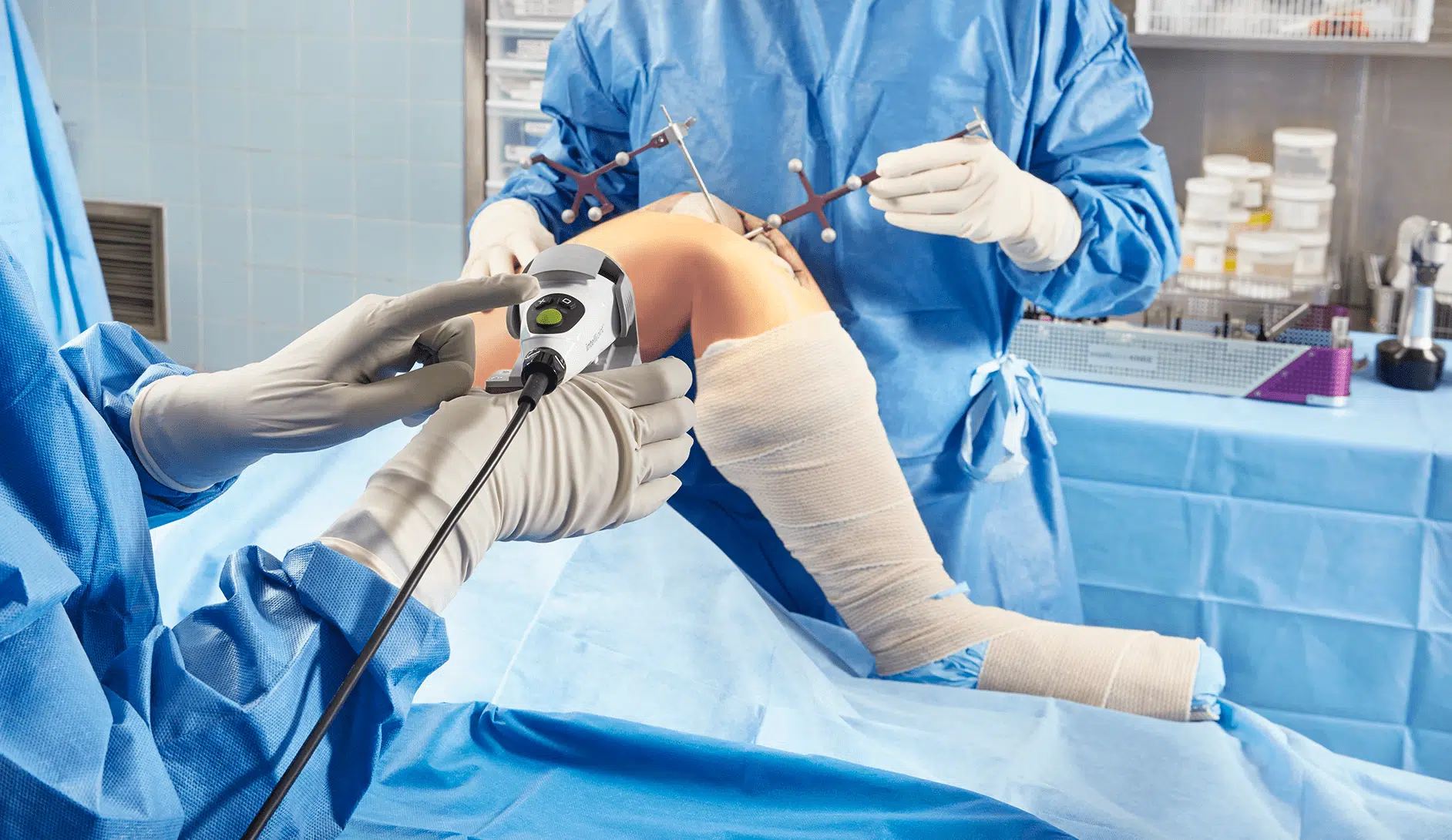
First arthroplasty cases performed under a proctored first-in-human protocol
Interpretable early evidence, by designPatient selection, investigator experience and structured training are what make the first cohort readable. They are design decisions, not operational details.
Patient selection

Selecting the first patient population

First-in-human recruitment should reduce avoidable variability without creating a population so narrow that the findings have little relevance to real use. The aim is a cohort that lets the device be assessed cleanly, while still resembling the patients it is ultimately intended for.

  • Diagnosis and disease severity
  • Primary versus revision arthroplasty
  • Bone quality, anatomy and deformity
  • Ligament and soft-tissue status, previous surgery
  • Comorbidities, anesthetic risk and infection risk
  • Ability to complete rehabilitation and attend clinical and imaging follow-up
  • Availability of established treatment alternatives

The first cohort is normally not the place for severe bone loss, highly complex revision cases, unusual anatomy, patients with multiple competing causes of poor function, or patients unlikely to complete follow-up. Complex cases can be added later, once the early signal is understood.

Selection criteria should connect directly to the intended-use population and the future clinical development pathway, so that the early evidence stays relevant to the eventual claims.

Sites & investigators

Choosing the right arthroplasty centers in DACH

Selecting first-in-human sites is more than identifying well-known names. The priority is centers that can deliver consistent surgery, disciplined documentation and complete follow-up, with the infrastructure to review early cases in detail.

Feasibility discussion on arthroplasty center selection in the DACH region
Center selection criteria

What we assess before a center is proposed

Surgical and study capability

  • Relevant arthroplasty volume for the joint and procedure
  • Experience with comparable implants and techniques
  • Medical device clinical investigation experience
  • Research coordinator capacity
  • Revision and emergency support

Data, imaging and follow-up

  • Imaging capability and, where relevant, RSA infrastructure
  • Standardized rehabilitation pathways
  • Long-term patient follow-up and retention
  • Data entry and documentation performance
  • Clear investigator commitment to the protocol

Each market brings its own context. Germany offers high-volume arthroplasty centers, including centers certified under EndoCert. Austria has established specialist centers and national referral patterns. Switzerland combines specialist arthroplasty centers with local language requirements and familiarity with SIRIS. Our feasibility and site selection team assesses each center individually before it is proposed.

Sites & investigators

What is assessed before a center is proposed

Selecting first-in-human sites is more than identifying well-known names. Each center is assessed individually against surgical, study, data and follow-up criteria.

Center selectionWhat we assess before a center is proposedCandidate centersDACH arthroplasty centers identifiedSurgical capabilityRelevant volume, comparable implants, revision supportStudy capabilityInvestigation experience, coordinator capacityData & imagingImaging and RSA infrastructure, documentation performanceFollow-up reliabilityRehabilitation pathways, long-term retentionProposed centersAssessed individually before proposal
Center selection funnel.
DACH execution

Germany, Austria and Switzerland: three routes, one study

A single first-in-human study can span the three markets, provided the different regulatory routes, language requirements and registry opportunities are planned from the start.

First-in-human arthroplasty feasibility network in DACH FIRST-IN-HUMAN ARTHROPLASTY NETWORK · DACH DEATCH One study, three routesShared protocol, endpoints and imagingcharter across all three marketsWatch: language, contracting andsubmission timelines differGermanyHigh-volume centers, several EndoCertcertified; EPRD for long-term evidenceWatch: contracting and data complexityAustriaEstablished specialist centers andnational referral patterns; BASG routeWatch: German-language documentationSwitzerlandSpecialist centers, SIRIS registry;Swissmedic and ClinO-MD frameworkWatch: separate Swiss pathway andlocal representation

Submission routes, language requirements and registry access differ by country and are assessed individually during feasibility.

Training & learning curve

Early outcomes reflect the surgeon as well as the implant

Planning and measuring the learning curve, rather than explaining it retrospectively, is what keeps the early evidence interpretable.

  • Device and instrument training
  • Documented surgical technique
  • Cadaveric or simulation training where relevant
  • Competency confirmation before the first case
  • Proctoring of the initial cases and manufacturer support in theatre
  • Documentation of any deviation from the planned technique
  • A defined learning-curve analysis in the statistical plan
  • Management of software or robotic system updates during the study

Key message. The learning curve should be planned and measured, not explained after inconsistent outcomes appear.

Investigator and site training follows ISO 14155 requirements and is documented before the first case.

Risk control

Staged enrollment, stopping rules and safety oversight

Early enrollment should be deliberately controlled, so that each of the first cases can be reviewed in detail before the study expands. A staged model gives the sponsor and the oversight group defined points to confirm that the device is behaving as expected before more patients are exposed.

Sentinel patientEarly reviewInitial cohortSafety reviewFull planned cohort

Pause or stop criteria

  • Unexpected device-related serious adverse events
  • Implantation failure, device breakage or malfunction
  • Unacceptable migration or subsidence
  • Early revision or reoperation
  • Repeated procedural difficulty or unexpected imaging findings
  • A pattern of similar complications
  • New preclinical, manufacturing or complaint information

Oversight models

  • Sponsor medical monitor
  • Independent medical monitor
  • Data Monitoring Committee
  • Clinical Events Committee
  • Independent imaging review

The model chosen should reflect the risk and complexity of the technology, and is agreed with the clinical monitoring plan before first enrollment.

Review gate agreed between sponsor and CRO before the first patient
Review gates, defined before the first patientPredefined pause and stop criteria, and an oversight model proportionate to the technology, support every gate between sentinel patient and full cohort.
Cohort structure

Escalation is a design decision

Sentinel patients, review gates and an oversight model proportionate to the technology are agreed with the clinical monitoring plan before the first enrollment.

Cohort structure & review gatesFrom sentinel patient to full cohortSentinel patientsFirst cases, proctoredReview gate 1Pause and stop criteria checkedExpanded cohortEnrollment widens by designReview gate 2Imaging and safety reviewedFull cohortEarly evidence readablePredefined pause and stop criteriaUnexpected device-related serious adverse events, implantation failureor breakage, unacceptable migration or subsidence, early revision.Oversight model, agreed before first enrollmentSponsor or independent medical monitor, Data Monitoring Committee,Clinical Events Committee, independent imaging review.
From sentinel patients to full cohort, with predefined gates.
Endpoints

What should the first study measure?

The first study should establish a clear early safety and performance picture, using endpoints defined in advance that map onto the intended claims. This is the framework; the detailed logic sits on arthroplasty endpoints and PROMs.

Safety endpoints

Device- and procedure-related adverse events, infection, dislocation or instability, periprosthetic fracture, neurovascular injury, thromboembolic events, wound complications, reoperation, revision, device deficiency or malfunction.

Procedural endpoints

Successful implantation, completion with the intended instruments, intraoperative complications, procedure duration, blood loss, conversion to an alternative device or technique, technical difficulty and unplanned instrumentation.

Early performance endpoints

Implant position and alignment, stability, range of movement, pain, joint-specific function, early fixation or migration, ability to complete rehabilitation and, where appropriate, patient satisfaction.

Each endpoint should remain traceable to a conclusion the clinical evaluation report will eventually need to support, and is prespecified with our biostatistics team in the SAP.

Joint-specific priorities

Early evidence priorities differ by joint

A concise orientation rather than a substitute for arthroplasty endpoints and PROMs, which covers endpoint selection and responder logic in detail.

Hip

Fixation, stability, dislocation, periprosthetic fracture, migration and function.

Knee

Alignment, stability, stiffness, pain, range of movement and function.

Shoulder

Stability, glenoid fixation, notching, range of movement and rotator-cuff-related function.

Small joints

Implant integrity, pain, joint-specific function, reoperation and radiographic performance.

Imaging & fixation

Plan imaging before the first patient is enrolled

Imaging is often where early fixation and migration questions are answered, so the approach should be agreed before the first patient is enrolled rather than assembled afterwards. An imaging charter that defines acquisition, projections and timepoints keeps images comparable across sites and supports reliable pooled analysis.

Biplanar hip radiographs supporting the imaging charter of a first-in-human study
Imaging charter & RSA

What the imaging plan has to define

Imaging charter

  • Standardized acquisition, projections and patient positioning
  • Baseline and follow-up timepoints
  • Component position, alignment and radiolucent lines
  • Subsidence or migration, loosening and osteolysis
  • Fracture, osseointegration and implant integrity
  • Core-lab reading or independent review where endpoint objectivity matters

When RSA is relevant

  • Cementless implants where early fixation is the main uncertainty
  • New porous coatings or surface treatments
  • Modified geometry or a new fixation concept
  • Where specialist centers and a clear interpretation plan are available

Marker placement, precision and migration thresholds are covered on imaging, core lab and RSA for arthroplasty studies.

Imaging & fixation

The imaging plan is agreed before the first patient

Imaging is often where early fixation and migration questions are answered, so the charter is written up front rather than assembled afterwards.

Imaging & fixationThe imaging charter is written before the first patient is enrolledWhat the imaging charter definesStandardized acquisition, projections and patient positioningBaseline and follow-up timepointsComponent position, alignment and radiolucent linesSubsidence or migration, loosening and osteolysisFracture, osseointegration and implant integrityCore-lab reading where endpoint objectivity mattersWhen RSA becomes relevantCementless implants where early fixation is the main uncertaintyNew porous coatings or surface technologiesSmall, technically intensive early studiesThree-dimensional migration relative to boneDouble examinations that establish precisionCentral analysis with defined quality thresholds
What the imaging charter defines, and when RSA becomes relevant.
Follow-up strategy

Design the schedule so the same cohort can mature

The first-in-human study should capture early safety, but it should also open a pathway for evidence that matures over time. Setting the schedule at the design stage means the same cohort can carry short-term safety, functional recovery, fixation behavior and, later, survivorship signals.

Discharge6 weeks3 months6 months12 months24 monthsPMCF & registry follow-up

The final schedule depends on the joint, the implant type, the fixation method, the recovery pathway, the intended claims and the known and theoretical risks. Illustrative timepoints are a starting point, not a template. The long tail is carried by orthopedic PMCF and device registries under EU MDR.

Country pathways

Germany, Austria and Switzerland

Orientation across the three markets. The full submission routes, document sets and timelines are maintained by our regulatory team for each study.

Germany

The EU MDR clinical investigation pathway, with ethics and competent authority planning, device documentation requirements and site contracting. High-volume centers, including those certified under EndoCert, matter here. EPRD may support future registry or long-term evidence planning.

Austria

Also the EU MDR clinical investigation pathway, with ethics review and BASG requirements as applicable, country-specific document preparation, German-language requirements and specialist center feasibility.

Switzerland

A separate national framework: Swissmedic and ethics review, ClinO-MD requirements, local representation where applicable, and SIRIS as a potential source of long-term registry evidence.

Country submissions, ethics files and site activation are handled by our regulatory affairs and study start-up teams.

DACH execution

Three routes, one study

A single first-in-human study can span Germany, Austria and Switzerland, provided the regulatory routes, language requirements and registry opportunities are planned from the start.

One protocolOne first-in-humanstudy can span thethree markets.GermanyEU MDR clinical investigation routeEthics and competent authority planningHigh-volume centers, including EndoCertEPRD for future long-term evidenceAustriaEU MDR clinical investigation routeEthics review and BASG requirementsGerman-language document preparationSpecialist center feasibilitySwitzerlandSeparate national frameworkSwissmedic and ethics review, ClinO-MDLocal representation where applicableSIRIS as long-term registry evidenceOne datasetComparable endpoints,one statistical plan,one study report.Submission routes, language requirements and registry access differ by country and are assessed individually during feasibility.
Country routes converging into one comparable dataset.
Clinical operations

From protocol to first patient in

Once the design is agreed, delivery becomes a connected chain rather than a series of handovers. Keeping strategy, operations, data and reporting within one team is what maintains consistency across DACH sites.

Evidence & protocol reviewCountry feasibilitySite selectionSubmissionsContracts & activationTrainingMonitoringData & imagingStatisticsCSR

Eclevar MedTech can provide a single work package or full study delivery: feasibility and site selection, study start-up, clinical monitoring, EDC and data management, biostatistics and clinical reporting, as part of the wider medical device CRO offer, backed by our operational infrastructure.

Evidence pathway

From first-in-human to pivotal evidence and PMCF

The initial study is the start of the evidence program, not its conclusion. Its value is greatest when its endpoints are chosen so the early data stay traceable to the conclusions the CER will eventually need to support.

Hip and knee radiographic follow-up from first-in-human study to PMCF
The stages

What each stage is actually for

First-in-human

Early safety, feasibility and initial performance.

Expanded or pilot study

Refine assumptions, procedures and endpoint estimates.

Pre-market investigation

Support predefined safety and performance objectives, in a pre-market clinical trial.

PMCF

Address remaining uncertainty in routine clinical use, through a proportionate orthopedic PMCF strategy.

Registry or RWE

Long-term survivorship, revision and rare outcomes, through device registries and real-world evidence.

CER update

Integrate all evidence into the benefit-risk conclusion.

This mirrors the evidence architecture set out in the arthroplasty hub: early endpoints stay traceable to the eventual CER conclusions, and no single study is expected to answer every short-term and long-term question. Where appropriate, the first cohort can continue into arthroplasty PMCF, registries and real-world evidence in DACH.

What Eclevar MedTech delivers

Each need can be commissioned on its own, or combined into full study delivery

  • Is a first-in-human study justified?: evidence-gap and clinical-strategy assessment
  • How should early risk be controlled?: staged-enrollment and safety-oversight model
  • Which endpoints should be used?: joint-specific endpoint and PROM framework
  • Which DACH centers are suitable?: country, KOL and site feasibility
  • How should imaging be managed?: imaging charter, core lab and RSA strategy
  • How will the study be submitted?: country-specific regulatory and ethics support
  • How will evidence mature?: pivotal, PMCF, registry and CER integration plan
  • Can you run the full study?: protocol, start-up, monitoring, data, statistics and reporting
Why work with Eclevar MedTech

Reviewer experience, applied to early arthroplasty evidence

Orthopedic and reviewer leadership

The program is led by Dr Nikhil Khadabadi, an NHS orthopedic surgeon and former TÜV SÜD Notified Body clinical reviewer.

One connected evidence team

Clinical strategy, protocol writing, operations, imaging, data management, biostatistics, PMCF and CER support planned together.

Specialist DACH study delivery

Country feasibility, submissions, activation, monitoring and site coordination across Germany, Austria and Switzerland.

Flexible engagement

Commission a protocol review, endpoint strategy, imaging package or a full clinical investigation.

Timeline & budget

What actually drives an early arthroplasty program

Timelines follow the maturity of the device and evidence package, protocol readiness, country selection, the number of centers, availability of specialist investigators, imaging and RSA requirements, contracting and submissions, the cohort-staging model and follow-up duration. Costs follow countries and sites, procedural complexity, monitoring intensity, investigator training and proctoring, imaging frequency, core lab or RSA scope, independent safety oversight, EDC and imaging integration, statistical complexity and follow-up duration. We quote in defined work packages, using the same cost model as our European clinical trial cost benchmarking.

Clinical investigation planning under ISO 14155 for an early arthroplasty program
FAQ

Questions sponsors ask first

When is a first-in-human arthroplasty study required?

A first-in-human study may be required when a device is sufficiently novel that existing clinical data and any equivalence argument leave meaningful uncertainty about safety or early performance. A focused evidence-gap review should confirm this before a protocol is commissioned.

How many patients are usually included?

There is no fixed number. The cohort should be large enough for interpretable early evidence and small enough for close case-by-case review, with the size justified by the device, the questions and the staging model.

Should the first study be single-center or multicenter?

It depends on whether consistency or recruitment speed matters more. A single center can reduce variability early, while a multicenter design supports faster recruitment and broader generalisability once the technique is stable.

Which endpoints are suitable for a first-in-human joint replacement study?

Suitable endpoints usually combine safety, procedural and early performance measures selected for the specific joint and intended claims. Each endpoint should remain traceable to a later CER conclusion.

When is RSA appropriate for a new implant?

RSA may be appropriate when early fixation or migration is the central uncertainty (a cementless design, a new porous coating, modified geometry or a new fixation concept), and when specialist centers and a clear interpretation plan are available.

Can Germany, Austria and Switzerland be included in one study?

Yes. A single study can span the three markets, provided the different regulatory routes, language requirements and registry opportunities are planned from the start.

How should staged enrollment and stopping rules be designed?

Around defined review gates, beginning with sentinel patients and expanding only after each safety review. Pause and stop criteria should be predefined, with oversight proportionate to the technology.

Can the first-in-human cohort continue into PMCF follow-up?

Yes. Where appropriate, the early cohort can continue into longer-term PMCF or registry follow-up. Designing that pathway from the start strengthens the long-term evidence base and supports future CER updates.

Start the conversation

Planning the first clinical use of a new arthroplasty device?

Share your device description, intended claims, existing preclinical evidence and target markets. We review the main clinical uncertainties and outline a proportionate first-in-human strategy covering patients, centers, endpoints, imaging, DACH delivery and the route into longer-term evidence.

Your documents are reviewed confidentially. An NDA can be put in place before we receive any technical or clinical information. You can also reach the team through the contact page.

Reforming Clinical Evaluation of Medical Devices in Europe