Validate the assumptions that still matter, then design and deliver the European or hybrid pivotal investigation through one integrated clinical, data, and statistical team.
US and international sponsors reaching this point are not asking whether to run a study. They are asking whether the program is ready for a pivotal investigation, whether a targeted feasibility stage is still worth its cost and calendar, and how Europe-led or hybrid execution should be structured. Eclevar takes a position on that question first, then designs and runs the study that follows.
A pivotal investigation confirms, it does not explore. Unresolved assumptions about the procedure, the endpoint, or the site become confounders in the study meant to settle the question. The reverse failure costs as much: a second pilot that repeats what is already known. The test is narrow. A feasibility stage earns its place only when its result can change a pivotal decision that has not yet been made.
Where Route B is met, we say so. A further pilot that cannot change the pivotal design adds cost without adding evidence.
Readiness is not one verdict but the state of five domains. The design gate is where all five have moved far enough for the protocol to be fixed.
Figure 1. From Residual Uncertainty to Pivotal Readiness
Five domains, four states. No scores, no weighting, no dashboard.
The value of a feasibility study is not the dataset but the pivotal decisions it lets the sponsor take with evidence. Each planned observation should be attached, before the protocol is written, to the decision it will inform.
| Feasibility finding | Pivotal decision |
|---|---|
| Endpoint variability | Sample size and endpoint selection |
| Procedure consistency | Training and investigator qualifications |
| Recruitment per site per month | Number of sites and recruitment duration |
| Screen-failure pattern | Eligibility criteria and site mix |
| Imaging feasibility | Acquisition protocol and core-lab model |
| Device handling | Training, instructions, and device controls |
| Operator learning | Run-in, qualification, or case-sequence strategy |
| Protocol deviations | Protocol simplification and clarification |
| Follow-up burden | Visit schedule and retention plan |
| Missing data | eCRF and monitoring controls |
A feasibility study producing only descriptive observations, with no predefined pivotal decision framework, risks becoming an expensive delay.
The cycle runs once when the observation resolves what it was designed to resolve, and again on a narrower question where material uncertainty remains. Proceeding to pivotal is one outcome, not the purpose.
Figure 2. Feasibility-to-Pivotal Decision Cycle
Seven stages, one feedback loop, four possible outcomes.
Feedback loop: where stage 05 leaves material uncertainty, the cycle returns to stage 02 with a narrower objective rather than passing the question into the pivotal protocol.
Assumptions hold and the design gate is met.
Endpoint, population, or operating model changes.
A narrower clinical or technical question remains.
The evidence does not support committing pivotal budget.
A pivotal protocol is written backwards from the decision it must support. Before the design is discussed, the evidence objective is agreed in writing: which submission, which conformity route, which claims, which population.
FDA may accept information from a clinical investigation conducted outside the United States when the investigation is well designed and well conducted and the applicable conditions under 21 CFR 812.28 are met. Acceptance of that information does not by itself establish that the evidence is sufficient for the requested regulatory decision.
Sufficiency is a separate, submission-specific question. Population applicability, comparability of medical practice, endpoint alignment, device comparability, and the expectations attached to the particular submission all affect whether the evidence is relevant and adequate for the decision being requested. Those considerations are not acceptance conditions contained in 21 CFR 812.28, and they should not be read as one list.
Compliance with EU MDR does not establish FDA acceptability or sufficiency. ISO 14155:2026 is the current international standard for good clinical practice in medical device clinical investigations, and alignment with it does not establish FDA acceptability or sufficiency either. FDA feedback is device-specific and submission-specific, and no CRO can guarantee an agency outcome. US regulatory leadership remains with the sponsor’s FDA regulatory lead or a separately retained qualified FDA specialist.
Regulatory references reviewed August 8, 2026: 21 CFR 812.28 and 21 CFR 814.15. This is not legal advice. Related reading: Can European Clinical Data Support an FDA Medical Device Submission? (publication pending)
Geography follows the evidence question, not a starting preference. Each model carries a different evidence risk and operating cost, and each is right for some devices and wrong for others.
The geographic comparison is developed in full in our article US, Europe, or Hybrid: Where Should You Run Your Medical Device Clinical Study? (publication pending)This page covers the execution consequences once the model is chosen.
Pivotal timelines fail at the same point: the enrollment assumption was built from procedure volume and enthusiasm, not from the patients a site can actually consent under this protocol, against the studies already running there.
National requirements differ across Member States, and start-up sequencing differs with them. See feasibility and site selection, study start-up, and our country-selection guide (publication pending).
A recruitment plan is credible when derived from the participants who reach primary follow-up, not from annual procedure volume. Every stage removes patients; every site-level input caps the rate at which the rest can be enrolled.
Figure 3. From Site Volume to Pivotal Recruitment Capacity
Relative widths only. No units, no dataset, no benchmark.
Illustrative only, no units and not derived from a study dataset.
Clinical, operational, data, and statistical leads review the protocol together, once, before it is fixed. A document that is scientifically sound but operationally unrealistic produces deviations, missing data, and a primary analysis that must be defended rather than reported.
Early cases can differ from later cases for reasons unrelated to the device. Where that effect is plausible it is handled in the protocol, not explained afterwards in the report: training cannot correct a protocol that ignored the learning curve.
National requirements, ethics processes, and contracting practice are not identical across Europe. The operating model applied to them can be: one set of definitions, one escalation route, one recruitment review, one source of truth for study status.
Eclevar manages the European regulatory and ethics submission workstream under one program governance, using verified local processes and support where required. Sponsor outcome: first-patient-in follows a known critical path rather than whichever country replies first.
Sponsor outcome: problems surface as signals with owners and deadlines, not as findings at database lock.
Sponsor outcome: the file supports the submission when the study ends, because it was maintained during conduct.
Data Management and Biostatistics participate before protocol finalization. A database designed afterwards inherits every ambiguity the protocol left in it, and those reappear as queries, deviations, and late analysis decisions.
Related capability pages: clinical monitoring, regulatory affairs and strategy, clinical data management and EDC, and the specialist medical device CRO overview.
Five functions run in parallel across the same milestones. The cells marked as decision points are where the study cannot advance until the functions agree, and where fragmented delivery usually fails.
Figure 4. One Governance Model From Protocol to Clinical Investigation Report
Five aligned lanes across ten milestones. No durations are implied.
Cross-functional decision point
Risk-based monitoring is a device-specific judgment about which failures would alter the primary conclusion or the safety assessment. It is not a fixed percentage of source data verification, and it is not a decision to monitor remotely.
Remote and centralized methods reduce the volume of on-site work; they do not replace it. Procedural devices, implantables, and imaging endpoints still require on-site verification where the record is generated.
The published example below demonstrates multicountry European delivery of an investigational-device study and the operational disciplines relevant to later pivotal development. It is presented for those transferable disciplines and not as evidence of a Europe-led FDA pivotal program.
Eclevar’s operating scope varied between these programs. The figures are not presented as full-service responsibility for every program, as US studies, or as evidence accepted by any authority.
Study classification: a pre-market clinical investigation, not a pivotal investigation. Coloplast A/S is not a US sponsor. No FDA use of these data is stated or implied, and no study outcomes are published here. Eclevar's contribution is limited to clinical evidence architecture, European delivery, and statistical methodology. Reference to the sponsor and to the public registration does not imply endorsement. Further examples: client success stories.
The people who take the position on feasibility versus pivotal are accountable for delivering what follows.

Mark leads cardiovascular clinical strategy, combining 25 years of Consultant Cardiac Surgery experience with first-hand senior leadership Notified Body experience. He tests pivotal readiness through the intended claims, endpoints, patient population, operator assumptions, and the decision the study must support.

Orthopedic surgeon and former Notified Body clinical reviewer. On feasibility and pivotal programs he shapes protocol and endpoint strategy for implantable and procedural devices, sets investigator qualification thresholds, and works through how operator learning, procedural standardization, and follow-up burden affect what the confirmatory study can credibly measure.

External strategic advisor to ECLEVAR MedTech. Dawn brings a US clinical operations perspective to study planning: how site and investigator considerations differ between regions, where operational feasibility assumptions break down in practice, and how the execution interfaces between a US program and a European program are set up so that one protocol can run across both.

Sébastien brings data management and biostatistics into the study before the protocol is fixed. He owns the database specification, the edit checks, the statistical analysis plan, and the missing-data strategy, and he is accountable for the path from first data entry through database lock to the analysis datasets, tables, and figures the report is built on.

Charline runs program governance across participating countries: one critical path, one escalation route, and one status of record for the sponsor. On feasibility and pivotal programs she is accountable for start-up sequencing, site activation, recruitment review site by site, and the operational decisions that keep a multicountry study running to one operating model.
Medical Writing, Regulatory Affairs, Quality, and the wider Clinical Operations team are assigned as functions per program: protocol drafting and the Clinical Investigation Report, clinical investigation applications, ethics submissions, substantial modifications, safety reporting, monitoring, and quality oversight per country. The engagement team is confirmed for each program according to the device, therapeutic area, countries, study design, and contracted scope.
A defined working session, not a capability presentation. It produces a position on whether the program is ready for pivotal development, and what the European or hybrid study would have to look like.
Confidential technical documentation is not required to start.
A complete pivotal design is not produced from an introductory call, and we do not present one.
A feasibility study is justified only when it can change the pivotal plan, and pivotal readiness has to be shown across the device, protocol, endpoints, sites, data, and intended regulatory use. The Review is where that judgment is made with evidence.
A feasibility or pilot investigation resolves uncertainty: device handling, endpoint behavior under routine conditions, what a site can realistically recruit. A pivotal investigation is confirmatory, with hypotheses and analysis specified in advance. The second should not do the work of the first.
When its result could change a pivotal decision not yet made: sample size, endpoint selection, eligibility, site mix, training strategy, or visit schedule. If the plausible findings would leave the design unchanged, the study adds cost without adding evidence, and we say so.
Yes, under Regulation (EU) 2017/745 and applicable national requirements, with applications to the Member States concerned. Whether Europe is right depends on population applicability, standard of care, investigator availability, and the intended use of the evidence.
FDA may accept information from a clinical investigation conducted outside the United States when the investigation is well designed and well conducted and the applicable conditions under 21 CFR 812.28 are met. Acceptance of that information does not by itself establish that the evidence is sufficient for the requested regulatory decision.
Sufficiency is a separate, submission-specific question, affected by population applicability, comparability of medical practice, endpoint alignment, device comparability, and the expectations attached to the particular submission. Compliance with EU MDR does not establish FDA acceptability or sufficiency, and alignment with ISO 14155:2026, the current international standard, does not establish FDA acceptability or sufficiency either.
When US representation adds evidence value European data alone would not carry, when US investigators matter to adoption, and when one protocol can realistically run across both regions. Hybrid execution adds coordination and oversight complexity, so it should follow from the evidence model.
From the protocol outward: eligible population, standard-of-care and procedure requirements by country, investigator and infrastructure criteria, protocol-specific site feasibility, competing studies and screen-failure drivers, then recruitment assumptions per site per month. Procedure volume and declared interest are not recruitment evidence.
No general number. Site count follows from the sample size, the realistic enrollment rate per site per month, the recruitment window, and the need to avoid concentration in a few centers.
Through qualification thresholds, standardized training, proctoring where the procedure requires it, prospective capture of case sequence and procedural metrics, and, where justified, run-in cases. Not every study needs them. What matters is that the design accounts for the learning curve.
Before the protocol is finalized. The database specification, analysis plan, and missing-data strategy depend on protocol choices. Reviewing them afterwards means changing the protocol late, or accepting a dataset that makes the primary analysis harder to defend.
Device and intended use, development stage, existing preclinical and clinical evidence, current device version, protocol or synopsis, target population and candidate endpoints, intended FDA and European pathways, countries under consideration, and sample-size assumptions. Confidential documentation is not required for the first conversation.
Yes. Core clinical, data, statistical, and medical-writing functions are coordinated under one Eclevar governance model, which is why database and analysis decisions are taken before the protocol is fixed.
From the recruitment model and the critical path, not from a template. The drivers are sample size, enrollment rate per site per month, countries and sites, follow-up duration, imaging or adjudication requirements, and monitoring intensity. We give a range with its drivers, and what would narrow it.
Official content
Whitepapers, client voices and publications produced by our own teams and by our partners: BSI, TÜV SÜD and RegenLab.

Whitepaper · BSI x Eclevar
Written with the notified body BSI: a practical look at what clinical evidence has to show under EU MDR 2017/745, and at the quality bar the data have to clear. It is the same bar a European dataset meets before it is put in front of any reviewer.
PMCF studies · Regenerative medicine · 5 EU countries
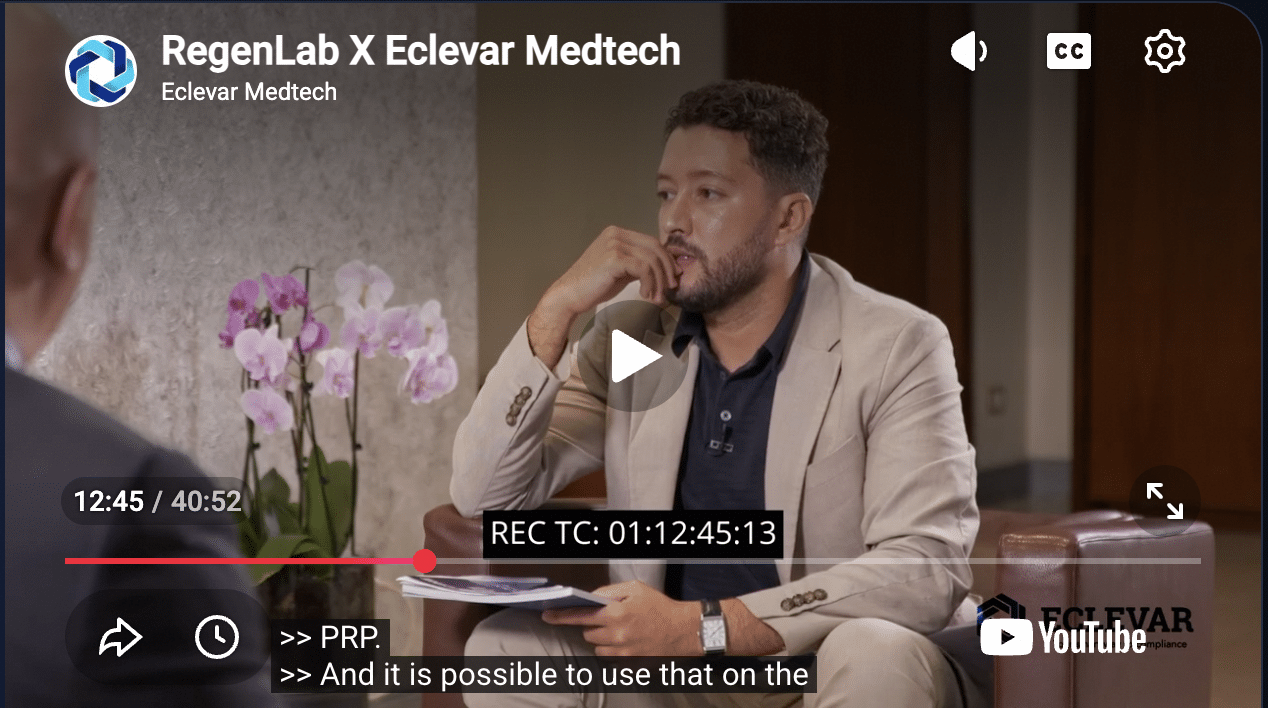
Eclevar runs RegenLab's PMCF program on chronic wound products. It is a randomized study of 160 subjects across 14 centers in 5 EU countries, covering both diabetic foot ulcer and venous leg ulcer. The partnership combines Eclevar's ISO 14155 expertise with the Milo Studio platform, from study design through to the final study report.
« Eclevar, with its tailored approach and the advanced Milo Studio platform, represents a significant strategic advantage. »Antoine Turzi, CEO, RegenLab
Coming soon. Breakthrough Device Technology under the EU MDR, a whitepaper written with TÜV SÜD, co-authored by Dr Nikhil Khadabadi.
Europe-led and hybrid pivotal studies work when the evidence model and the operating model are aligned prospectively. That alignment is what the Review produces.