Cardiovascular & Structural Heart · EU MDR 2017/745

Cardiovascular endpoint adjudication and core lab, as one system

Class III cardiovascular and structural heart devices, run through European sites with VARC-3 endpoints, imaging core lab, independent adjudication, PMCF and CER.

TAVITMVR / TTVRVARC-3Core lab & adjudicationEU MDR 2017/745
Cardiovascular clinical investigation under ISO 14155
Adjudication & core lab, one system
1
Charter & endpoint definitions
2
Event identification
3
Independent CEC
4
Imaging core lab (echo/CT)
5
Reconciled adjudicated data
6
Locked, defensible endpoints
One charter, one committee, one core lab: from event triggers to a locked, defensible endpoint dataset.
Expertise & recognition

A recognized European cardiovascular team

EUCROF Platinum Award 2026
EUCROF Platinum Award 2026xShare Open Call for Clinical Research, co-funded by the European Union
Dr Mark Da Costa

Dr Mark Da Costa

Chief Operating Officer & Head of Cardiovascular

TÜV SÜD
25+yrs

in cardiac surgery & cardiovascular device evaluation

  • Cardiac surgeon & former TÜV SÜD Lead Cardiovascular Reviewer
  • Reviewed clinical evidence for 400+ cardiovascular devices
  • Leads Eclevar's TAVI, structural heart & high-risk cardiovascular device programs
LinkedIn
Susanne Höfer

Susanne Höfer

Head of Cardiovascular Clinical Operations · DACH

Previously
Edwards Lifesciences Stryker ReCor
19+yrs

in international clinical research (cardiovascular & interventional)

  • Led international programs covering ~200 sites & ~3,000 patients
  • Investigator engagement, KOL collaboration & site training
  • Oversees cardiovascular study delivery across the DACH region
LinkedIn
S. Meier Piantanida

Sébastien Meier Piantanida

Chief Data Officer · Biometrics & Data Systems

30yrs

in clinical data management, EDC & biometrics systems

  • Leads EDC, clinical data management & biometrics across the study lifecycle
  • Expertise in CDISC, CDASH, SDTM & ADaM
  • Oversees validated data flows between sites, the Core Lab & statistical teams
LinkedIn
Mathilde Renier

Mathilde Renier

Senior Clinical Data Manager · Cardiovascular

10+yrs

in cardiovascular clinical data management

  • Manages eCRF & database build, validation, cleaning & lock
  • Coordinates imaging & endpoint data from the Core Lab to analysis
  • Supports VARC-3-aligned data collection, review & traceability
LinkedIn
Charline Petitdemange

Charline Petitdemange

Lead Clinical Project Manager · Cardiovascular programs (France & UK)

10+yrs

in clinical research & medical device studies

  • Leads cardiovascular investigations & PMCF studies from start-up to close-out
  • Manages site coordination, monitoring, timelines & cross-functional teams
  • Former CPM at the Center de Recherche Cardio-Vasculaire des Alpes
LinkedIn
Trusted by

Leading medical device teams

TERUMOMerilNIHON KOHDENVYGONColoplastSHOFUASAHI INTECCRegenLabTERUMOMerilNIHON KOHDENVYGONColoplastSHOFUASAHI INTECCRegenLab
On the ground with our clients

Real cardiovascular partners

Our clinical team on site with the manufacturers who trust Eclevar to run their cardiovascular and structural heart evidence.

Eclevar MedTech team with Terumo on EU MDR vascular strategy
With Terumo · EU MDR vascular device strategy
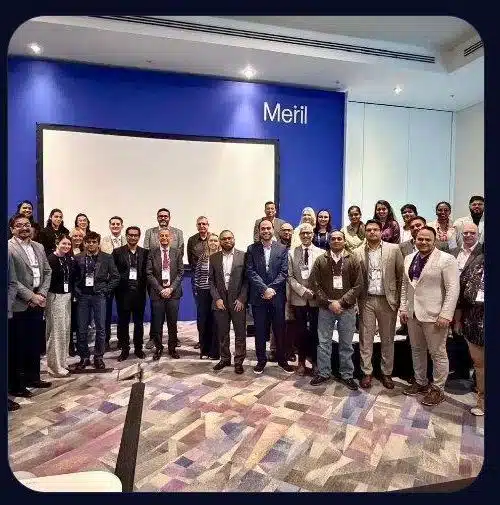
Eclevar MedTech team with Meril Life Sciences
With Meril Life Sciences · structural heart program
Why programs stall

Where cardiovascular adjudication workflows break

Programs rarely fail because the sponsor forgot to define an endpoint. They fail because the pieces around it were built separately and only meet at database lock, where the discrepancies surface.

WHERE PROGRAMS STALL Where cardiovascular adjudication workflows break 1 Endpoints not turned into collectable fields 2 Incomplete source document packages 3 Late or inconsistent core lab reads 4 Imaging and EDC data conflict Database lock delay Most failures are interface failures, between the protocol, the sites, the reviewers, the imaging systems and the analysis datasets.

Most failures are interface failures, between the protocol, the sites, the reviewers, the imaging systems and the analysis datasets.

A CEC charter alone does not create reliable adjudication. Endpoint definitions, the source document package, event trigger logic, the imaging workflow, blinded review and the analysis datasets must operate as one system.

Services at a glance

Six coordinated services, one adjudication workflow

Each service is a defined deliverable. Together they carry an endpoint from the protocol to a locked, reconciled dataset.

CEC setup

Charter, endpoint operationalisation, governance and reviewer model.

Approved operational charter

Event adjudication

Independent classification of pre specified clinical events.

Final adjudicated event status

Echo core lab

Central blinded echo assessment of valve function, PVL and gradients.

Blinded central echo reads

CT core lab

Central CT assessment of anatomy, sizing, access and morphology.

Device sizing inputs

Reconciliation

Alignment of site, EDC, safety and imaging data before lock.

Reconciled endpoint dataset

Final dataset

Locked outputs, analysis-ready, for database lock and CSR.

Analysis-ready outputs

Related independent oversight, kept separate. DSMB support is a distinct safety review package for first in human and high risk studies. A DSMB is a separate body from the CEC and is never conflated with it.

Clinical Events Committee

We operationalise the endpoint framework. We do not redefine it.

We turn the endpoint framework chosen in the protocol into an operational adjudication system. Eclevar provides the governance and operations. Independence comes from the members and the governance, not from Eclevar. The endpoint taxonomy lives in the VARC-3 endpoint reference.

CEC GOVERNANCE Eclevar administers. Independent reviewers adjudicate. Eclevar operations Charter, packages, scheduling, traceability INDEPENDENT REVIEWERS Reviewer 1 Reviewer 2 Agreement? YES Final adjudicated decision recorded NO Third review or committee resolution Final adjudicated status

What the service covers

Operationalisation. Endpoint definitions become event triggers, source document requirements and collectable fields.

Charter and governance. Charter, reviewer selection, conflict of interest management, quorum and meeting governance.

Blinded workflow. Package assembly, reviewer assignment, independent votes, disagreement resolution and repeat adjudication rules.

Proportionate by design

The service defines which events are adjudicated and which remain reported by the site, how many reviewers are required, how disagreements resolve and how outputs reach the analysis.

It does not claim that every event needs adjudication. The plan is proportionate to endpoint importance, study phase and classification risk.


European execution

Country, site & KOL feasibility

Country selection drives cardiovascular center density, device adoption, registry access, imaging readiness, follow-up reliability, contracting timelines and cost per patient.

European Cardiovascular Feasibility Network EUROPEAN CARDIOVASCULAR FEASIBILITY NETWORK NOUKDEFRITES UKNHS data continuity, specialist centresWatch: cost attribution and site process FranceStrong clinical networksWatch: hospital contracting, start-up NordicsStrong longitudinal registriesWatch: access and governance vary bycountry GermanyHigh-volume cardiovascular centersWatch: contracting and data complexity Italy / SpainExperienced operators, competitiverecruitmentWatch: regional and foundation contracting

Registry access and data governance vary by Nordic country and are assessed individually during feasibility.

Core Lab services

Central, blinded imaging assessment

For the endpoints that depend on imaging, echo, CT and angiography are assessed centrally under blinded review, then reconciled with the adjudication and analysis datasets.

CORE LAB · CENTRAL READING Central, blinded assessment across imaging modalities Echo PVL, gradients, EF CT annulus, access, sizing Angiography procedural, vascular CENTRAL READING SCREEN Blinded central read One reading standard across modalities, blinded, then reconciled with the endpoint dataset.

Core Lab operations are managed by Eclevar and performed through qualified independent readers, integrated into Eclevar's data and adjudication workflow.

Echo core lab

Valve function · PVL · gradients
  • PVL grading
  • Gradients
  • Effective orifice area
  • Ventricular and valve function over time
  • Inter reader variability and re read rules

CT core lab

Anatomy · sizing · access
  • Annular measurements
  • Calcification
  • Coronary height
  • Access assessment
  • Device sizing inputs and morphology

Angiography

Where the study requires it
  • Procedural success
  • Vascular complications
  • Device positioning
  • Coronary obstruction
  • Acute regurgitation
Independent core lab and endpoint adjudication
Independent core lab & adjudicationEvery cardiovascular imaging endpoint is read and adjudicated the same way, across European sites.
Workflow A · Adjudication

From event identification to the analysis dataset

Four disciplined phases carry an event from detection to a reconciled, analysis-ready record.

WORKFLOW A · ADJUDICATION Four phases, from event identification to analysis dataset 1 IDENTIFY Site event detection Event trigger 2 PREPARE Source document request Completeness review Remove identifiers 3 ADJUDICATE Reviewer assignment Independent review Disagreement resolution 4 RECONCILE Final adjudication EDC alignment Analysis-ready dataset
Workflow B · Imaging

Central reads that reconcile into one endpoint dataset

The imaging and adjudication workflows stay independent. Only their outputs converge, into a single reconciled endpoint dataset.

WORKFLOW B · IMAGING Central reads that reconcile into one endpoint dataset Acquire Image acquisition Transfer Secure, identifiers removed Quality control Completeness & protocol Central read Blinded reader assessment Resolve Query or repeat read Reconcile EDC integration & lock The imaging and adjudication workflows stay independent; only their outputs converge. CEC output + Core Lab output Reconciled endpoint dataset
Imaging & data

One imaging and data pipeline, adjudication-ready

From site echo and CT to core lab reads, DICOM pseudonymisation and endpoint adjudication, we keep a single controlled pipeline, so the same clinical event never exists in three inconsistent forms.

Clinical data management and biostatistics
Case identification

Events reach the committee from more than one source

A recurring failure is that events are simply never sent to the CEC. Identification does not rest on the site alone.

CASE IDENTIFICATION Events reach the committee from more than one source AE and SAE reports Procedure forms Hospitalisations Imaging findings Laboratory signals Device deficiencies Death notifications Monitoring findings Data review algorithms Potential adjudication case
CASE IDENTIFICATION Potential adjudication case AE and SAE reports Procedure forms Hospitalisations Imaging findings Laboratory signals Device deficiencies Death notifications Monitoring findings Data review algorithms

Where these functions exist and are validated for the study, the MILO EDC platform can support the adjudication workflow, connecting event flagging, package tracking and reviewer assignment to the audit trail.

Data reconciliation

Every source of truth must agree

Reconciliation aligns the site reported event, the safety database, the CEC decision, the Core Lab result, the EDC endpoint field, device deficiencies and the analysis dataset into one consistent record.

DATA RECONCILIATION Every source of truth must agree Event reported by the site Safety database CEC decision Core Lab result EDC endpoint field Device deficiency Analysis dataset Reconciliation layer Discrepancy management One event ID One final classification One analysis-ready record A clean EDC is not enough. Every clinical, safety, imaging and adjudication record must agree.
Quality, blinding & audit trail

Five pillars, ready for inspection

The workflow is governed by SOPs and built to be ready for inspection. Frameworks such as ISO 14155, GCP principles and GDPR are applied to the scope of each study.

QUALITY, BLINDING & AUDIT TRAIL Five pillars, ready for inspection Qualified reviewers Training, experience and conflict of interest review Protected blinding Controlled access and blinded source packages Decision traceability Votes, meetings and disagreement resolution Validated transfers Controlled mappings and data transfer checks Archive ready to inspect Version history, minutes and adjudication records
QUALITY, BLINDING & AUDIT TRAIL Five pillars, ready for inspection Qualified reviewersTraining, experience and conflict of interest review Protected blindingControlled access and blinded source packages Decision traceabilityVotes, meetings and disagreement resolution Validated transfersControlled mappings and data transfer checks Archive ready to inspectVersion history, minutes and adjudication records

No certification is claimed that Eclevar does not hold. Systems are configured and validated, where applicable, to support the relevant electronic record requirements and data transfer specifications of each study.

Class III cardiovascular clinical evidence under EU MDR
Class III cardiovascular evidenceFrom TAVI and transcatheter valves to durable long-term follow-up under EU MDR 2017/745.
Typical timeline

Phases, not fixed durations

No universal timeline is published without study specific data. The program moves through defined phases.

TYPICAL TIMELINE Phases, not fixed durations 1 SETUP Charter and reviewer model 2 INITIATION Training and pilot cases 3 OPERATIONS Rolling reads and adjudication 4 PRE LOCK Backlog clearance and reconciliation 5 LOCK Final decisions and datasets 6 ARCHIVE Documentation ready to inspect
Delivery model & responsibilities

Who does what

ActivityEclevarSponsorSiteReviewers
Charter draftingLeadApprovesConsultedConsulted
Package QCLeadOversightResponds
AdjudicationCoordinatesBlindedAdjudicate
Core Lab readCoordinatesOversightAcquiresRead
ReconciliationLeadReviewsClarifies
Final datasetProducesApproves
Cost drivers

What moves the budget

Shared openly so sponsors can scope realistically. Scope drives the quote, so no generic prices are shown where variability is high.

Study scale

Subjects, countries, duration and expected event rate

Review complexity

Endpoints, readers, meetings and double reading

Data burden

Source documents, languages, image quality and queries

Technical integration

Imaging transfer, EDC integration, reconciliation and lock

Commercial models
Setup feePer case adjudicationPer image or readCommittee meeting feePlatform feeReconciliation packageDatabase lock package
European clinical operations

Cardiovascular sites, run end to end

Heart Team coordination, high-volume structural heart centers, proctoring logistics and monitoring, with VARC-3 endpoints and reimbursement-grade evidence built in from the protocol onwards.

Cardiovascular clinical operations across European sites
Eclevar expertise

Clinical oversight and review experience in one workflow

Eclevar combines cardiac clinical oversight, former Notified Body review experience, data management and biostatistics in one adjudication workflow, so endpoint definitions, imaging, CEC decisions and analysis datasets stay aligned from protocol to database lock.

Cardiovascular clinical oversight

Dr Mark Da Costa

Cardiac surgeon
Former TÜV SÜD cardiovascular reviewer

Integrated delivery capabilities

CEC operations
Core Lab coordination
Data management
Biostatistics
Medical writing
MILO workflow integration

The biostatistics scope here covers only the adjudication and Core Lab integration. Full scope: biostatistics for medical device studies.

Frequently asked

Questions sponsors ask first

What is a Clinical Events Committee?
An independent committee that reviews and classifies pre specified clinical events using the study's endpoint definitions and source documents.
When does a cardiovascular study need a CEC?
When primary or major safety endpoints are complex, clinically important, or vulnerable to inconsistent classification across sites.
What is the difference between a core lab and a CEC?
A core lab centrally assesses imaging or diagnostic data. A CEC adjudicates clinical events. Some endpoints use outputs from both.
How are core lab and CEC results reconciled with the EDC?
Through predefined data mappings, discrepancy management, audit trails and a final reconciliation before database lock.

Discuss your cardiovascular adjudication and Core Lab requirements

Receive a structured scope covering endpoints, reviewer model, imaging modalities, data workflows, timelines and cost drivers for your study.

Request a CEC & Core Lab scope assessment

Reforming Clinical Evaluation of Medical Devices in Europe