

Chems Hachani
Founder and CEOSets the evidence strategy with the sponsor and stays accountable for delivery from first scoping call to final report.
In August 2025 NICE concluded that there was not enough evidence to decide whether price differences between transcatheter heart valves are justified, and told NHS trusts to use the least expensive clinically appropriate valve. For any manufacturer whose device costs more, the answer is comparative evidence on outcomes and resource use, collected in the NHS. Here is what NICE asked for and how a cost-outcomes trial is run.








Device manufacturers across cardiovascular, orthopedics, wound care and more work with Eclevar. Read all client success stories.
NICE late-stage assessments look at categories of technologies already in wide use in the NHS and ask whether their price differences are worth paying. For transcatheter heart valves, the committee found too little evidence to tell, recommended access to a range of valves, and advised using the least expensive valve when more than one is clinically appropriate.
NICE also said where the missing evidence can come from: primary studies or secondary analyses of real-world data. A randomized comparison of valves already used in routine care, with quality of life and NHS resource use collected alongside clinical outcomes, is the most direct way to answer the price question.
The same logic applies to other device categories that NICE assesses this way. A price premium needs outcomes and costs measured in the setting where the purchasing decision is made.
COS-TAVI is an investigator-led UK randomized trial comparing three contemporary valve platforms on health-related quality of life and cost-effectiveness. It is sponsored by an NHS trust, funded by a valve manufacturer and registered as ISRCTN14725744, and Eclevar is its CRO. Its public design shows the choices any cost-outcomes trial has to make.
| Choice | What the payer needs | How to build it |
|---|---|---|
| Comparators | Devices that are actually bought and used in routine care | Randomize between devices already marketed for the indication, in centers experienced with all of them |
| Quality of life | Utilities that can be turned into quality-adjusted life years | Use the instrument of the NICE reference case, EQ-5D for adults, plus a disease-specific score |
| Costs | NHS and personal social services resource use | Record procedure time, length of stay, readmissions and primary and social care use |
| Time horizon | Lifetime value, not only the index admission | Pair a trial-based analysis with a model parameterized from the trial and the registry |
| Clinical endpoints | Definitions comparable with published series | Use standard academic definitions, such as VARC-3 for TAVI, and an events committee |
| Real-world link | Long-term follow-up at low cost | Plan registry linkage from the start, with consent and data flows agreed |
Our article on health economic studies for medical devices covers when a single-arm or a randomized design is enough for other European payers.
Our TAVI clinical trial team and our UK market access team work on these studies, and you can follow the COS-TAVI site activation as it progresses.
A NICE HealthTech evaluation of a category of technologies already in widespread NHS use, meant to help buyers choose the options that give the best clinical effectiveness and value for money.
That there was not enough evidence to determine whether price variation between transcatheter heart valves is justified, that trusts should offer a range of valves, and that the least expensive valve should be used when more than one is clinically appropriate.
NICE said further evidence could come from primary studies or secondary analyses of real-world data. Registry analyses need the valve, the surgical risk and the adjustment factors NICE listed to be credible.
Not as a clinical investigation, if every device is used within its intended purpose. It still needs Health Research Authority and ethics approval through IRAS.
The investigator's NHS trust or university acts as sponsor and holds the regulatory responsibilities. The manufacturer funds the research costs under an agreement with the sponsor.
A small senior team, with European delivery and U.S. clinical consultants for sponsors who plan evidence on both sides of the Atlantic.
Sets the evidence strategy with the sponsor and stays accountable for delivery from first scoping call to final report.

Former clinical lead for final labeling on Medtronic's Hugo robotic-assisted surgery launch team, where he helped design surgeon training and proctoring and started a clinical registry for the platform.
Previously at
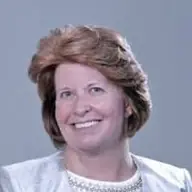
Provides strategic input on U.S. medical-device clinical operations, regulatory considerations and real-world evidence programs.

Your first point of contact for scoping, budget scenarios and proposals.
Eclevar leadership includes former Notified Body reviewers. Meet the full team on the leadership page.
Whitepapers, recognition and recordings from our teams and partners.
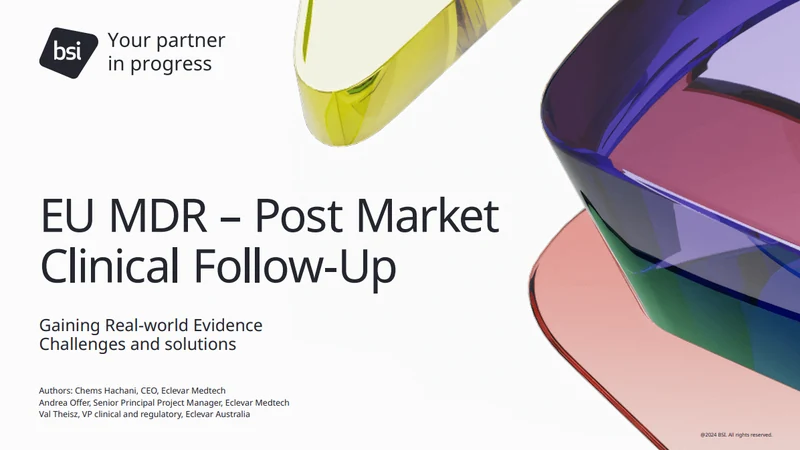
 Whitepaper · BSI and Eclevar
Written with Notified Body BSI: a practical reading of the clinical evidence expectations under EU MDR 2017/745, relevant to any high-risk device program.
Read the BSI whitepaper White paper · TÜV SÜD
Published in the TÜV SÜD knowledge hub with Eclevar's contribution: how breakthrough device technology is approached under the EU MDR.
Read the TÜV SÜD white paper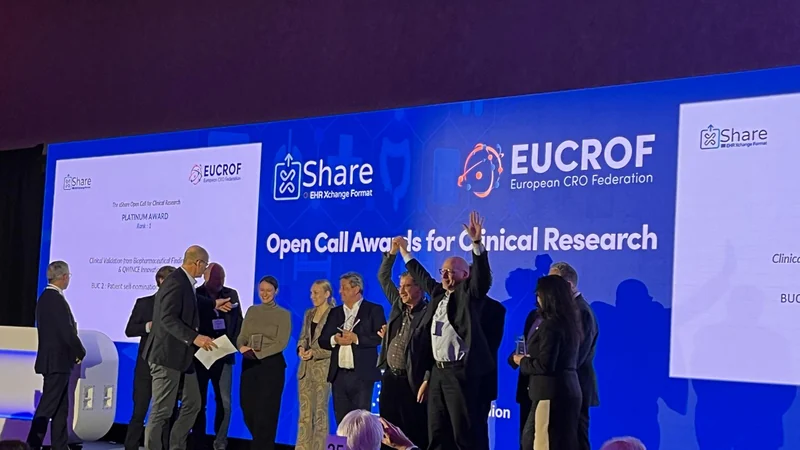
Top prize in the xShare / EUCROF EHDS & Clinical Research Open Call, presented in Amsterdam. Co-funded by the European Union, Horizon Europe Grant Agreement No. 101136734.
Read the press coverage
Antoine Turzi, CEO of RegenLab, on the randomized PMCF study run across 14 sites in 5 EU countries.
Watch on YouTube
A clinician discusses information capture and patient screening with MILO.
Watch on YouTube
A short introduction to the CER and its clinical evidence.
Watch on YouTubeThis article is general information for manufacturers and clinical teams. It does not report results of COS-TAVI, which depend on completion of the study, and does not predict a NICE or purchasing decision.
Tell us the device, the comparators NICE or your buyers look at, and the claim you need to support. We propose a design, the centers, the approvals route and a budget for a cost-outcomes study or a registry-based analysis.
We aim to respond within one business day.