Wound real-world evidence

Retrospective wound care studies in the United States

ECLEVAR can access U.S. wound care data to help manufacturers study how their products are used and how wounds heal in routine practice. Before you commission a study, we check whether the records identify your product and follow the same wound long enough to answer your question.

One question, three checks, then a decision

Is your product identified?

By brand where the records allow it, by category where they do not.

Is the same wound followed?

Repeat visits linked to one ulcer, with dated measurements.

Is the outcome recorded?

A documented closure, distinguished from a patient's last visit.

You receive a written go or no-go before any study budget is committed.

Work aligned withEU MDR 2017/745ISO 14155:2026ISO 1348521 CFR Part 11GDPR

The question

What can U.S. wound records tell you?

A dressing manufacturer might ask how often diabetic foot ulcers treated with its product had documented closure within 12 weeks of first application. To answer, we need to identify the dressing, link repeat visits to the same ulcer and distinguish a recorded closure from a patient's last visit.

Healing over time

For diabetic foot ulcers or venous leg ulcers, we assess whether dated measurements support a change in wound area, documented closure or time to closure.

Treatment patterns

Where records identify the product and application dates, we can describe when clinicians start treatment, how often they reapply it and when they switch.

Comparative outcomes

If a usual-care cohort is available, we check whether wound size, duration, prior treatment and follow-up are comparable before proposing an adjusted analysis.

Data source

A wound-focused U.S. record network

The source is an electronic health record network used in wound management across the United States. What it can support depends on the product, the indication and the outcome, which is why every engagement starts with a data-fit review.

~10%

of U.S. hospitals

Approximate share covered by the wound EHR network ECLEVAR can access.

Device and product granularity

Brand-level identification where the records hold it. Where they hold only a category, we say so in the feasibility assessment.

DFU and VLU cohort construction

Diabetic foot ulcer and venous leg ulcer populations defined by eligibility rules, first treatment date and follow-up window.

Imaging and wound-assessment variables

Wound measurements and images, checked for availability and consistency across visits.

Longitudinal treatment and follow-up data

Visit-level history that lets one wound be followed from first application to closure or last contact.

Site-level and provider-level segmentation

Results can be described by care setting when the question calls for it.

Where sponsors use it

Four evidence gaps, one starting point

The work starts with the reviewer or payer question, then selects the lowest-risk evidence path that can credibly answer it.

Evidence gapTriggerBest-fit pathOutput
Deficiency or reviewer responseExisting clinical evidence does not close a specific notified body question.Retrospective cohort with a targeted analysis.Evidence memo, study report and reviewer-response material.
PMCF or CER refreshThe CER or PMCF needs stronger current-use evidence without waiting for a long registry.Retrospective registry with reusable outputs.CER input, PMCF evidence package and clinical interpretation.
Reimbursement evidenceThe payer question is defined but the available evidence is not decision-ready.Real-world evidence analysis with payer-oriented endpoints.Reimbursement evidence report and decision narrative.
Comparative evidenceA comparator is needed, but a new prospective control arm is too slow or costly.External or synthetic control where methodologically defensible.Comparator analysis and sensitivity package.

Study models

Four designs the data can support

The design follows the question. A retrospective analysis is the core model. A prospective extension is added only when feasibility shows the existing records are not deep enough.

Core model

Retrospective registry

Evidence from existing records: healing outcomes, treatment patterns and product use in routine practice.

Comparator

External control arm

A standard-care cohort drawn from real-world data, set against your device cohort without starting a new control arm from zero.

Comparator

Synthetic control arm

An analytically constructed comparator population, used where the method can be defended and its limits are reported.

Add-on

Hybrid prospective extension

Prospective follow-up or targeted survey work that enriches the retrospective dataset when it cannot answer the question alone.

Feasibility first

How we decide whether a study is feasible

We agree on the population, first treatment date, comparator and outcome with your clinical team. We then check permitted uses, product identification, eligible wound and patient counts, and completeness of follow-up.

Gate 1

Feasibility

Review the evidence gap, test data availability and confirm a realistic path.

Gate 2

Data quality

Assess data sources, completeness, variable fit and cohort logic.

Gate 3

Design

Agree on the study model, endpoints, analysis plan and deliverables.

Gate 4

Final review

Internal quality review and regulatory alignment before the output goes to your team.

What the feasibility assessment says

You receive a written assessment identifying which question the data can answer, where the evidence is weak and whether to proceed. For example, if records identify a dressing category but omit the brand, a category-level treatment study may be feasible while a product-specific comparison would need another source. Where wound images or measurements are relevant, we check their availability and consistency across visits.

Workflow

An 8-week workflow, from go or no-go to final evidence package

Eight weeks is the target once feasibility confirms that the agreed data source can answer the defined question within a fixed scope. If the data are not fit for purpose, the recommendation is a no-go or a separately quoted extension.

Week 1

Feasibility and evidence objective

Decision question, indication, data-fit review and go or no-go recommendation.

Week 2

Data mapping and gap definition

Variable review, cohort logic, data-quality checks and fit-for-purpose assessment.

Week 3

Protocol and statistical analysis plan

Study concept and design aligned with the evidence question.

Weeks 4 to 5

Extraction, cohort build and cleaning

Dataset preparation, endpoint construction and sponsor checkpoints.

Weeks 6 to 7

Analysis and clinical interpretation

Statistics, medical interpretation and evidence synthesis.

Week 8

Final output package

Study report, CER input, PMCF support, reimbursement report and reviewer-response material.

Timelines depend on timely access to the agreed data source and on sponsor response times at each checkpoint.

Deliverables and scope

What your team receives

For a feasible study, ECLEVAR prepares the protocol and statistical analysis plan, builds the cohort and delivers an analysis report. The report shows how many wounds met each eligibility criterion, how missing visits affected the analysis and which differences between treatment groups could still explain the findings.

We can tailor the output to a clinical evaluation update, a post-market follow-up question or a payer evidence discussion. Clinical, data, biostatistics and medical writing sit in one team, so the same people carry the work from feasibility to final report.

A fixed scope, agreed after feasibility

The fixed scope includes

  • Evidence question and feasibility assessment
  • Data mapping and cohort definition
  • Protocol or evidence plan, and statistical analysis plan
  • Data extraction support, cleaning and analysis
  • Biostatistics and clinical interpretation
  • Study or evidence report
  • CER, PMCF, reviewer-response or reimbursement integration material
  • Project management, sponsor checkpoints and senior review

The sponsor provides

  • A clear target question, deficiency or payer request
  • Timely access to the agreed data source
  • Product and indication information needed for interpretation
  • A named decision-maker for checkpoints
  • Reasonable response times to keep the 8-week clock on track

Quoted separately if needed

  • New prospective patient recruitment
  • Site contracting, monitoring or investigator payments
  • New surveys requiring fieldwork or respondent recruitment
  • Primary data collection not available in the agreed source
  • External laboratory, core-lab or imaging services
  • Major scope changes after data-fit confirmation
  • Third-party data license or access fees

Optional prospective follow-on work is quoted separately and only if you request it.

Defensibility

Built to stand up to reviewer scrutiny

Each step is controlled so the final evidence can be traced back to the question, the source data and the analytical decisions.

Source data

Access, provenance, completeness.

Cohort logic

Eligibility, index date, follow-up.

Statistical plan

Endpoints, confounding, sensitivity.

Clinical interpretation

Meaning, limitations, relevance.

Decision output

CER, PMCF, notified body or payer use.

Controls that protect credibility

Senior medical review

Clinical and regulatory relevance checked at defined milestones.

Data-quality controls

Completeness, plausibility and reproducibility checks before analysis.

Pre-specified decisions

Protocol, statistical analysis plan and cohort rules agreed before final analytical work.

Transparent limitations

Known data limitations are documented, tested and reflected in conclusions.

Sponsor checkpoints

No hidden design drift: decisions and changes are documented and approved.

Reusable documentation

Outputs structured so the evidence can feed a CER, a PMCF report, a notified body response or a payer dossier.

What ECLEVAR will not do

  • Force a retrospective dataset to answer a question it cannot support.
  • Hide missingness, residual confounding or limitations to make a result look stronger.
  • Promise reviewer or payer acceptance. The work is designed to be defensible; the decision belongs to the reviewer.

Track record

The numbers behind the method

Of the 56 studies ECLEVAR has delivered, 21 are PMCF studies and registries. The feasibility and data-quality gates on this page come from that work.

56

Studies delivered

As of November 2026

By study phase

Studies by country

France18
Germany12
United Kingdom10
Italy8
Spain6
Nordic market3
Ireland2
Other5

A study running in several countries is counted once in each country.

400+

Devices assessed by former notified body reviewers now in ECLEVAR leadership

9

Clinical monitors (CRAs)

4

Project managers

3

Medical writers

3

Data management and biostatistics

2

Quality assurance

Clients

Medical device manufacturers we work with

Manufacturers of wound care products, implants, monitoring systems and dental devices use ECLEVAR for clinical investigations, PMCF and registries. More in our client success stories.

Client: RegenLab

Multicountry prospective PMCF in wound care

A two-cohort program in chronic wounds, diabetic foot ulcers and venous leg ulcers, run across European sites under one protocol and one data model.

160

participants

14

sites

5

European countries

Client: Perouse Medical, Vygon Group

Six registered observational studies across a vascular portfolio

ECLEVAR structured the program architecture and supports delivery. Intended evidence use: clinical evaluation and PMCF.

6

registered observational studies

3

device families

1,150+

subjects

5 years

follow-up

Team

The people you will speak to

A small senior team, with U.S. clinical consultants working alongside European delivery for sponsors who plan evidence on both sides of the Atlantic.

Portrait of Michael McGuffey

Michael McGuffey

U.S. Clinical Consultant

Former clinical lead for final labeling on Medtronic's Hugo robotic-assisted surgery launch team, where he helped design surgeon training and proctoring and started a clinical registry for the platform.

Portrait of Dawn Heimer

Dawn Heimer, PhD

U.S. Clinical and Regulatory Consultant

Provides strategic input on U.S. medical-device clinical operations, regulatory considerations and real-world evidence programs.

Portrait of Chems Hachani

Chems Hachani

Founder and CEO

Sets the evidence strategy with the sponsor and stays accountable for delivery from first scoping call to final report.

Portrait of Karina Schönborn

Karina Schönborn

Business Development Lead

Your first point of contact for scoping, budget scenarios and proposals.

ECLEVAR leadership includes former notified body reviewers; the full team is on the leadership page. Platinum Award · CVBF & MILO Health, xShare / EUCROF EHDS & Clinical Research Open Call. The award recognizes the submitted data use case and is not an evaluation of CRO services.

Questions

What sponsors ask before they start

What U.S. wound data does ECLEVAR work with?

Records from an electronic health record network used in wound management, covering about 10% of U.S. hospitals. The records are visit-level and include wound assessments, treatments and follow-up. How precisely a product is identified varies, so we check product identification, cohort size and follow-up for your question before any study is commissioned.

Can a U.S. retrospective wound study support a CER or PMCF under the EU MDR?

It can contribute clinical data from routine use when the device is identified in the records, the population is relevant to the intended use, and the methods are fixed before analysis. The manufacturer still has to justify in the clinical evaluation why U.S. data apply to the device and population in question. Whether the evidence is sufficient is the notified body's decision.

How long does a retrospective wound study take?

The target is eight weeks from kickoff to the final output package, once the feasibility review confirms that the agreed data source can answer the question within a fixed scope. The timeline depends on timely data access and on sponsor response times at each checkpoint. If the data are not fit for purpose, we recommend a no-go or quote an extension separately.

What if the records do not identify our product by brand?

A category-level treatment study may still be feasible, for example describing outcomes for a dressing category. A product-specific comparison would need another source or a prospective extension. The feasibility assessment states which of these applies before you commit.

Can you build a comparator from the same data?

Where a usual-care cohort is available, we first check that wound size, duration, prior treatment and follow-up are comparable. If they are, we propose an adjusted analysis with sensitivity analyses. Residual confounding and other limitations are reported with the results.

What do you need from us to start?

The product name, wound indication, outcome and follow-up period you have in mind, and the comparator if you need one. If the work responds to a deficiency letter or a payer request, share it under a confidentiality agreement so the analysis targets the exact question.

Videos, podcasts, white papers and news

Videos, podcasts and white papers with notified body and industry experts

How ECLEVAR thinks about evidence is public. Watch and listen to the conversations we host, and see what the team has been working on recently.

EU MDR Masterclass with Dr. Bassil Akra, Chems Hachani and Julia Frese

Video masterclass · TÜV SÜD and AKRA TEAM

EU MDR Masterclass: classification, clinical data and technical files

A 40-minute roundtable hosted by Chems Hachani with Julia Frese, Regulatory Expert at TÜV SÜD, and Dr. Bassil Akra, Founder and CEO of AKRA TEAM.

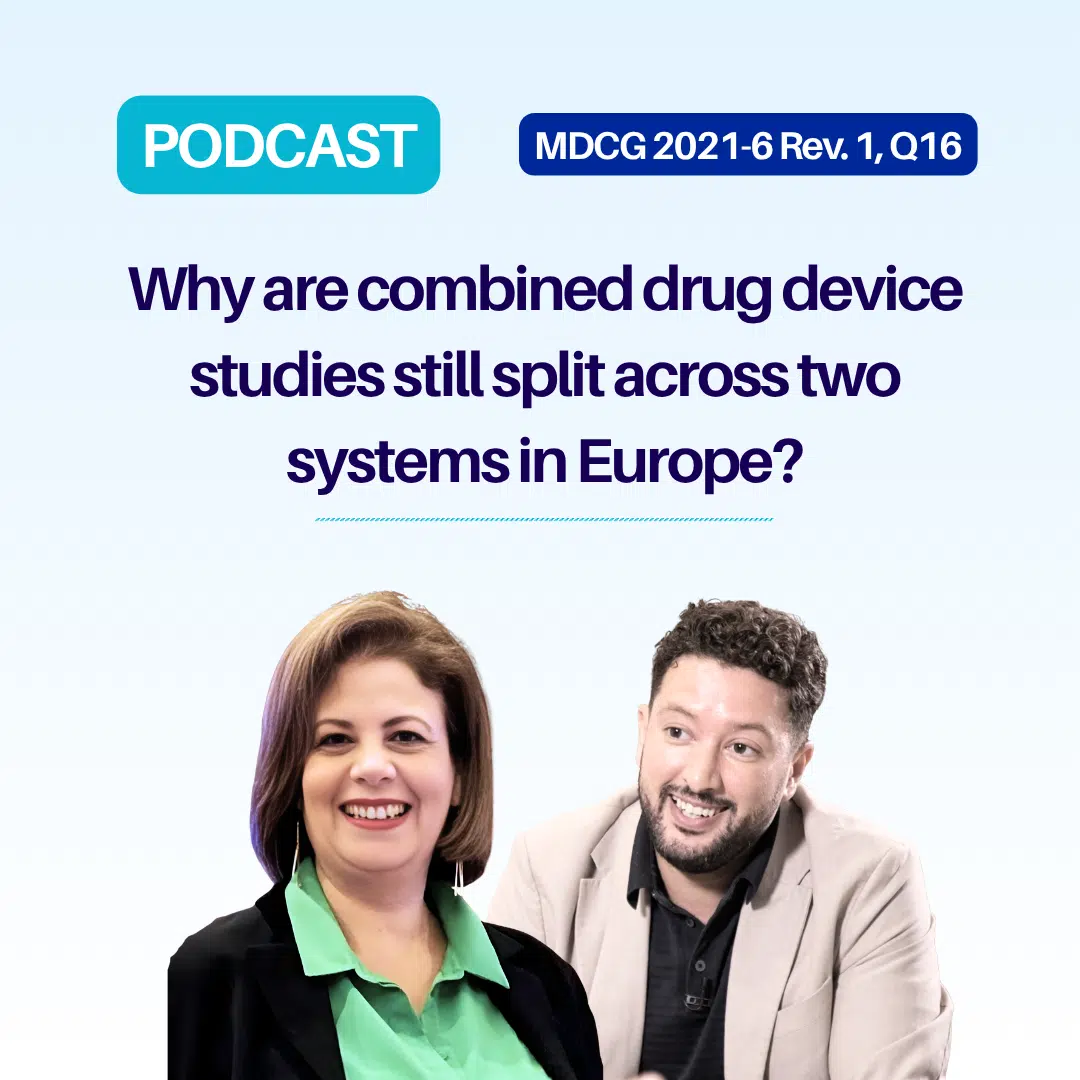
Podcast with Dr. Fatima Sanfourche and Chems Hachani on combined drug-device studies in Europe

Podcast · Combination products

Why are combined drug-device studies still split across two systems in Europe?

Chems Hachani talks with Dr. Fatima Sanfourche, PhD, Global Senior Director for QA & RA Compliance for Medical Devices, Combination Products & eHealth at Bayer and Scientific Board Member of ECLEVAR MedTech.

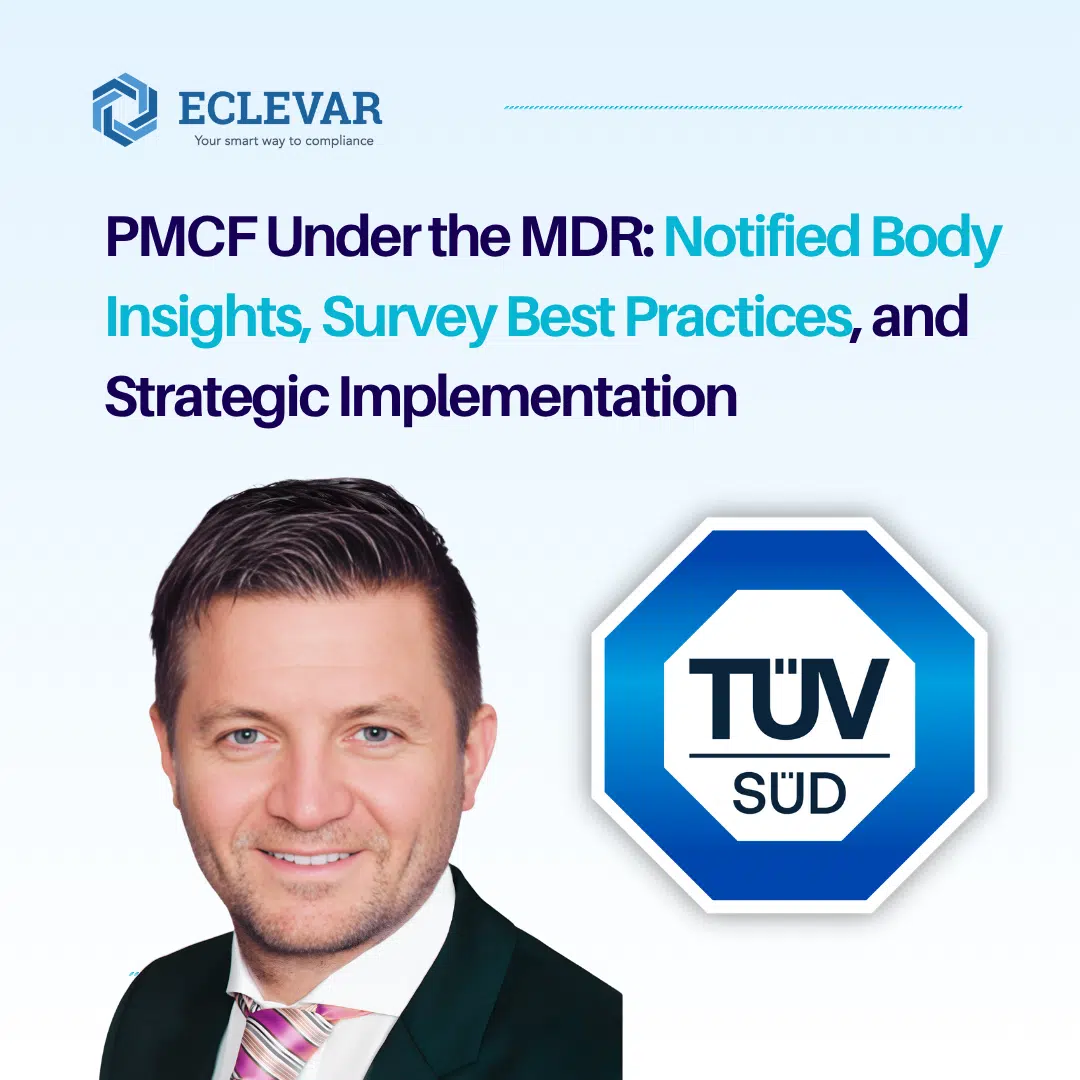
PMCF under the MDR webinar with a notified body expert

Webinar replay · Notified body insights

PMCF under the MDR: notified body insights and survey best practices

What reviewers look for in PMCF planning, and how to design PMCF surveys that stand up to scrutiny, with a notified body expert.

Webinar on level 4 surveys for orthopedic devices

Webinar replay · Level 4 surveys

Using high-quality surveys to close clinical data gaps in orthopedics

How level 4 surveys are designed and used to address clinical data gaps for orthopedic devices.

BSI · White paper

EU MDR white paper written with BSI

“EU MDR post-market clinical follow-up: gaining real-world evidence.” Covers clinical evaluation, PMCF strategy and the transition of legacy devices.

TÜV SÜD · White paper

Contribution to a TÜV SÜD white paper

A TÜV SÜD publication on the breakthrough device pathway under the EU MDR and what early market access requires of the evidence.

News · New destination

Clinical data collection in Mauritius and Réunion

One EU site in Réunion and lower-cost sites in Mauritius, under one protocol, for FDA and EU MDR evidence.

News · xShare, Pisa

MILO Match demonstrated at the xShare meeting in Pisa

On October 21, 2026, ECLEVAR MedTech presented a live MILO Match prototype alongside CVBF, using the pediatric GAPP study as the use case. The demonstration used synthetic data and simulated connections.

News · Partnership

Memorandum of understanding with Bioexcel CRO

ECLEVAR MedTech and Bioexcel CRO signed a memorandum of understanding to work together on clinical research and regulatory affairs across Europe and India.

Next step

Discuss your wound care product

Send the product name, wound indication, outcome and follow-up period you have in mind. If you need a comparison, tell us what clinicians typically use instead.

We aim to respond within one business day. A confidentiality agreement can be signed before you share any document.

Share the decision question

Deficiency letter, PMCF or CER gap, reimbursement question or comparator need.

Open the data-fit discussion

Under a confidentiality agreement, we review the data source, variables, completeness and cohort logic.

Lock the route and scope

Go or no-go, evidence model, deliverables, assumptions and fixed-scope kickoff.